Remarks of Chairman J. Christopher Giancarlo before Derivcon 2018

Remarks of Chairman J. Christopher Giancarlo before Derivcon 2018, New York City, New York

February 1, 2018

Introduction

Good morning. Thank you for that warm introduction.

My compliments to the Wholesale Markets Brokers’ Association Americas (WMBAA) for creating the original Sef-Con and to Anthony Parrotta and Tabb Group for transforming it into Deriv-Con. There is nothing like this conference in terms of looking at the functioning and health of global markets for swaps trading.

Swaps Market Notional Amount: Fog of Confusion

Well, here we are. It is 2018 – ten years after the global financial crisis. Sometimes, years must pass to gain perspective. For a moment, let’s recall that year, 2008. Many in this room remember it very well, maybe too well. It continues to haunt us.

You may remember that, then, as the economy sunk into recession, policy makers, bankers, lenders, and investors rapidly, frantically, made decisions to save the system. Well, they did. Those were monumental decisions, with national and global impact. The decisions also had a lasting, powerful impact over time. We live with those decisions a decade later.

The phrases, “interconnection” and “interdependence” have become part of our vocabulary. Former Fed Chairman, Alan Greenspan, once told a Congressional committee that in 2008 we had reached “an intellectual turning point.1

But, since then, economists and historians have examined those decisions, looking at the data and the information available. And, there has been a common theme: that the information often was vague, hard to understand, even inflated, bloated, or misunderstood.

In fact, sometimes the data may have been wrong, or, at least, wrongly used. Often times, it was misleading.

Some of the assessments have been harsh. Peter Wallison thinks there was lack of transparency, that figures were hidden behind other statistics, like a “shadow.”2 He talks about venality, irrationality, and competence. There are questions about perspective, reporting, and credibility. Elsewhere, Wallison has called the policies of that time based on “a false narrative.”3 Others, like journalist Gillian Tett, claim that economic models often processed the wrong data. Andrew Sorkin found that the swap assets of companies like AIG were valued with wildly disparate figures4 and many of the institutions labeled “too big to fail” and those allowed to fail, like Lehman Brothers, were wrongly assessed.

The worry is that there was a fog or distortion or myopia or fear that mis-framed the financial picture. In fact, in his post-financial crisis commentary, Mervyn King, the former governor of the Bank of England, sees the data and decision-making in 2008 as something like medieval “alchemy,” where mythology, tradition, expectation, and misunderstanding prevailed.5

Clearly, as earthshaking as was the crisis, its impact was exacerbated by the lack of a more clear, accurate, and honest assessment of risk, value and markets. This was particularly the case in the over-the-counter derivatives markets, where the notional figures are in the hundreds of trillions of dollars, numbers without meaning, barely comprehensible for any of us.

And that vagueness of risk-based market sizing has remained a problem. In 2012, Congressman Jack Kingston, then a member of the House Committee on Appropriations wrote to the Commodity Futures Trading Commission (CFTC). He asserted that “notional value” was not an accurate measurement of systematic risk. He voiced concern that the notional numbers would lead Congress to appropriate money unwisely, spending scare resources in the wrong places. He said that, “innocent farmers, ranchers, and producers” would “pay the price” for appropriations that were based upon such misrepresentative numbers.6 He asked for new measurements that would, in his words, “set the record straight” and help Congress properly apportion taxpayer resources.

And the record needs to be set straight. Notional amounts are still used to describe the size and risks of the global interest rate swap (IRS) markets. Recent examples include the headline, “EU Derivatives Market Worth €453T, ESMA Analysis Reveals,”7 and the following text: “the notional value of OTC derivatives contracts outstanding was $630 trillion… which was eight times greater than global output and 6.5 times larger than outstanding debt securities.”8 Quotations like these give a misleading picture of the true size of markets for swaps and derivatives and sow confusion about their systemic risk profile.

Ladies and gentlemen: swaps have a problem of large numbers. We have known it for a long time. Sizing the global swaps markets in hundreds of trillions of dollars has done nothing to bring clarity to newspaper accounts, policy discussions in Congress, or regulatory policy setting in the decade since the financial crisis. Rather, it more often confuses the issue and hinders dispassionate consideration and sound policy setting.

That is why we must bring some clarity to how to accurately size contemporary swaps markets.

Last year, in appointing Dr. Bruce Tuckman as CFTC Chief Economist, I asked him to develop a more accurate measurement of the swaps market, specifically focused on its risk transfer function.

He and his staff have done so in a paper published this morning on CFTC.gov. They have put forward a new paradigm, a shift in perspective, a new way of seeing. I urge you to read their paper.

And if economists’ academic papers are not your thing, then listen to Dr. Tuckman’s podcast on “CFTCTalks - Episode 29” that will be released tomorrow.

A New Paradigm: Entity-Netted Notional Amounts

In his presentation, Dr. Tuckman explains why notional amount is not a good measure of the size of the IRS market, that is, of the magnitude of risk transfer through IRS.

First, since a significant fraction of forward rate agreements (FRAs), overnight index swaps (OIS), and swaptions are of very short term, notional amount exaggerates the extent of risk transfer through those products.

Second, since IRS trading conventions leave pairs of counterparties with risk-offsetting long and short positions, notional amount—which adds longs and shorts—dramatically overstates risk transfer between pairs of counterparties.

Dr. Tuckman’s analysis, therefore, introduces the concept of entity-netted notionals (or “ENNs”). ENNs are designed as a means of accurate measurement of risk transfer in swaps markets.

By netting longs and shorts between pairs of counterparties, within each currency, ENNs capture the market risk transfer in IRS markets much more accurately than notional amounts. Furthermore, empirical calculations of ENNs reveal that there is a tremendous amount of such netting in the IRS market. They thereby provide a new element of realism and accuracy.

So, here is a sneak preview from Dr. Tuckman’s analysis:

  • For all U.S. reporting entities as of December 15, 2017, notional amount across all currencies and across the dominant IRS products, namely, fixed-for-floating swaps, FRAs, OIS, and swaptions, is $179 trillion.
  • Expressed in 5-year risk equivalents, that notional amount falls to $109 trillion.
  • Now, applying Tuckman’s ENNs analysis, the figure drops to $15 trillion, or just over 8% of notional amount.

Measured with ENNs, the $15 trillion size of the interest rate swap market is of the same order of magnitude as other fixed income markets, such as:

• the US Treasury market at $16 trillion,

• the corporate bond market at $12 trillion,

• the mortgage market at $15 trillion, and

• the municipal securities market at $4 trillion.9

Suddenly, at $15 trillion, the IRS market is more normalized and intelligible as part of the US economy.

To describe ENNs intuitively, imagine that each pair of swap counterparties established its net interest rate risk position with bonds instead of swaps. More precisely, within each pair of counterparties, the counterparty that is net long has purchased a 5-year equivalent risk position in bonds from the counterparty that is net short. Then, the sum of those hypothetical bond positions across all pairs of counterparties is a measure of the size of the market and is equal to the ENNs as defined in this paper.

A lot of the difference between the IRS market’s notional amount and its ENNs can be explained by the great extent to which bank and dealer interest rate books are cleared through central counterparties (CCPs). In other words, clearing increases netting opportunities, which, in effect, decreases the size of the IRS market.

Yet, while it has been long recognized that notional amounts are not indicative of size, they continue to be used in important regulatory calculations, like capital requirements and thresholds. Revealing the extent to which notional amounts overstate size, as measured by ENNs, hopefully should lead to consideration of the use of more suitable metrics of IRS risks and, more generally, of derivatives risks.

For reasons explained in Dr. Tuckman’s paper, ENNs are not intended to measure counterparty credit risk -- metrics like gross or net market value and gross or net credit exposure do that. Nor do ENNs serve to quantify operational risk, which may remain better understood by notional amount. Nevertheless, ENNs are a new and, likely, better measure of IRS market size based on risk transfer.

Now, some may ask whether the ENN analysis is suitable for calculating regulatory thresholds such as for registered swap dealing activity. While that may be worth academic consideration, it was not my intention in directing Dr. Tuckman’s research to come up with a specific alternative to the CFTC’s current swap dealer de minimis calculation methodology. Rather, the purpose was far more broadly to bring greater clarity to the public understanding of the global derivatives markets.

The ENN analysis can be extended in several ways. First, ENNs can be calculated for other large markets, like credit default swaps and foreign exchange derivatives. Second, ENNs can increase understanding of how various sectors use derivatives. Perhaps more importantly, ENNs can support more precise analysis and policy development concerning swaps and other derivatives and their impact on systemic stability in global financial markets.

For now, Dr. Tuckman and the CFTC’s Office of Chief Economist invites thoughtful consideration and discussion of the concept of entity-netted notionals. We look forward to hearing from a broad range of academic, commercial, regulatory and policy-setting communities about how ENNs may best serve as a suitable means of accurate measurement of risk transfer in global swaps markets.

Reg Reform 2.0: First Step

I began by marking this as the tenth anniversary of the financial crisis. In response to the crisis, Congress enacted the Dodd-Frank Wall Street Reform and Consumer Protection Act of 2010 (Dodd-Frank). Congress required that swaps trading be subject to a comprehensive regulatory framework in the same way that other asset classes like equities, bonds, and futures, were subject to regulation. More specifically, under Title VII of the law, Congress mandated that swaps trades be centrally cleared, margined, reported and executed on registered platforms.

Although a 2,300 page law, Title VII was relatively straightforward and concise. Congress proposed a principles-based approach over a prescriptive one in keeping with the regulatory tradition of the agency to which it assigned oversight of most of the swaps market.

Thus was the impetus for the CFTC’s implementation of a range of swaps market regulation - an implementation that can be considered as swaps reform version 1.0. The CFTC advanced ahead of other regulators in implementing the key reforms: centrally clearing, transaction margining, transaction reporting and regulated execution. The CFTC’s determination and dispatch were remarkable. Overall, CFTC Reg Reform 1.0 served to implement the bulk of Dodd-Frank’s swaps reforms and demonstrate their core value proposition.

Yet, in a number of respects, the specifics of the implementation were less satisfactory. They contain some underlying defects that still need to be addressed. My predecessor often admitted the need for “tweeks” and “fine tuning.” My criticism has been less muted, especially in the area of swaps execution,10 where the agency veered most from the spirit of Dodd-Frank, adopting rules for swaps that were highly prescriptive and disproportionately tailored on decades-old futures market rules.

Now, a certain amount of error had to be expected from the first roll out of regulatory reform, given the breadth of the ruleset change and the speedy timeline for implementation. This is why large public policy projects – like software applications – usually have a follow-on effort to fix flaws and replace hard patches in the first version that designers did not envision. Version 1.0 of any application usually leads in short order to version 2.0.

In the case of the CFTC’s swaps reforms, the four years since the implementation offer ample experience, better quality data, and market reaction upon which to analyze and reconsider the efficacy of the rules. We can see the flaws and know what bugs need to be fixed to better achieve the purposes of swaps market reform.

That is why we plan over the course of the coming year to put forth concepts and ideas to improve the CFTC’s reform implementation. We refer to these upcoming proposals as “Reg Reform 2.0”. The goal will be enhancement of derivatives markets – their resilience, transparency, soundness, diversity and vibrancy. The task will be to better balance the needs of market participants for risk mitigation and market vitality and the needs of Americans for economic growth and prosperity. The purpose is the make swaps market reform work as intended and work well. The direction will be to go forward with reform, not roll it back.

And, of course, a first step in swaps Reg Reform 2.0 is to introduce a more accurate measure of swaps market size. We have taken that first step today.

Conclusion

In conclusion, the great empirical difference between notional amount and ENNs in the IRS market argues strongly for moving away from notional amount as a metric of market size and risk transfer. By expressing notional amounts in 5-year equivalents and netting longs and shorts between pairs of counterparties within each currency, ENNs capture the market risk transfer in IRS markets much more accurately than outstanding notional amounts. Furthermore, empirical calculations of ENNs reveal that these risk and netting effects are tremendously important: the $179 trillion of outstanding IRS notional amount for U.S. reporting entities across all currencies collapses to $15 trillion ENNs - a size that more accurately represents the true relationship of the U.S. IRS market to the global economy.

In a landmark book, titled “The Structure of Scientific Revolutions,”11 Professor Thomas Kuhn said that the success of a paradigm shift can be measured in usage over time. The great empirical difference between notional amount and ENNs in the IRS market makes the case for moving away from the notional amount as a metric of market size and risk transfer toward a more realistic, accurate viewpoint.

Only time will mark a shift in the paradigm of how we measure the size of swaps markets. The alternative is to continue to live with inexactitude, misinterpretation, and inaccuracy.

At one point in his book, Professor Kuhn says that a paradigm shift triumphs over a traditional “mystical”12 aesthetic. Dr. Tuckman’s analysis is a necessary perspective, achieving much-needed clarity and accuracy.

It is time we all agreed to look ahead with such clarity.

Thank you.

1 Alan Greenspan, cited in GILLIAN TETT, FOOL’S GOLD 251 (2009).

2 PETER J. WALLISON, HIDDEN IN PLAIN SIGHT 74-83 (2015).

3 PETER J. WALLISON, BAD HISTORY, WORSE POLICY 23 (2013).

4 ANDREW ROSS SORKIN, TOO BIG TO FAIL 157-159 (2009).

5 MERVYN KING, THE END OF ALCHEMY 50 (2016).

6 Letter from Jack Kingston, Congressman and Chairman of the House Subcommittee on Agriculture, Rural Development Food and Drug Administration, and Related Agencies, to Gary Gensler, Chairman of the Commodity Futures Trading Commission (June 8, 2012) (on file with the Commodity Futures Trading Commission).

7 Law360, October 19, 2017, accessed from www.Law360.com on December 27, 2017. ESMA is the European Securities and Markets Authority.

8 BIS Statistical Bulletin, December 2017, p. 252.

9 Financial Accounts of the United States, Board of Governors of the Federal Reserve System, Second Quarter 2017.

10 CFTC Commissioner J. Christopher Giancarlo, Pro-Reform Reconsideration of the CFTC Swaps Trading Rules: Return to Dodd-Frank, White Paper, Jan. 29, 2015 (White Paper), http://www.cftc.gov/idc/groups/public/@newsroom/documents/file/sefwhitepaper012915.pdf.

11 THOMAS KUHN, THE STRUCTURE OF SCIENTIFIC REVOLUTIONS (1962).

12 Id. at 158.


Last Updated: February 1, 2018

Remarks of Chairman J. Christopher Giancarlo before the Market Risk Advisory Committee Meeting

Remarks of Chairman J. Christopher Giancarlo before the Market Risk Advisory Committee Meeting

January 31, 2018

Thank you, Commissioner (Rostin) Behnam.

Good morning, everyone. A warm welcome to all of the Market Risk Advisory Committee (MRAC) Committee members, presenters and participants, both here and on the telephone. It is good to have you all with us.

This is the first time my new fellow Commissioners and I are appearing together in an official capacity at the agency. It is very good to be with Commissioners (Brian) Quintenz and (Rostin) Behnam. Hopefully, the three of us will have additional company this year.

Today, we’ll continue the CFTC’s history of thoughtful and thought-provoking advisory Committee hearings under the new Commission.

We had hoped to kick off that continuation last week with a Technology Advisory Committee (TAC) Committee hearing. It is unfortunate that the meeting had to be rescheduled. Commissioner Quintenz, Daniel Gorfine, and the TAC members have done a lot of preparation. Nevertheless, it will be a great program when it takes place in the next few weeks. Don’t miss it.

Our other advisory Committees: the Agriculture Advisory Committee (Ag), the Energy and Environmental Markets Advisory Committee (EEMAC) and the Global Markets Advisory Committee (GMAC) will also have scheduled meetings in the months to come.

But today, we kick off the year with MRAC. As you know, this committee was very active and effective under former Commissioner (Sharon) Bowen. No doubt, such quality work will continue under Commissioner Behnam, Designated Federal Officer Alicia Lewis, and the Committee members.

Today MRAC will discuss the product self-certification process under Part 40 of the Commission’s regulations. It looks like a great agenda.

Two weeks ago I had the honor to speak at the annual conference of the ABA Section on Derivatives and Futures Law. I discussed derivatives on virtual currencies and the appropriateness of requirements under CFTC regulations for the review of such products. As you are all aware, Designated Contract Markets (DCMs) must comply on an ongoing basis with 23 core principles, and Core Principle 3 requires that contracts must not be readily susceptible to manipulation.

I spoke about the “Review and Compliance Checklist” that the CFTC staff deploys to ensure:

  • that self-certified virtual currency futures products and their cash-settlement processes are not readily susceptible to manipulation, and
  • that virtual currency derivatives products are sufficiently margined.

I also said that I was neither an apologist nor an opponent of the current process of self-certification. Rather, I - alongside my fellow commissioners – have inherited the process. And we are not the first Commission to have a conversation about the right balance of interests for the self-certification process, as that conversation predates virtual currencies.1

I also said that it is quite clear that Congress and prior Commissions designed the product self-certification framework to give the DCMs, in their role as self-regulatory organizations, the ability to design and certify new products. Congress deliberately framed the self-certification process so that development of derivatives products would not be hampered by cautious regulators wary of the political risks of approving new products. I went on to say that the CFTC’s current product self-certification framework is consistent with public policy that encourages market-driven innovation that has made America’s listed futures markets the envy of the world.

A week after the ABA conference, I met in Washington with a senior European markets regulator to discuss a range of topics. Unprompted, he brought up the CFTC’s self-certification process and said that it was the reason why almost all new financial products originated out of the United States.2 It stuck me that sometimes it helps to be reminded of our advantages by those that don’t enjoy them.

That is not to say that existing processes should not be analyzed and, where appropriate, improved. At the ABA conference, I noted criticism from some market participants that the CFTC did not hold public hearings prior to self-certification of Bitcoin futures.  I pointed out that, unlike provisions in the Commodity Exchange Act (CEA) and Commission regulations for rule self-certifications that provide for a public comment period,3 there is no avenue for public input into CFTC staff review of product self-certifications in the CEA or Commission regulations.4 It is hard to believe that Congress was not deliberate in making that distinction.

In fact, it is DCMs and Designated Clearing Organizations (DCOs) - and not CFTC staff - that must solicit and address stakeholder concerns in new product self-certifications. Interested parties, especially clearing members, should indeed have an opportunity to raise appropriate concerns for consideration by regulated platforms proposing virtual currency derivatives and DCOs considering clearing new virtual currency products.

That is why I have asked CFTC staff to add an additional element to its Review and Compliance Checklist for virtual currency product self-certifications. That is requiring DCMs and Swaps Execution Facilities (SEFs) to disclose to CFTC staff what steps they have taken in their capacity as self-regulatory organizations to gather and accommodate appropriate input from concerned parties, including trading firms and Future Commission Merchants (FCMs). Further, I have asked staff to take a close look at DCO governance around the clearing of new virtual currency products and formulate recommendations for possible further action. There may well be other improvements to consider.

In closing, I believe the issues raised by self-certification of virtual currency futures are: (a) the degree of responsibility of DCMs under the CEA and Commission regulations to ensure that virtual currency derivatives are not readily susceptible to manipulation given the nascent state of this emerging asset class and (b) the degree of responsibility of a DCOs under the CEA and Commission regulations to ensure that virtual currency derivatives are sufficiently margined.

I look forward to your discussion of these important issues. It is timely. We see what is on the horizon. We must be prepared and responsible. The present is prelude to the future. As we confront the challenges ahead, we will look to the thoughtful discussions of advisory committees like yours.

And, again, Commissioner Behnam, thank you for organizing this meeting. Thank you all for attending.

####

1 See 71 Fed. Reg. 1953, 1956 (Jan. 12, 2006) (discussing the need to balance the flexibility Congress gave DCMs in being able to self-certify new products quickly against the obligations of the DCM and the Commission to assure themselves that the certification is accurate, and noting that it is not the intention of the Commission or its staff to inject a chilling effect into the self-certification process).

2 Prior to the changes made in the Commodity Futures Modernization Act of 2000 (CFMA) and the Commission’s subsequent addition of Part 40, exchanges submitted products to the CFTC for approval. From 1922 until the CFMA was signed into law, 793 products were approved. Since then, exchanges have self-certified12,016 products. For financial instrument products specifically, the numbers are 494 products approved and 1,938 self-certified. See http://www.cftc.gov/IndustryOversight/ContractsProducts/index.htm

3 See Section 5c(c)(3)(C) of the CEA, 7 U.S.C. 7a-2(c)(3)(C), and 17 C.F.R. 40.6(c)(2).

4 See Section 5c(c)(1) of the CEA, 7 U.S.C. 7a-2(c)(1), and 17 C.F.R 40.2.


Last Updated: January 31, 2018

Opening Statement of Commissioner Rostin Behnam before the Market Risk Advisory Committee

Opening Statement of Commissioner Rostin Behnam before the Market Risk Advisory Committee

January 31, 2018

Introduction

Good morning and welcome to the first Market Risk Advisory Committee (“MRAC”) meeting of 2018. I am pleased to sponsor this Committee, and believe my timing to address important market risk issues could not be better. Ground-breaking new ideas have gone from theory to application in just the past few months. I am especially mindful and appreciative of the Commission’s ongoing efforts to affirmatively exercise its regulatory authority and expertise while remaining ever vigilant of the risks associated with the adoption of nascent technologies.

Before we move into the substance of today’s meeting, I want to thank Commissioner Quintenz and Chairman Giancarlo for being here today and for their contributions to this discussion.  

I also want to thank today's moderator, Paul Architzel. Before entering private practice, Paul spent more than 25 years at the CFTC in the Office of General Counsel and as Chief Counsel in the CFTC’s former Division of Economic Analysis, now the Division of Market Oversight. Paul played a leading role in many rulemakings that shaped our current processes for new product review and approval. Since leaving the Commission in 2003, Paul has remained an active and well-respected member of the derivatives bar. Thank you, Paul, for facilitating our ambitious agenda.

I want to thank each of the panelists.  We have gathered a distinguished group of speakers, and their readiness to participate is greatly appreciated and critical to today's discussion.

I want to thank Alicia Lewis, the Committee's Designated Federal Officer.  Alicia started working in my office in mid-December, and MRAC was task number one on day one.  She has handled the role with great professionalism and discipline, and the quality of her work will be displayed throughout the day.

I also want to thank the members of the MRAC. Today we welcome two new members, Jason Cohen, Chief Executive Officer of NEX SEF and Kathleen Cronin, Senior Managing Director and General Counsel of CME Group. Jason and Kathleen will be taking the place of departing MRAC members John Nixon and Kimberly Taylor. Former Commissioner Bowen selected this impressive group and you have all demonstrated the ability to tackle and opine on difficult and important issues. Your time and service is greatly appreciated.

However, as you may know, the charter for this Committee will expire in the next few months.  Today will likely be the last meeting of this group before we renew the charter and reconstitute membership.

Why Now?

As I recently stepped into my role as the Sponsor of this Committee, it perhaps would have been sensible to renew, re-populate, and set a new course for the MRAC all at once. However, the introduction of two Bitcoin futures contracts caused many to inquire about—perhaps for the first time—the Commission’s role in the listing of new products under the Commodity Exchange Act (the “CEA” or “Act”) and Commission regulations.

While I commend the Chairman for releasing backgrounders on self-certification of bitcoin products and on the oversight of and approach to virtual currency futures markets,1 recording a podcast roundtable with CFTC leaders on Bitcoin,2 and launching a Bitcoin education webpage,3 these communications can fall flat in the absence of meaningful dialogue.

The launch of the Bitcoin futures products is a testament to the forward thinking, innovative spirit of the derivatives markets. As the market and market participants continue to adopt technologies that make new products, new relationships, and new forms of conduct possible, I believe it is critical that the CFTC: (1) engage with industry in addressing risk; (2) provide legal and regulatory certainty to the market; (3) educate the general public; and (4) question and challenge the status quo, in the market and within the Commission. 

A Question of Process

Turning to today’s agenda, the four panels are organized and ordered to ensure our dialogue remains focused on the issue of self-certification of new products. That being said, in thinking about this meeting, and the Commission’s recently announced approach and responsibilities with respect to virtual currencies—unquestionably new and novel assets—the overarching theme is largely one of process. We all should feel accountable for what we do, but also for what we do not do. And while we are now living in an age that is not big on process, but often prefers to emphasize “likes” and tweetable sound bites, process is important because it provides the bearings, the connections in the record—and in the story—of how we accomplish our duties.

By way of background, the Commodity Exchange Act and the Commission regulations, Parts 40.2 and 40.3 specifically, provide for two processes when it comes to the listing of a new contract (or other instrument) for trading by a designated contract market (“DCM”) or swap execution facility (“SEF”)4, which I’ll refer to together as “exchanges”. Generally, under the Act, an exchange may either elect to list a new product for trading under Regulation 40.2 through written certification that the new contract complies with the Act and Commission regulations, or it may request that the Commission grant prior approval for the listing of the new contract under Regulation 40.3.5 If an exchange requests approval under Regulation 40.3, the Commission then must approve the new contract, unless it finds that the contract would violate the Act or Commission regulations.6 Regulations 40.2 and 40.3 implement these processes, setting forth, among other things, the contents of required submissions, the Commission’s authority to stay the listing of new products, the Commission’s authority to request—and the duty of the exchange to provide—additional information, and the applicable timelines.7

Relevant to today’s discussion, for self-certification, the exchange must file its submission with the Commission “by the open of business on the business day preceding the product’s listing.”8 This timeline reflects the Commission’s reliance on the exchanges, which have clear incentives to list contracts that comply with the Act and will not be susceptible to manipulation; and which have well-developed, sophisticated surveillance and self-regulatory systems. This timeline also reflects the understanding that the self-certification process, as compared to the voluntary approval process, is considered more of a formality reserved for those instances where the product is neither controversial nor presents issues requiring extensive analysis or consideration of the public interest, the latter being a determination that is properly made by the Commission.9

The Perils of Revision

As the Chairman has recently noted, “The CFTC has received some criticism from large market participants for not holding public hearings prior to self-certification of Bitcoin futures.”10 That being said, as the most recent CFTC backgrounder notes, “the product self-certification process does NOT provide for public input.”11 And narrowing focus to the two bitcoin futures contracts, the Chairman clarified, “Neither statute nor rule would have prevented CME and CFE from launching their new products before public hearings could have been called.”12 While the self-certification process does not expressly provide for public input, that does not mean that public input in the process of launching new and novel products is impossible or undesirable. To the contrary, dialogue between the Commission, the exchanges, and market participants is vital to the process. I am hopeful that today’s MRAC meeting will both shed light on the importance of such dialogue and perhaps provide the public input regarding Bitcoin futures that did not occur prior to certification. At the very least, this meeting provides a forum for public input regarding future products in the virtual currency space.

The CFTC staff developed a standard of “Heightened Review”, “within the limits and parameters of the current self-certification process, for determining whether the Bitcoin futures products comply with the exchange’s obligations under the CEA core principles and CFTC regulations and related guidance.”13 I fully support and commend the staff, under the direction of the Chairman, for taking initiative and quick action in a timely and direct manner to address concerns related to the listing of Bitcoin futures contracts despite the regulatory confines of the self-certification parameters.

However, the need for a new “Heightened Review” process demonstrates that the Commission must reconsider its historical regulatory approach to new products – in fact, the implementation of the “heightened review” process is a new regulatory approach in and of itself. Such changes require a more formal process, subject to Commission deliberation and public notice and comment. I am pleased that the Chairman has asked the CFTC’s General Counsel to propose for Commission consideration possible regulatory and/or statutory steps to better support the staff’s approach to virtual currency product review.14 I look forward to exploring our options, which I hope will include some parameters for determining when self-certification may not be appropriate, and for determining when such matters are appropriately brought before the Commission.

Self-Certification Works

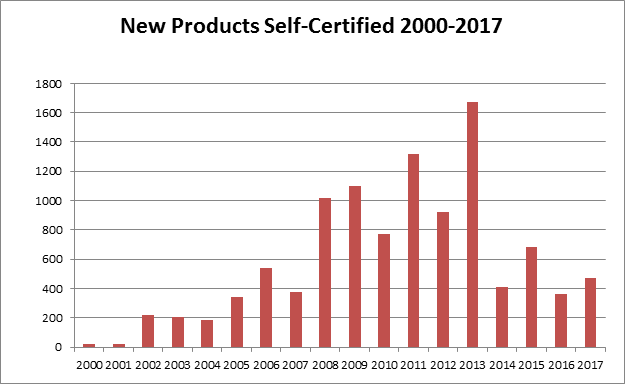
To be clear, this meeting is not intended to question the efficacy and usefulness of self-certification. Self-certification is a unique process that has served market participants, the CFTC, and the general public very well. Indeed, since Congress authorized the CFTC to establish a self-certification process for the listing of new futures products in 2000,15 exchanges have self-certified 10,628 new products, providing more risk management tools for commercial end-users across many different asset classes.16 As set forth in Part 40 of the Commission regulations, it is a process that relies on the Act and core principles as the benchmarks and standards for how an exchange and derivatives clearing organization (“DCO”) must design a product. Any action above and beyond this must be subject to Commission action so that the Commission, as a whole, may deliberate the merits and consider the risks of new products in a transparent forum.
 

New Product Self-Certified 2000-2017

* Data compiled from the CFTC’s Filings and Actions database, which includes submissions from DCMs, DCOs, and Swap Data Repositories (“SDRs”).17

The Agenda

Our first panel today will focus on the statutory and regulatory frameworks and processes with respect to the listing of new products through self-certification. A part of the discussion will be devoted to clarifying the different internal processes for review associated with self-certification versus voluntary approval. Of particular relevance to me is the Commission’s flexibility under each of the governing Commission rules to assure the opportunity for thoughtful analysis and public comment in appropriate circumstances.

Our second panel will focus more specifically on how the Commission assesses, initially and on an on-going basis, the adequacy of risk management and surveillance of new products. Panelists from the Commission’s Divisions of Clearing and Risk, Swap Dealer and Intermediary Oversight, and Enforcement will provide insight into how each of their Divisions considers products that present novel or unique risk profiles, and how they go about developing the expertise necessary to accomplish their missions.

Our third panel features representatives from DCMs and DCOs who will discuss the self-certification process from their perspective.

Our fourth and final panel will address the question of novelty. The experts on this panel will discuss the question of novelty and whether the current self-certification process allows for adequate regulatory consideration when a product is itself determined to be novel or presents complex or unique issues.

Closing

I am hopeful that today's conversation will serve to educate the public on the success of the self-certification process, and perhaps shed light on what lies ahead in the virtual currency space. As market participants introduce new virtual currency products in the months and years ahead, I look forward to a broader conversation by the Commission in considering what steps can be taken to better evaluate novel products in a transparent manner, and to bring together all ideas, concerns, and suggestions, to best inform the general public about our process of review.  In my view, novelty is a fleeting concept, which time consumes.  But, while novelty exists, it shines brightly, and must be handled with care.

I believe the CFTC must prioritize, above all else, the protection of customer property, and the promotion of safe, transparent derivatives markets.  With that said, the self-certification process may not be an appropriate regulatory tool for all new products.  The Commission, working in partnership with market participants, and perhaps this Committee, should continue to evaluate its regulatory and procedural approach to new product listings, considering what we do and what we do not do in that process. We will ultimately be accountable for the products listed within our jurisdiction. We own this space, and we should own it responsibly. I want to do everything in my power to support and promote innovation; however, the Commission must exercise our duties such that when we look back on the record, it shows that we took the necessary steps to fulfill our mission in a careful and deliberative manner.

Everyone in this room plays a key role in the success of the derivatives market. We all have unique and often diverse interests, responsibilities, and duties. But we also have many common interests, not the least of which is the promotion and support of healthy, safe, and transparent derivatives markets. As a regulator, I believe it is the Commission’s responsibility to hold public meetings like these to educate, introduce fresh ideas, reconcile differences, and find solutions to new challenges so that market participants and the general public, our number one constituent, feels confident that we are fulfilling our responsibilities and can hold us accountable for our actions. As a community—regulators and market participants together—it is our responsibility to have these conversations, although difficult at times, to ensure we are constantly learning from past actions, and seeking better solutions to protect the public interest.  I strongly believe this approach best serves all of us in long-run as these markets continue to grow, innovate, and break barriers.

I want to again thank everyone for being here today, the MRAC Committee members, the speakers, Paul Architzel, Alicia Lewis, Commissioner Quintenz, and Chairman Giancarlo.  I look forward to today's discussion.

1 CFTC, CFTC Backgrounder on Self-Certified Contracts for Bitcoin Products (Dec. 1, 2017), sheet(Dec. 1, 2017) http://www.cftc.gov/idc/groups/public/@newsroom/documents/file/bitcoin_factsheet120117.pdf; and CFTC, CFTC Backgrounder on Oversight and Approach to Virtual Currency Futures Markets (Jan. 4, 2018), http://www.cftc.gov/idc/groups/public/@newsroom/documents/file/backgrounder_virtualcurrency01.pdf.

2 CFTC Talks, Episode 20, Dec. 6, 2017, Roundtable with CFTC Leaders on Bitcoin, at http://www.cftc.gov/Media/Podcast/index.

3 CFTC, Bitcoin, http://cftc.gov/bitcoin/index.htm.

4 CEA section 5(c)(1); 7 U.S.C. 7a-2(c)(1); and 17 C.F.R. 40.2 and 40.3.

5 CEA sections 5c(c)(1) and (4)(A); 7 U.S.C. 7a-2(c)(1) and (4)(A).

6 CEA section 5c(c)(5)(B); 7 U.S.C. 7a-2(c)(5)(B).

7 17 C.F.R. 40.2(a)-(c) and 40.3(a), (c).

8 17 C.F.R. 40.2(a)(1).

9 See generally Revised Procedures for Commission Review and Approval of Applications for Contract Market Designation and Exchange Rules Relating to Contract Terms and Conditions, 62 FR 10434, 10437-8 (Mar. 7, 1997).

10 J. Christopher Giancarlo, Remarks of Chairman J. Christopher Giancarlo to the ABA Derivatives and Futures Section Conference, Naples, Florida (Jan. 18, 2018), http://www.cftc.gov/PressRoom/SpeechesTestimony/opagiancarlo34.

11 CFTC Backgrounder on Oversight and Approach to Virtual Currency Futures Markets, supra note 1, at 2.

12 J. Christopher Giancarlo, supra note 10.

13 CFTC Backgrounder on Oversight and Approach to Virtual Currency Futures Markets, supra note, at 3; and J. Christopher Giancarlo, supra note 10.

14 J. Christopher Giancarlo, supra note 10.

15 See Commodity Futures Modernization Act of 2000, Pub. L. 106-554, 114 Stat. 2763 (2000), and CEA section 5c(c)(1); 7 U.S.C. 7a-2(c)(1).

16 See CFTC, Contracts & Products, http://www.cftc.gov/IndustryOversight/ContractsProducts/index.htm.


17 The data includes 4,849 security futures products and 1,223 products (all but one in electricity) certified by Nodal Exchange in 2013.


Last Updated: January 31, 2018


Opening Statement of Commissioner Brian D. Quintenz before the CFTC Market Risk Advisory Committee

Opening Statement of Commissioner Brian D. Quintenz before the CFTC Market Risk Advisory Committee

January 31, 2018

Thank you, Commissioner Behnam, for convening today’s meeting and for your sponsorship of the Market Risk Advisory Committee (MRAC). I look forward to a thoughtful discussion of the process by which exchanges may list contracts for new or novel products and the CFTC’s role in that process.

Importance of Product Innovation

I agree with Chairman Giancarlo’s long held perspective on regulation’s ability to foster financial market innovation. I believe that the self-certification of new financial products can play an important role in realizing that philosophy. Specifically, the self-certification process ensures that the market’s introduction of new products is not delayed by regulators’ political considerations. It reflects the government providing the market with the freedom and space to innovate outside of Washington bureaucracy. I think we all benefit from that free market approach.

Market Risk

Let me take a moment to discuss the concept of “risk” – a term that gets thrown around broadly, and mostly with negative connotation, in connection with our financial markets. For those who want regulators to remove all financial risk from the markets, I have news for you. That cannot and will not happen. Every element of the financial system has and always will have risk. Our markets’ ability to empower risk takers, provide feedback on value creation vis a vis its riskiness, and transfer risk to those most willing and able to bear it are what make them the envy of the world. I would seek to preserve those market functions, not bureaucratize them.

Other Tools of Market Oversight Beyond Self Certification

While we are focusing on the self-certification process today, I must note that self-certification is where a new contract’s regulatory life begins, not where it ends. After a contract’s self-certification and its initial listing, the CFTC will then surveil that product’s trading and clearing activity on a daily basis, review every new rule issued by exchanges and clearinghouses affecting that product, and regularly perform market-wide and clearinghouse-level stress tests incorporating that product’s margin sufficiency.

In addition to supervision by the CFTC, the trading of new contracts is subject to oversight by the exchanges to ensure that the contract complies with the core principles set forth in the Commodity Exchange Act and CFTC regulations, including that the contract is not readily susceptible to manipulation1 and is subject to rules ensuring the contract’s financial integrity.2

Further, as to risks assumed by Futures Commission Merchants (FCM), FCM’s positions are continually monitored, their trading activity is subject to potential trading halts, and their risk management policies are reviewed on a regular basis.3

Public Concerns

Regarding public input, the CFTC is and should always be receptive to hearing the public’s concerns regarding a new product and the process by which it was listed. I am pleased that this MRAC meeting has been convened to provide a forum to discuss any concerns that the public may have with the process for listing new and novel products.

I look forward to hearing from today’s participants about:

the types of risks that exchanges consider when deciding to list a new product;

how exchanges assess whether a cash market is sufficiently transparent and liquid to support accurate and fair pricing for related derivatives products; and

whether exchanges and clearinghouses have adjusted their risk management practices following particular product launches.

In closing, I would like to note that the Technology Advisory Committee is planning on holding its initial meeting on February 14th. We hope that you can join us then for discussions regarding blockchain, cryptocurrencies, automated trading and cybersecurity, among other issues.

Thank you again to Commissioner and the MRAC members for today’s meeting.

1 DCM Core Principle 3 (7 USC § 7(d)(3)), CFTC regulation 38.200; SEF Core Principle 3 (7 USC § 7b-3(f)(3)), CFTC regulation 37.300).

2 DCM Core Principle 11 (7 USC § 7(d)(11)), CFTC regulation 38.602; SEF Core Principle 7 (7 USC § 7b-3(f)(7)), CFTC regulation 37.700.

3 CFTC Regulations 38.255, 38.601, 38.604, and 39.13(h)(5)


Last Updated: January 31, 2018


Remarks of Commissioner Brian Quintenz before the Commodity Markets Council State of the Industry 2018 Conference

Remarks of Commissioner Brian Quintenz before the Commodity Markets Council State of the Industry 2018 Conference

Drawing without an Eraser

January 29, 2018

Thank you for that very kind introduction.

Before I begin, let me quickly say that the views contained in this speech are my own and do not represent the views of the Commission. I’m very pleased to be speaking here with you today at the Commodity Markets Council’s annual State of the Industry conference.

Over the winter holiday, my children and I went on a Disney Cruise. I’m not going to tell you who enjoyed it more, but I did want to share a story from our trip. One of the on-board activities we did together after breaking my children away from the 24 hour self-serve ice cream bar was a Disney animating class. To start the class, everyone was given drawing paper and a pencil, and we followed along step by step as the teacher sketched out Winnie the Poo and Tigger. When my drawing started to look more like a snowman than a Poo bear and I needed to revise it, I suddenly realized my pencil didn’t have an eraser. I quickly looked around to see if I could borrow someone else’s, but none of the other pencils had erasers either. The teacher explained to us that when Walt Disney first organized his animating studio, he removed all the erasers from pencils. His idea was that he wanted his artists to be deliberate in their sketching but to also not be fearful of mistakes – that it was more powerful to see mistakes concretely on paper and use them to “build” the final result or character.

It turns out this philosophy of creation—of being thoughtful and deliberate but also using concrete mistakes as you go to improve the result—is not unique to Disney cartoonists. It was Ernest Hemingway’s practice to first use a pencil and then a typewriter to construct his novels. As he explained in a book he penned for aspiring writers, “If you write with a pencil you get three different sights at it to see if the reader is getting what you want him to. First when you read it over; then when it is typed you get another chance to improve it, and again in the proof. Writing it first in pencil gives you one-third more chance to improve it.”1Stephen King also preferred to write with a fountain pen, noting that the act of writing longhand “slows you down. It makes you think about each word as you write it.”2 Perhaps Michelangelo summed it up best when he stated, “A man paints with his brains and not with his hands.”

You may be wondering what the creative process of these renowned artists can possibly have in common with financial regulation. Well, actually, quite a bit. Good public policy requires thoughtful deliberation, a clear vision of the ultimate objective, and, in some cases, many, many drafts—perhaps even more than Hemingway’s customary three. It is usually only when a policy proposal gets put on paper and disseminated to the public that the far reaching consequences (and perhaps mistakes) of its provisions can be fully understood and, hopefully, improved.

One pending rulemaking before the Commission which certainly warrants rigorous thoughtfulness, a willingness to revise, and has a long history of drafts, is position limits. Indeed, I have heard it described as the “eternal rulemaking”—with the Commission issuing multiple versions of the proposal since 2011. Another way to view the rule’s evolution is to see the Commission’s most recent Reproposal in December 2016 as yet another opportunity to review, refine, and build upon its prior work.3

I would like to take a moment to recognize the number of significant improvements the Reproposal would make to the Commission’s prior position limits proposals. For example, the Reproposal would update the deliverable supply estimates for purposes of establishing spot month speculative limits, permit exchanges to recognize non-enumerated bona fide hedge or spread exemptions, and remove the quantitative test for cross-commodity hedges.

However, market participants have raised a number of practical and logistical, as well as substantive, concerns with the Reproposal. It is also extremely complex—over 280 pages in the Federal Register with approximately 1,730 footnotes. I think the Reproposal can be improved so that any position limits regime adopted by the Commission will be workable and reflect current commercial hedging practices. But before I get into specifics, I think it is helpful to take a step back and remember why Congress included a statutory provision for position limits in the first instance.

Addressing the Burden of Price Volatility

Since 1936, the Commodity Exchange Act (“CEA”) has cited the “burden” posed on the public by sudden or unreasonable fluctuations or unwarranted changes in the price of a commodity, and directed the Commission to establish such limits on trading as it finds necessary to “diminish, eliminate or prevent” any such burden that could be caused by “excessive speculation.”4 When implementing this provision, Congress also directed the Commission in the Dodd-Frank Act, “to the maximum extent practicable” to ensure sufficient market liquidity for bona fide hedgers and ensure that the price discovery function of the underlying market is not disrupted.5

Nowhere, however, did the CEA say position limits were the only tool for addressing the burden of unreasonable or unwarranted price moves tied to excessive speculation. In fact, over the past 80 years, a suite of regulatory tools has been created and implemented at both the Commission and exchange level to address this burden, including the special call powers of the agency, market surveillance capabilities, large trader reporting obligations, and exchange-set accountability levels in various contract months. The exchanges have proved to be strong partners in the CFTC’s efforts to promote and protect vibrant, liquid, well-functioning derivatives and cash commodity markets.6 In addition to their inherent motivation to provide credible, well-functioning markets, both DCMs and SEFs have regulatory obligations to monitor and surveil their markets in real-time and to detect and/or prevent price manipulation, price distortions, disruptions in the delivery or cash settlement process, and position limit violations.7

With that history in mind, I think it is incumbent on the Commission to ensure that any position limits it establishes are appropriately tailored within the construct of the entire regulatory tool kit that is already being used to address price volatility that can be caused by excessive speculation.

In my opinion, an effective position limits regime would be “built” upon two policy platforms. First, the regime must provide commercial market participants and end-users with the reasonable flexibility they need to hedge their risks efficiently – the Commission cannot and should not dictate to commercial firms how they should manage their risk through one-size-fits-all mandates. Second, the final rule should not create the potential for additional price volatility risk in our markets by impairing liquidity and impeding price discovery.

With those complementary objectives in mind, I think several aspects of the 2016 Reproposal should be revisited, such as using accountability levels in lieu of hard limits in non-spot months and the practicality for both end-users and the Commission of imposing position limits for economically equivalent swaps. Given the length and complexity of the rule, there are many issues that I look forward to discussing with staff and market participants.

For purposes of today, however, I have chosen to focus on what is, in my opinion, the lynch pin to an operative positon limits regime: ensuring there are no unnecessary restrictions or burdens placed on market participants’ ability to engage in bona fide hedging activity. That starts with ensuring that the scope of what constitutes a bona fide hedge is broad enough to generally encompass legitimate, risk-reducing activities. Next, it requires ensuring that any “enumerated” bona fide hedges includes common commercial hedging strategies so that market participants have regulatory certainty about their most basic and frequent hedging methods. And lastly, it means providing an efficient, simple process for market participants to receive approval to engage in non-enumerated hedges.

I will discuss each of these points in turn.

Definition of Bona Fide Hedging

The Reproposal would revise the definition of a bona fide hedging position for physical commodities from the prior proposal so that the definition incorporates only those elements required by statute. In doing so, the proposal eliminates two of the general requirements of the existing bona fide hedging definition: the incidental test and the orderly trading requirement test. I support the elimination of both these requirements.

The Commission also received feedback from many commenters expressing concern that this revised definition still remains too narrow. For example, the “economically appropriate test” requires that a position must be “economically appropriate to the reduction of risk in the conduct and management of a commercial enterprise” in order to qualify as a bona fide hedge. In the Reproposal, the Commission interprets the word “risk” in this prior sentence to refer solely to price risk.8 Commenters pointed out that this interpretation excludes a number of risks that may create or impact price risk— operational risk, liquidity risk, credit risk, locational risk, political risk, and seasonal risk—that commercial firms may find appropriate and necessary to hedge.9 I hope the Commission can examine this point further, so that we ensure the Commission’s interpretation of “risk” is broad enough to accommodate the many different types of risks that commercial firms need to hedge in their day-to-day business operations.

Further, the Reproposal also states that in order to meet the “economically appropriate test,” a commercial enterprise generally must take into account all inventory or products that it owns or controls in determining if a derivatives position reduces the overall risk of the enterprise.10 In other words, an entity must generally hedge its cash exposure on a net basis across all entities that aggregate positions—although the Commission did note that gross hedging may be appropriate in certain circumstances where net cash positions do not necessarily measure total risk exposure.11

I am concerned that this interpretation conflicts with how many commercial firms manage the risks of their cash operations. Energy and agricultural firms frequently choose to manage their exposures on a regional or portfolio basis. This makes sense because many of the markets these companies participate in are regional.

For example, an electric utility may have excess physical generation in one region, but be short physical power in another region. Given the geographic dislocation of the two markets, the utility may wish to manage the risks of its power plants independently for any number of reasons—different supply and demand fundamentals, transportation and storage costs, timing issues. I chose electricity as an example, but the same could be true for a grain elevator with fixed price sale commitments in the Midwest and corn inventory in South America. It may not make economic sense for the grain elevator to satisfy its sale commitments in the Midwest with corn from South America. In both cases, I think the firm should be able to choose the level at which it manages its risk. Firms should be able to establish risk management programs that are tailored to the specific facts and circumstances of their businesses and not be forced to adopt a predetermined, one-size-fits all, Washington DC dictated approach to hedging. Going forward, I think there is an opportunity for the Commission to further clarify its views on this point and ensure that commercial firms have the flexibility to manage their exposures in a way that reflects the complexities and realities of their physical businesses.

Enumerated Bona Fide Hedging Positions

In addition to ensuring a sufficiently broad definition of bona fide hedging, I am also concerned that the Reproposal’s list of enumerated bona fide hedge positions is too narrow to allow for many hedging strategies commonly used by market participants.12 The purpose of enumerating certain bona fide hedging positions is to provide regulatory certainty and alleviate administrative burdens for market participants engaging in common, legitimate, risk-reducing activities. If the list is indeed too narrow, then end-users must go through unnecessary, costly hurdles in order for their hedging activity to granted bona fide status.

Generally, in constructing an enumerated hedging list, I do not believe the Commission’s overarching premise should be that all market activity is speculative activity until proven otherwise. Rather, the presumption should be that market participants relying on an enumerated bona fide hedging exemption are engaging in legitimate hedging activity. In fact, the Commission and exchanges have many tools at their disposal to detect, combat, and punish speculative activity masquerading as bona fide hedging, making the risk of a “broad” enumerated list low.

For example, the Reproposal failed to fully include anticipated merchandising activities as an enumerated bona fide hedge, because, depending on the facts and circumstances, the exemption could be utilized in bad faith to engage in speculative activity.13 Accordingly, although the Reproposal recognizes that anticipated merchandising may qualify as a bona fide hedge, it declined to include it among the list of enumerated hedges. As a substitute, the Reproposal provides that exchanges may recognize anticipatory merchandising transactions as non-enumerated bona fide hedges subject to their assessment of the particular facts and circumstances.14

Congress specifically included “merchandising” and “anticipated merchandising” in its statutory bona fide hedging definition.15 Given this statutory language and the prevalence and importance of anticipated merchandising activities in the market, the Commission should consider including such activities among enumerated bona fide hedging positions. Energy and agricultural merchandisers play a critical role in providing economic services and market liquidity for producers and end-users, ensuring that commodities move along the supply chain to the location where they are needed most with minimal price volatility. Through extensive investments in physical storage and transportation capabilities, merchandisers are able to act as the go between producers and end-users, allowing for the management of price risk at both ends of the supply chain.

Let’s take a common example that is frequently cited—unpriced physical purchase or sale commitments when an offsetting sale or purchase is anticipated, but not yet completed. Take a situation where gas oil is trading in Europe at around $130 per barrel, but is trading in New York for around $150 per barrel. Prices show there is a relative excess supply of oil in Europe as compared to New York, where the higher prices reflect a greater demand. Merchandisers respond to these market signals by transporting commodities to meet this heightened demand, ultimately to the benefit of consumers in New York in this particular example. Here, a merchant might purchase the oil in Europe, intending to ship the oil to New York to sell it. But, in order to lock in the price differential between the two locations and avoid assuming unnecessary price risk, the merchant must hedge both its purchase contract and anticipated sale contract with futures contracts.

Although this fact pattern describes a customary hedging practice in the energy or agriculture markets, it would not qualify as an enumerated bona fide hedge under the current definition because at the time the merchant establishes its short futures position, it has not yet executed the sale contract. While I appreciate concerns that a market participant could conceivably take advantage of an exemption for anticipated merchandising to establish a speculative position without ever having the intent to incur price risk in the physical markets,16 I think such concerns must be balanced against the harms caused by burdening and potentially restricting the use of legitimate risk management practices. Merchandising performs a critical role in the functioning of our commodity markets by connecting the two ends of the value chain: production and consumption. That activity needs to be risk managed effectively and efficiently. The Commission has other reporting and surveillance tools at its disposal to address speculative activity masquerading as a bona fide hedge.17

Going forward, I am eager to hear from market participants about how the list of enumerated bona fide hedging exemptions can be broadened to recognize legitimate commercial hedging activity.

Process for Exchange-Granted Non-Enumerated Hedge Exemptions

Of course, the list of enumerated bona fide hedges under CFTC regulations cannot, and should not, be expected to account for all forms of legitimate commercial hedging. Accordingly, market participants need an expeditious, efficient process for seeking non-enumerated hedge exemptions. In this regard, I think the Reproposal represents a significant improvement over the 2013 proposal, which required market participants to either request an interpretive letter from Commission staff or seek exemptive relief from the Commission itself in order to engage in non-enumerated bona fide hedging.18 Limiting end-users to only those two avenues for engaging in non-enumerated hedges is not commercially workable.

Under the Reproposal, eligible exchanges have the authority to administer exemptions for non-enumerated bona fide hedges, certain anticipatory bona fide hedges, and certain spread positions. This makes sense because exchanges have a deep familiarity with their contracts, customers, and prudent risk management strategies. As such, they are well-positioned to determine if a particular hedging activity should be recognized as a bona fide hedge.

However, I am concerned that even under the much improved Reproposal, the process for seeking a non-enumerated bona fide hedge exemption remains too burdensome for market participants and exchanges. From the perspective of the market participant, the proposed process provides little regulatory certainty. As proposed, the CFTC may review and overturn an exchange’s determination at any time, even years after the initial decision was made. This is problematic because market participants rely in good faith on exchange-granted exemptions to manage the risks of entire lines of business.

The exemption process also entails frequent reporting and extensive recordkeeping requirements, which I understand are designed to provide transparency and enable a fulsome, robust review by the Commission.19However, I would like to consider whether the exchange exemption process, and the CFTC’s oversight of it, can fit within the existing supervisory framework. For example, one good suggestion from commenters is for the Commission, as part its periodic Rule Enforcement Review process, to incorporate an exchange’s approval practices of hedging exemptions.20 If, during the course of those reviews, the Commission determines an exemption has been granted that is inconsistent with the bona fide hedging definition, then the Commission can revoke the exchange’s determination, provided the participant is given a reasonable amount of time to liquidate the position. On the other hand, if the Commission finds no discrepancies with the exchange’s determinations, this provides market participants with some certainty that the Commission’s and exchange’s views are generally aligned.

It should not be a significant regulatory burden for end-users to seek approval to engage in non-enumerated bona fide hedge activities. With that principle in mind, I am eager to explore how the application process for non-enumerated hedges could be improved.

Conclusion

In conclusion, I would like to reiterate my appreciation for all of the hard work staff has devoted over the past several years to improving and refining prior position limits proposals. I would also like to thank the members of the Commodity Markets Council and your leadership for submitting many letters and thoughtful comments throughout this process that will allow the Commission to create a workable position limits regime. Good public policy, while needing to start with a sound a reasonable premise, is usually “built” upon many drafts and revisions. I recognize that getting this rulemaking right is a much harder, and more frustrating task than completing a Winnie the Poo sketch without an eraser. But I am confident we can get there. I look forward to engaging with staff and market participants to work together to develop a position limits regime that enhances market integrity, liquidity, and efficiency. Thank you very much for having me.

1 Ernest Hemingway, By-Line: Ernest Hemingway: Selected Articles and Dispatches of Four Decades (William White ed., 1967).

2 Michael Bywater, Everything Starts with the Pen, The Independent, Oct. 17, 2010, http://www.independent.co.uk/arts-entertainment/books/features/everything-starts-with-the-pen-2109252.html.See also Interview by Bryant Gumbel with Stephen King, The Early Show (2001), https://youtu.be/w0lofwQTWKk.

3 Position Limits for Derivatives, 81 Fed. Reg. 96704 (Dec. 30, 2016) (“Reproposal”).

4 Commodity Exchange Act of 1936, P.L. 74-675, 49 Stat. 1491, §5 (adding section 4a), available at https://fraser.stlouisfed.org/scribd/?title_id=1096&filepath=/files/docs/historical/congressional/commodity-exchange-act.pdf.

5 CEA section 4a(a)(3). CEA section 4a(a)(3) also provides that the Commission should, to the maximum extent practicable in its discretion, diminish, eliminate, or prevent excessive speculation and deter and prevent market manipulation, squeezes, and corners.

6 Since 2015, NYMEX, COMEX, CME, CBOT, and ICE Futures U.S. have brought over 50 exchange enforcement actions for violations of position limits or position accountability levels. See CME Group, Market Regulation Enforcement, http://www.cmegroup.com/market-regulation/enforcement.html; ICE Futures U.S., Disciplinary Notices, https://www.theice.com/futures-us/notices. This is in addition to the exchanges’ regular market surveillance activity that enables them to detect and investigate potential trade practice violations. See also NYMEX-COMEX Market Surveillance Rule Enforcement Review, Division of Market Oversight 6-10 (Oct. 11, 2016), http://www.cftc.gov/idc/groups/public/@iodcms/documents/file/rernymex_comex101116.pdf; Ice Futures U.S. Market Surveillance Rule Enforcement Review, Division of Market Oversight 10-11 (July 22, 2014), http://www.cftc.gov/idc/groups/public/@iodcms/documents/file/rericefutures072214.pdf.

7 Seee.g., 17 C.F.R. §37.300 and §38.200 (respectively requiring SEFs and DCMs to only permit trading in contracts that are not readily susceptible to manipulation); 17 C.F.R. §§37.400-01 and §§38.250-38.253 (respectively requiring SEFs and DCMs to monitor trading to prevent manipulation, price distortion, and disruptions of the delivery or cash settlement process and monitor and evaluate market data in order to detect and prevent manipulative activity that would result in the failure of the market price to reflect the normal forces of supply and demand); 17 C.F.R. §37.404 (requiring a SEF to “demonstrate that it has access to sufficient information to assess whether trading in swaps listed on its market, in the index or instrument used as a reference price, or in the underlying commodity for its listed swaps is being used to affect prices on its market”); 17 C.F.R. §§37.500-504 and §38.254 (respectively requiring SEFs and DCMs to establish rules regarding the collection of information from market participants); 17 C.F.R. §37.600 (requiring a SEF to (i) adopt position limits or position accountability levels as are necessary and appropriate to reduce the potential threat of manipulation or congestion), and (ii) monitor compliance on the SEF with any Commission-set limit); and 17 C.F.R. §§38.300-301 (requiring DCMs to adopt, as necessary and appropriate, position limits or position accountability levels). It should be noted that currently position limits for swaps have not been established. In addition, the Reproposal contains guidance for DCMs and SEFs stating that they do not need to demonstrate compliance with Core Principles 5 and 6, respectively, until such time as they have sufficient swap position information. Reproposal; 81 Fed. Reg. at 96963.

8 Reproposal, 81 Fed. Reg. at 96746-47; Position Limits for Derivatives: Certain Exemptions and Guidance; Proposed Rule, 81 Fed. Reg. 38458, 38463 (June 13, 2016).

9 See letter from Edison Electric Institute dated February 28, 2017; letter from CME Group dated February 28, 2017 (arguing for inclusion of risks arising from conduct of a commercial enterprise); letter from Archer Daniels Midland Company dated February 28, 2017 (“managing price risk often entails assessing the various factors that influence price…it is ‘economically appropriate’ to manage the potential price risk of an exogenous event”); letter from Futures Industry Association dated February 28, 2017; letter from National Green and Feed Association dated February 28, 2017 (arguing for inclusion of basis risk, quality risk, locational risk and timing risk, among others).

10 Reproposal, 81 Fed. Reg. at 96746-48; Position Limits for Derivatives; Proposed Rule, 78 Fed. Reg. 75680, 75709 (Dec. 12, 2013) (“2013 Proposal”).

11 Reproposal, 81 Fed. Reg. at 96747.

12 Proposed 17 C.F.R. §§ 150.1(3), (4), or (5).

13 Energy and Environmental Markets Advisory Committee Meeting Transcript 168-169 (Feb. 26, 2015) (explaining that it was appropriate to defer to exchanges to evaluate a particular example of anticipatory hedging because, based on the generic fact pattern, the Commission could not be certain market participants would not use the exemption as a pretext for speculation); available at http://www.cftc.gov/idc/groups/public/@aboutcftc/documents/file/emactranscript022615.pdf; Reproposal, 81 Fed. Reg. at 96749.

14 Reproposal, 81 Fed. Reg. at 96749.

15 CEA section 4a(c)(2)(A). Specifically, the CEA states that a bona fide hedge includes hedges against the “potential change in the value of assets that a person owns, produces, manufactures, processes, or merchandises or anticipates owning, producing, manufacturing, processing or merchandising.”

16 2013 Proposal, 78 Fed. Reg. at 75718-19 (explaining why the Commission withdrew the exemption for anticipated merchandizing).

17 For example, if anticipated merchandising is recognized as an enumerated bona fide hedging position, market participants would be required to file forms with the Commission containing information about the firm’s activities in the cash market that justify its reliance on the exemption. The CFTC can ensure that these forms provide the information necessary for the Commission to confirm that the market participant’s business and activities in the cash market are consistent with the claimed exemption. These filings, along with the Commission’s ability to subsequently request additional information from the market participant, are powerful tools at the Commission’s disposal that should deter and prevent speculators from misusing hedging exemptions. Proposed Rule 150.3(h); 17 C.F.R. §18.05 (special call authority).

18 Reproposal, 81 Fed. Reg. at 96775-76.

19 For example, exchanges must provide weekly reports to the Commission describing all hedge exemptions granted, revoked, or modified; publish at least quarterly summaries of the types of positions recognized by the exchange; keep records of all oral and written communications between the exchange and the applicant; and, submit to the CFTC on a monthly basis any required reports provided by the applicant to the exchange.

20 See, e.g., 17 C.F.R. part 37 (SEFs); 17 C.F.R. part 38 (DCMs); and 17 C.F.R. part 40 (provisions common to registered entities). DMO conducts regular reviews of a DCM’s ongoing compliance with core principles, including rules requiring exchanges to prevent market manipulation, monitor trading, and monitor for compliance with position limits. DMO intends to conduct similar rule enforcement reviews for SEFs.


Last Updated: January 31, 2018

Statement of CFTC Director of Enforcement James McDonald

Statement of CFTC Director of Enforcement James McDonald

January 29, 2018

Today, the CFTC announces the filing of eight actions that go to the core of our mission: to preserve market integrity and protect those who participate in our markets from fraud and manipulation. Specifically, these eight actions involve the settlement of three corporate cases against major financial institutions, as well the filing of five complaints, charging six individuals and one company, with spoofing and manipulation in the futures markets in violation of the Commodity Exchange Act.

The corporate cases involve a civil settlement with Deutsche Bank, which includes a fine of $30 million for spoofing and manipulation; a civil settlement with UBS, which includes a fine of $15 million for spoofing and attempted manipulation; and a civil settlement with HSBC, which includes a fine of $1.6 million for spoofing. The $30 million fine against Deutsche Bank marks the largest imposed by the CFTC to date for spoofing-related misconduct. Notably, the fines would have been substantially higher but for each banks’ substantial cooperation, and for UBS, its additional self-reporting of the conduct.

The CFTC today also announces the filing of civil complaints against six individuals and one company. These cases were filed in the Northern District of Illinois, Southern District of Texas, and District of Connecticut. These cases involve charges against three individuals who allegedly engaged in spoofing and manipulation as traders for major banks, and who allegedly taught their subordinates to spoof as well; two individuals who allegedly engaged in spoofing and manipulation as traders for proprietary trading firms; and one individual and company who allegedly built a computer program designed to spoof and manipulate the market. This alleged misconduct stretches across multiple futures markets—from precious metals, like gold and silver, to the Dow, NASDAQ, and S&P 500 E-mini futures, which are some of the most heavily traded contracts in the world.

These cases were investigated and filed in connection with the Division of Enforcement’s new Spoofing Task Force, which is a coordinated effort across the Division—with members from our offices in Chicago, Kansas City, New York, and Washington, DC—to root out spoofing from our markets. My thanks to all of the Task Force team members, and in particular to Neel Chopra who headed up the coordination effort. I am also grateful for the assistance of our law enforcement partners at the Department of Justice and the FBI, and for the assistance of the CME Group.

Spoofing is a particularly pernicious example of bad actors seeking to manipulate the market through the abuse of technology. The technological developments that enabled electronic and algorithmic trading have created new opportunities in our markets. At the CFTC, we are committed to facilitating these market-enhancing developments. But at the same time, we recognize that these new developments also present new opportunities for bad actors. We are equally committed to identifying and punishing these bad actors.

Spoofers seek to profit by unlawfully injecting false information into the market to distort prices and to trick others into trading at manipulated prices. If left unchecked, spoofers will gain an unfair and unlawful advantage over others, which hinders competition, undermines market integrity, and harms law-abiding victims. Spoofing drives traders away from our markets, reducing the liquidity needed for these markets to flourish. And spoofing harms businesses, large and small, that use our markets to hedge their risks in order to provide stable prices that all Americans enjoy.

The CFTC’s enforcement program is built around the twin goals of holding wrongdoers accountable and deterring future misconduct. We believe these goals are best achieved when we hold accountable not just companies, but also individual wrongdoers. As these cases show, we will work hard to identify and prosecute the individual traders who engage in spoofing, but we will also seek to find and hold accountable those who teach others how to spoof, who build the tools designed to spoof, or who otherwise aid and abet the wrongdoing. These cases should send a strong signal that we at the CFTC are committed to identifying individuals responsible for unlawful activity and holding them accountable.

In the cases announced today, we identified the alleged misconduct through our traditional surveillance and enforcement tools, and also through new ones we are developing. For example, we identified some of the alleged conduct using sophisticated data analysis, which we have worked to develop at the CFTC over the past year. Through analysis of market data, we can identify trading patterns that reveal unlawful conduct. I expect, going forward, we will use this type of data analysis across a range of trading activity to detect and punish various forms of misconduct.

Also over the past year, the CFTC has worked to develop its cooperation program for both companies and individuals. Today’s filings stem from this enhanced cooperation program, and show how a successful program can both hold entities and individuals accountable for their misconduct while opening valuable new avenues of information that can lead to additional prosecutions. Going forward, I strongly believe that these new tools, when coupled with the traditional ones, will enable us to achieve our twin goals of accountability and deterrence—and ultimately stamp out fraud and manipulation from our markets.

Finally, I would like to personally thank the CFTC staff responsible for these cases: Margaret Aisenbrey, Candice Aloisi, Joyce Brandt, Laura Brookover, Neel Chopra, Patryk J. Chudy, Jordon Grimm, Rachel Hayes, Lenel Hickson, Jr., Rebecca Jelinek, Charles Marvine. Carlin Metzger, David Oakland, Katie Rasor, Christopher Reed, Peter Riggs, Thomas Simek, Allison Sizemore, Manal M. Sultan, Lara Turcik, Stephen Turley, Sam Wasserman, Alben Weinstein, and Brandon Wozniak


Last Updated: February 1, 2018

Remarks of Chairman J. Christopher Giancarlo to the ABA Derivatives and Futures Section Conference

Remarks of Chairman J. Christopher Giancarlo to the ABA Derivatives and Futures Section Conference, Naples, Florida

January 19, 2018

Introduction

Thank you. Good afternoon.

I’d like to recognize my fellow Commissioners Behnam and Quintenz, and the CFTC staff who are at this conference. They are formidable, knowledgeable public servants. I am proud to work with them. Their ideas enhance and enlarge any discussion. Dan Davis, Matt Kulkin, Jamie McDonald, Eric Pan, Vince McGonagle … all of you ... thanks for your presence and participation.

And, I would like to thank the conference organizers for inviting me and putting on such a great program. It is also good to see so many fine colleagues, like Rita Molesworth, Ken Raisler, and so many others. Ken reminded me that your annual search for the sun was very timely this year, given the temperatures elsewhere.

Members of the ABA Derivatives Section know each other well. It’s a relatively small section, though larger than it used to be. Every year you meet together and assess the current state of derivatives. The potential of your meetings is evident, the results enormous. There is much power and influence here. In many ways, this meeting is the equivalent of the Fed’s annual “Jackson Hole” meeting for derivatives lawyers.

I want to tap into that power and influence today.

As you know, before Dodd-Frank, the size and scope of this section was determined by the Commodity Exchange Act (CEA) regulatory jurisdiction being limited to exchange-traded derivatives.  Your meetings before 2008 reflected this limitation.

However, with the passage of Title VII of Dodd-Frank and expanded Federal regulation of all derivatives – and with no initiative of any kind to repeal Title VII – the scope of issues to be considered, debated and sensibly addressed by this ABA section became more expansive, substantial and lasting.

Now, we need to move forward again, expanding our scope once again. This section must rise to the opportunity, attract the best and the brightest of the next generation of lawyers, and make further contributions to the jurisprudence of derivatives law and practice.

In fact, we meet at a time when the world is changing ever more rapidly, transforming, as the Internet and other exponential digital technologies are having an increasing impact on everything in the early Twenty-First Century from information transfer to retail shopping to personal communications.

It is no surprise that those technologies are having an equally transformative impact on US derivatives markets. They have altered trading, markets and the entire financial landscape with far ranging implications for capital formation and risk transfer. They include algo-based trading and automated data transfer, “big data” information analysis and interpretation, artificial intelligence driving dynamic trade execution, “smart” contracts valuing themselves and calculating payments in real-time, and distributed ledger technology, more commonly known as blockchain, that is challenging traditional market infrastructure.

In recent years, a number of these technologies have turned from several tributaries into one river, which recently became a surging torrent, a gulf stream. You can see it…read about it: virtual currencies.

Challenges and Opportunities of Virtual Currencies

In the waning months of 2017, virtual currencies, especially Bitcoin, took the world by storm. The Wall Street Journal estimates that Bitcoin’s value increased 1,375% in 2017.1 Stories about it and other virtual currencies moved rapidly from online chatter to the back pages of the financial press to the front pages of the national press to quarterly analysts’ calls of bank CEOs and to White House press briefings.

They are sweeping us rapidly, day-by day, hourly, into a new future. And that torrent is bumping up against some of the established frameworks of futures regulation, including the obligation of futures exchanges to ensure that virtual currency futures are not susceptible to manipulation, and of futures clearinghouses to ensure that such products are adequately risk managed.

That is why I wanted to speak with you. Virtual currencies demand the focused attention of this group. We cannot ignore them. This is not the time or place for denial or misunderstanding or personal preference. This is the time for recognition, reflection, and wisdom…a time to set the course for the future….navigating through new waters. Not tomorrow. Today.

In the past, this ABA section has produced some important and timely responses to changes in the derivatives market. And, we need you now. We need this section now.

Much interest in virtual currencies is driven by an emerging generation whose lives are increasingly lived in a global, interconnected, on-line world. It is a generation in which many would sooner invest in digital assets through their mobile phones than in corporate bonds through a stockbroker.

Among other things, the attraction of digital currency lies in the potential of an algorithmic, decentralized store of value, unit of account and medium of exchange that disintermediates the traditional banking system and its associated transaction fees and charges.2 Further attraction lies in the enormous promise of distributed ledger technology that underpins many virtual currencies, including Bitcoin, a promise that has the attention of leaders of both governments and industry.

Supporters of virtual currency point to Bitcoin’s innovative technological solution to the age-old “double spend” problem – which has always driven the need for a trusted, central authority to ensure that an entity is capable of, and does, engage in a valid transaction. Bitcoin replaces the central authority with a software rules-based, open consensus mechanism.3 Indeed, an array of thoughtful business, technology, academic, and policy leaders have extrapolated some of the possible impacts that derive from such an innovation, including how market participants conduct transactions, transfer ownership, and power peer-to-peer economic systems.4

Yet, many of the virtues claimed for Bitcoin itself seem at present to be quite scant: it is fairly unstable as a store of value, highly volatile as a unit of account and relatively expensive as a medium of exchange. Critics argue that the current interest in Bitcoin is overblown and resembles a fever, even a mania. They have declared Bitcoin’s heightened valuation to be a bubble similar to the famous “Tulip Bubble” of the seventeenth century.5 They say that virtual currencies perform no socially useful function and, worse, can be used to support illicit activity.6 Some assert that Bitcoin should be banned, as a few nations have done.7

There is clearly no shortage of opinions on virtual currencies such as Bitcoin. In fact, virtual currencies may be all things to all people: for some, potential riches, the next big thing, a technological revolution, and an exorable value proposition; for others, a fraud, a new form of temptation and allure, and a way to separate the unsuspecting from their money.

Whatever one’s opinion, an objective perspective helps. As of the morning of January 16, the total value of all outstanding Bitcoin was about $200 billion based on a Bitcoin price of $12,000.8 The total value of all outstanding virtual currencies was about $577 billion. The Bitcoin “market capitalization” is comparable to the stock market capitalization of a single “large cap” business, such as Intel or Citigroup (both around $200 billion). Because virtual currencies like Bitcoin are sometimes considered to be comparable to gold as an investment vehicle,9 it is important to recognize that the total value of all the gold in the world is estimated by the World Gold Council to be about $8 trillion which continues to dwarf the virtual currency market size. Clearly, the column inches of press attention to virtual currency far surpasses its importance in today’s global economy.

Yet, despite being a relatively small asset class, virtual currency presents both significant opportunities and challenges for regulators. The CFTC has alerted the public to the considerable risks of virtual currencies, such as Bitcoin. These include:

• operational risks of unregulated and unsupervised trading platforms;

• cybersecurity risks of hackable trading platforms and virtual currency wallets;

• speculative risks of extremely volatile price moves; and

• fraud and manipulation risks through traditional market abuses of pump and dump schemes, insider trading, false disclosure, Ponzi schemes and other forms of investor fraud and market manipulation.

Indeed, as a believer in America’s free market economy and commercial and economic liberty, I am disinclined to set regulatory policy from personal value judgments as to the social utility of a lawful, emerging technology, however considerable the inherent risks. In fact, I agree with former CFTC Commissioner and Acting Chair, Sheila Bair, who wrote recently specifically about Bitcoin that, “value – like beauty – is in the eye of the beholder.” 10

One thing is certain: ignoring virtual currency trading will not make it go away. Nor is it a responsible regulatory strategy. I also agree with Ms. Bair that, “instead of making value judgments about Bitcoin, what government should do is…take steps to help ensure that the bitcoin price – wherever the market assigns it – is reflective of investors making informed decisions, free of fraud and manipulation...”.11

Federal Oversight of Virtual Currencies

As you well know, United States law does not provide for direct, comprehensive Federal oversight of underlying Bitcoin or virtual currency spot markets. As a result, US regulation of virtual currencies has evolved into a multifaceted, multi-regulatory approach that includes:

  • State banking regulators;
  • The Internal Revenue Service (IRS);
  • The Treasury’s Financial Crimes Enforcement Network (FinCEN); and
  • The Securities and Exchange Commission (SEC).

The CFTC also has an important role to play. And, we have not been idle. As early as 2014, my predecessor, Chairman Timothy Massad, discussed virtual currencies and potential CFTC oversight under the CEA.12 Since then, the CFTC has:

• declared virtual currencies to be a commodity (2015)13

• enforced the laws prohibiting wash trading and prearranged trades of a virtual currency swap on a swap execution facility (2015);14

• taken action against unregistered Bitcoin futures exchanges (2016);15

• issued proposed guidance on what is a derivative market and what is a spot market in the virtual currency context (2017);16

• issued warnings about valuations and volatility in spot virtual currency markets (2017);17 and

• taken enforcement action against a virtual currency Ponzi scheme (2017).18

Why has the CFTC acted? The CFTC believes that the responsible regulatory response to virtual currencies involves the following:

1) First, educating consumers. Over the past six months, the CFTC has produced an unprecedented amount of consumer information concerning virtual currencies, including the CFTC’s Virtual Currency Primer,19 its Bitcoin consumer advisory,20 its market advisory,21 its dedicated bitcoin webpage,22 its proposed guidance on what is a spot market in the virtual currency context,23 and its weekly publication of Bitcoin futures “Commitment of Traders” data.24

2) Second, coordinating with other Federal regulators, especially the SEC, the Fed and the Treasury through its recently formed virtual currency working group, but also, where appropriate, the FBI and the Justice Department.

3) Third, asserting CFTC legal authority over virtual currency derivatives in support of anti-fraud and manipulation enforcement, including in underlying spot markets.

4) Fourth, increasing regulatory visibility into markets for virtual currency derivatives and underlying settlement reference rates through the gathering of trade and counterparty data.

5) Fifth, prosecuting perpetrators of fraud, abuse, manipulation or false solicitation in markets for virtual currency derivatives and underlying spot trading.

In the past several days the CFTC has filed a series of civil enforcement actions against perpetrators of fraud and market abuse involving virtual currency. These actions and others to follow confirm that the CFTC, working closely with the SEC and other fellow financial enforcement agencies, will aggressively prosecute those who engage in fraud and manipulation of US markets for virtual currency.

Virtual Currency Products: A Review and Compliance Checklist

The CFTC’s five objectives respond to the surging tide of global interest in virtual currency. Yet, that surging tide has also brought with it the world’s first Bitcoin futures products.

Much has been written in the press about the CFTC’s approach to the launch of Bitcoin futures, so a little perspective is also in order. The Bitcoin futures markets are relatively small with open interest at the CME of 6,290 bitcoin25and at Cboe Futures Exchange (CFE) of 4,901 bitcoin (as of Jan. 12, 2018). At a price of approximately $12,000 per Bitcoin,26 this represents a notional amount of about $135 million. In comparison, the notional amount of the open interest in CME’s WTI crude oil futures was more than one thousand times greater, about $170 billion (2,640,000 contracts) as of Jan. 12, 2018 and the notional amount represented by the open interest of Comex gold futures was about $75 billion (575,000 contracts).

Recently, CFTC staff undertook its review of CME and CFE’s Bitcoin futures products with great care and thoughtfulness. The uniqueness of these products impelled staff to carefully consider CME’s and CFE’s responsibility under the CEA and Commission regulations to ensure that their Bitcoin futures products and their cash-settlement process are not readily susceptible to manipulation,27 and the risk management of the associated Derivatives Clearing Organizations (DCOs) to ensure that the products are sufficiently margined.28

In this regard, the staff obtained the voluntary cooperation of CME and CFE with a set of steps that is unprecedented in scope. It includes seven elements:

1. Designated contract markets (DCMs) setting exchange large trader reporting thresholds at five Bitcoins or less;

2. DCMs entering direct or indirect information sharing agreements with spot market platforms to allow access to trade and trader data;

3. DCMs agreeing to engage in monitoring of price settlement data from cash markets and identifying anomalies and disproportionate moves;

4. DCMs agreeing to conduct inquiries, including at the trade settlement and trader level when anomalies or disproportionate moves are identified;

5. DCMs agreeing to regular communication with CFTC surveillance staff on trade activities, including providing trade settlement and trader data upon request;

6. DCMs agreeing to coordinate product launches to enable the CFTC’s market surveillance branch to monitor minute-by-minute developments; and

7. DCOs setting substantially high initial29 and maintenance margin for cash-settled instruments.

The first six of these elements were employed to determine that the new product offering complies with the DCM’s obligations under the CEA core principles and CFTC regulations and related guidance, including ensuring that a product is not readily susceptible to manipulation and monitoring the cash-settlement process under the staff’s “heightened review” process for virtual currencies. The seventh element, setting high initial and maintenance margins, was designed to ensure adequate collateral coverage in reaction to the underlying volatility of Bitcoin.

In crafting its process of “heightened review” for compliance with core principles, CFTC staff prioritized visibility and monitoring of markets for Bitcoin derivatives and underlying settlement reference rates. Staff felt that in gaining such visibility, the CFTC could best look out for Bitcoin market participants and consumers as well as the public interest in Federal surveillance and enforcement. This visibility greatly enhances the agency’s ability to prosecute fraud and manipulation in both the new Bitcoin futures markets and in its underlying cash markets.

As for the interests of clearing members, the CFTC recognized that major global banks and brokerages that are DCO clearing members are able to look after their own commercial interests by choosing not to trade Bitcoin futures (as some have done), requiring substantially higher initial margins from their customers (as many have done), and through their active participation in DCO risk committees.30

The CFTC has received some criticism from large market participants for not holding public hearings prior to self-certification of Bitcoin futures.31 Yet, unlike the rule self-certification process, there is no provision in statute for public input into CFTC staff review of new product self-certifications. Neither statute nor rule would have prevented CME and CFE from launching their new products before public hearings could have been called.

Nevertheless, staff is attentive to concerns raised by a few clearing members of at least one of the associated DCOs of the self-certifying DCMs of a lack of consultation and input before the DCOs began clearing these bitcoin futures contracts.

I do believe it is right that interested parties, especially clearing members, have an opportunity to raise appropriate concerns for consideration by regulated platforms proposing virtual currency derivatives and DCOs considering clearing new virtual currency products. This is especially so because of the nascent state of the underlying virtual currency markets and the unique challenges posed by this emerging asset class.

Therefore, I have recently asked CFTC staff to add an additional, eighth element to its review checklist. For all reviews of new virtual currency derivatives, DCMs and SEFs will be asked to disclose to the CFTC what steps they have taken in their capacity as self-regulatory organizations to gather and accommodate appropriate input from concerned parties, including trading firms and FCMs. Further, I have asked staff to take a close look at DCO governance around the clearing of new products and to consider recommendations for possible further action.

Next Steps

Although there is ready legal support in statute and CFTC regulation for many of the elements of the virtual currency review checklist, the staff will continue to work with exchanges on a voluntary basis at present. Nevertheless, it is worth discussing specific rule changes to accommodate the virtual currency review checklist in its own right.

I have asked the CFTC’s General Counsel to be prepared to discuss with members of the Commission the statutory support for codifying the various elements of the review checklist.  I have also asked him to propose for Commission consideration possible regulatory and/or statutory steps to better support the staff’s approach to virtual currency product review.

Some press reports concerning Bitcoin futures would suggest that the issue is about the overall process of product self-certification. While I am neither an apologist nor opponent, but rather an inheritor, of the current process of self-certification, I do feel that these reports miss the point. As explained, I believe the real issues are: (a) whether a DCM’s responsibility under the CEA and Commission regulations to ensure that virtual currency derivatives are not readily susceptible to manipulation is sufficiently robust given the nascent state of this emerging asset class and (b) whether a DCO has fulfilled its responsibility under the CEA and Commission regulations to ensure that virtual currency derivatives are sufficiently margined.

Nevertheless, I do want to make a brief comment on the CFTC’s product self-certification process. As some of the longer-serving members of this section know, Congress and prior Commissions deliberately designed the product self-certification framework to give DCMs, in their role as self-regulatory organizations, the ability to design and certify new products. Congress framed the self-certification process deliberately so that development of new and innovative derivatives products would not be hampered by cautious regulators conscious of the political risks of approving new products. The CFTC’s current product self-certification framework is consistent with public policy that encourages market-driven innovation that has made America’s listed futures markets the envy of the world. Whatever the market impact of Bitcoin futures, I hope it is not to compromise the product self-certification process that has served so well for so long.

The Choice

I believe that the CFTC’s response to the spectacular rise of virtual currencies has been a balanced one. Doing nothing would have been irresponsible. Had it even been possible under law or regulation, blocking these new futures products would not have stopped the rise of Bitcoin or other virtual currencies. Instead, it would have ensured that the virtual currency cash markets continue to operate without federal regulatory surveillance for fraud and manipulation.

Application of CFTC Margin Comparability Determination to “Nonfinancial Counterparty Minus” Entities

Let me now turn to a matter of cross-border rule compatibility between the US and the EU.

More than eight years ago, the G-20 Leaders met in Pittsburgh.  At that important meeting, G-20 Leaders committed “to take action at the national and international level to raise standards together so that our national authorities implement global standards consistently in a way that ensures a level playing field and avoids fragmentation of markets, protectionism, and regulatory arbitrage.”32

I support that commitment today.  As I wrote in an op-ed in a French newspaper last September, “[i]t is notable that the G-20 leaders pledged their efforts to the consistent implementation of global standards rather than identical implementation.  It follows that the best route to ‘consistent implementation’ is the through mutual deference to comparable foreign regulatory frameworks.”33

The CFTC has worked closely with its fellow European regulators on a series of issues, including central counterparties, trading venues, and uncleared margin.  I commend again European Commission Vice President Dombrovskis and his staff for all of their work and efforts to foster a closer relationship between the CFTC and European Commission.  As there remains much work to be done, I look forward to making our relationship stronger and more productive.

I still believe today that, despite the imperfect fit between two jurisdictions’ rules, the downside to any minor complications that arise from mutual deference are easily outweighed by the benefits associated with avoiding fragmentation in the markets, protectionism, and regulatory arbitrage.

I remain committed to the importance of clarity and certainty in these complicated matters.  This is why I want to briefly address one part of our recent determination that the EU margin rules are comparable to the CFTC rules.34

The European Commission did not require swap dealers to exchange variation margin with nonfinancial counterparties with derivatives exposure below the EU’s threshold for mandatory clearing. However, under Commission rules, some of these “nonfinancial counterparty minus,” or “NFC Minus,” entities may be considered “financial end users” and, thus, subject to variation margin requirements when transacting with a swap dealer.

The Commission undertook a thorough comparability analysis with the EU rules, looking at a number of issues, including the scope of entities subject to margin requirements.35  The CFTC recognized the possibility of a counterparty being both an “NFC Minus” under EU rules and a financial end user under our rules.

The Commission found “differences in scope” but, ultimately, “determined that the EU margin rules are comparable in outcome to the Final Margin Rule” and that if a covered swap entity, “in accordance with th[e] comparability determination, complies with the EU margin rules, would be deemed to be in compliance with the Final Margin Rule.”36

In my opinion, this broad comparability determination means that we will defer to our European counterparts when market participants elect to follow the EU’s margin rules, even when transactions involve “NFC Minus” entities that are financial end-users under CFTC rules.  As I said last October when we adopted this determination, I am confident that these measures have, and will continue to provide, certainty to market participants and also ensure that our global markets are not stifled by fragmentation, inefficiencies, and higher costs.37

I raise the “NFC Minus” issue in our margin determination because it is illustrative of the challenges associated with comparing two comparable, but not identical, sets of rules that both strive to accomplish similar policy objectives.

When I voted with my fellow Commissioners to unanimously approve this determination, I understood that comprehensive substituted compliance meant that we would grant deference to the European Union, and the EU would reciprocate as it relates to our rules in the United States.

Mutual commitment to cross border regulatory deference means that market participants can rely on one set of rules – in their totality – without fear that another jurisdiction will seek to selectively impose an additional layer of regulatory burden.  This approach, whether for margin, trading venues, clearinghouses, or other areas, I believe, is “essential to ensuring a strong and stable trans-Atlantic derivatives market that supports economic growth both in the European Union and the United States.”38

Whether we are referring to the margin exchanged with “NFC Minus” counterparties or another issue, I am confident that we and our European counterparts have arrived at the right conclusion.  The CFTC will continue to monitor the implementation of our rules, assess how market participants rely on substituted compliance, and ensure the protection of our markets and market participants. In doing so, I am committed to constant communication and close collaboration with my European counterparts.

Conclusion

History has placed us in this moment in time. New uses of technology, such as virtual currencies, expand our horizons and introduce new ways of thinking, new temptations, new risks, and new opportunities.

But, as with all new ideas, there may be – indeed, there will be - surprises and challenges. Predictions of certain boom or definite bust are common and of little value. It is more complicated than that.

I started this speech by asking for your input and comment. I will end on the same note. Thanks to Commissioners Quintenz and Benham and their advisory committees, we have the chance for input and feedback.

We turn to you. Circumstances have placed your subject area in the crossing currents of technology, economics, law, and regulation. This is a time to increase your visibility, your engagement, and your action. This is your time to step forward.

This is a moment for the section’s best work, to rise to a significant challenge, perhaps some of the most significant challenges of a lifetime. We need to attract the best and the brightest to the field, through example, guidance, placement and reward.

We need more conversations, more writing, and a more robust flow of ideas. We need visionary thinking, best practices, and creative intellectual products.

And we need this intellectual power not just to meet the challenge of virtual currency and complex cross border rule compatibility. We need it to meet the broader challenge of furthering sound and efficient regulation of global financial markets essential for economic growth and prosperity at a time of transformational digital technologies and complex international regulatory geo-politics.

As this moment in history reveals itself, we need to be ready and even pro-active, anticipating events and ready for the unexpected. We are being propelled into a future that is unknown, a future that requires more expertise, more thoughtfulness, more creativity and more commitment.

In short, a future that needs more of you.

Thank you.

1 Paul Vigna. For Bitcoin: A Year Like No Other. Wall Street Journal ( Jan. 2, 2018), https://www.wsj.com/articles/for-bitcoin-a-year-like-no-other-1514721601.

2 Milton Friedman spoke about the prospects of a disintermediated Internet payment system as far back as 1999. See National Taxpayers Union, “Milton Friedman Full Interview on Anti-Trust and Tech (1999),” video, Aug. 9, 2012, https://www.youtube.com/watch?v=mlwxdyLnMXM&feature=youtu.be.

3 See generally, CFTC Talks, Episode 24, Dec. 29, 2017, Interview with Coincenter.org Director of Research, Peter Van Valkenburgh, at http://www.cftc.gov/Media/Podcast/index.htm.

4 See Marc Andreessen, Why Bitcoin Matters, New York Times DealBook (Jan. 21, 2014), https://dealbook.nytimes.com/2014/01/21/why-bitcoin-matters/; Jerry Brito and Andrea O’Sullivan, Bitcoin: A Primer for Policymakers, George Mason University Mercatus Center (May 3, 2016), https://www.mercatus.org/publication/bitcoin-primer-policymakers; Christian Catalini and Joshua S. Gans, Some Simple Economics of the Blockchain, Rotman School of Management Working Paper No. 2874598, MIT Sloan Research Paper No. 5191-16 (last updated Sept. 21, 2017), https://papers.ssrn.com/sol3/papers.cfm?abstract_id=2874598; Arjun Kharpal, People are 'underestimating' the 'great potential' of bitcoin, billionaire Peter Thiel says, CNBC (Oct. 26, 2017), https://www.cnbc.com/2017/10/26/bitcoin-underestimated-peter-thiel-says.html; Hugh Son, Bitcoin ‘More Than Just a Fad,’ Morgan Stanley CEO Says, Bloomberg (Sept. 27, 2017), https://www.bloomberg.com/news/articles/2017-09-27/bitcoin-more-than-just-a-fad-morgan-stanley-ceo-gorman-says; Chris Brummer and Daniel Gorfine, Fintech: Building a 21st-Century Regulator’s Toolkit, Milken Institute (Oct. 21, 2014), available at http://www.milkeninstitute.org/publications/view/665.

5 See generally, Bronwyn Howell, Is Bitcoin the Tulip Craze of the 21st Century, or Something Else? American Enterprise Institute: AEIdeas (Jan 5, 2018), http://www.aei.org/publication/is-bitcoin-the-tulip-craze-of-the-21st-century-or-something-else/.

6 Virtual currencies are not unique in their utility in illicit activity. National currencies, like the US Dollar, and commodities, like gold and diamonds, have long been used to support criminal enterprises.

7 Countries that have banned Bitcoin include Bangladesh, Bolivia, Ecuador, Kyrgyzstan, Morocco, Nepal, and Vietnam. China has banned Bitcoin for banking institutions.

8 Sehttps://coinmarketcap.com/ for latest numbers.

9 See, e.g.http://openmarkets.cmegroup.com/12749/bitcoin-gold-growth-comparison.

10 Sheila Bair, Former FDIC Chair: Why We Shouldn’t Ban Bitcoin, Yahoo Finance (Dec. 26, 2017), https://finance.yahoo.com/news/former-fdic-chair-sheila-bair-shouldnt-ban-bitcoin-141019569.html.

11 Id.

12 Testimony of CFTC Chairman Timothy Massad before the U.S. Senate Committee on Agriculture, Nutrition and Forestry (Dec. 10, 2014), http://www.cftc.gov/PressRoom/SpeechesTestimony/opamassad-6.

13 In re Coinflip, Inc., Dkt. No. 15-29 (CFTC Sept. 17, 2015), http://www.cftc.gov/idc/groups/public/@lrenforcementactions/documents/legalpleading/enfcoinfliprorder09172015.pdf.

14 In re TeraExchange LLC, Dkt. No. 15-33 (CFTC Sept. 24, 2015), http://www.cftc.gov/idc/groups/public/@lrenforcementactions/documents/legalpleading/enfteraexchangeorder92415.pdf.

15 In re BXFNA Inc. d/b/a Bitfinex, Dkt. No. 16-19 (CFTC June 2, 2016), http://www.cftc.gov/idc/groups/public/@lrenforcementactions/documents/legalpleading/enfbfxnaorder060216.pdf.

16 Retail Commodity Transactions Involving Virtual Currency, 82 Fed. Reg. 60335 (Dec. 20, 2017), www.gpo.gov/fdsys/pkg/FR-2017-12-20/pdf/2017-27421.pdf.

17 CFTC, A CFTC Primer on Virtual Currencies (Oct. 17, 2017),http://www.cftc.gov/idc/groups/public/documents/file/labcftc_primercurrencies100417.pdf.

18 On September 21, 2017, the CFTC filed a complaint in federal court in the Southern District of New York against Nicholas Gelfman and Gelfman Blueprint, Inc., seehttp://www.cftc.gov/idc/groups/public/@lrenforcementactions/documents/legalpleading/enfgelfmancomplaint09212017.pdf.

19 See supra note 17.

20 CFTC Customer Advisory: Understand the Risks of Virtual Currency Trading (Dec. 15, 2017), http://www.cftc.gov/idc/groups/public/@customerprotection/documents/file/customeradvisory_urvct121517.pdf.

21 CFTC, Statement on Self-Certification of Bitcoin Products by CME, CFE and Cantor Exchange (Dec. 1, 2017), http://www.cftc.gov/PressRoom/PressReleases/pr7654-17.

22 CFTC, Bitcoin, http://www.cftc.gov/Bitcoin/index.htm.

23 See supra note 16.

24 CFTC, Commitments of Traders, http://www.cftc.gov/MarketReports/CommitmentsofTraders/index.htm.

25 Each CME contract represents 5 bitcoin.

26 The price changes day to day. As of January 17, the Wall Street Journal is reporting that the price has fallen below $11,000 for the first time since early December. See Mike Bird and Gregor Stuart Hunter, Bitcoin sinks as more regulation looms, Wall Street Journal,( Jan. 17, 2018, B130, https://www.wsj.com/articles/just-another-day-for-bitcoina-20-plunge-1516103459.

27 See CEA Section 5(d)(3), 7 U.S.C. 7(d)(3); Section 5(d)4), 7 U.S.C. 7(d)(4); 17 C.F.R. 38.253 and 38.254(a), and Appendices B and C to Part 38 of the CFTC’s regulations.

28 CEA Section 5b(c)(2)(D)(iv), 7 U.S.C. 7a-1(c)(2)(D)(iv) (“The margin from each member and participant of a derivatives clearing organization shall be sufficient to cover potential exposures in normal market conditions.”).

29 In the case of CME and CFE Bitcoin futures, the initial margins were ultimately set at 47% and 44% by the respective DCOs. By way of comparison that is more than ten times the margin required for CME corn futures products.

30 One clearing member called for the CFTC to force DCOs to establish a separate clearing system for virtual currencies. However, the CFTC’s “hands were tied” by statute and regulation from requiring a separate clearing system or guaranty fund as a condition to Bitcoin futures product self-certification. The CEA does not require a self-certification process for clearing new futures products. Where separate guaranty funds have been established at DCOs in the past, they have come about through independent negotiations between clearing members and DCOs, not by CFTC action.

31 FIA, Open Letter to CFTC chairman Giancarlo Regarding the Listing of Cryptocurrency Derivatives (Dec. 7, 2017), https://fia.org/articles/open-letter-cftc-chairman-giancarlo-regarding-listing-cryptocurrency-derivatives.

32 Leaders’ Statement from the Group of 20 (“G20”) Pittsburgh Summit, Treasury.gov, Sept. 24-25, 2009, https://www.treasury.gov/resource-center/international/g7-g20/Documents/pittsburgh_summit_leaders_statement_250909.pdf.

33 J. Christopher Giancarlo, Op-Ed in Les Échos : Deference Is the Path Forward in Cross-Border Supervision of CCPs, CFTC.gov, http://www.cftc.gov/PressRoom/SpeechesTestimony/giancarlooped091117.

34 Comparability Determination for the European Union: Margin Requirements for Uncleared Swaps for Swap Dealers and Major Swap Participants, 82 Fed. Reg. 48394 (Oct. 18, 2017), http://www.cftc.gov/idc/groups/public/@lrfederalregister/documents/file/2017-22616a.pdf.

35 Id. at 48398-99.

36 Id. at 48413.

37 Release PR 7629-17, CFTC Comparability Determination on EU Margin Requirements and a Common Approach on Trading Venues, CFTC.gov, Oct. 13, 2017, http://www.cftc.gov/PressRoom/PressReleases/pr7629-17.

38 Release PR 7656-17, CFTC Approves Exemption from SEF Registration Requirement for Multilateral Trading Facilities and Organised Trading Facilities Authorized Within the EU, CFTC.gov, Dec. 8, 2017, http://www.cftc.gov/PressRoom/PressReleases/pr7656-17.


Last Updated: January 24, 2018

 

Joint Statement from CFTC and SEC Enforcement Directors Regarding Virtual Currency Enforcement Actions

Joint statement from CFTC and SEC Enforcement Directors Regarding Virtual Currency Enforcement Actions

January 19, 2018

Washington, DC – Joint statement from CFTC Enforcement Director James McDonald and SEC Enforcement Co-Directors Stephanie Avakian and Steven Peikin regarding virtual currency enforcement actions.

“When market participants engage in fraud under the guise of offering digital instruments – whether characterized as virtual currencies, coins, tokens, or the like – the SEC and the CFTC will look beyond form, examine the substance of the activity and prosecute violations of the federal securities and commodities laws.

“The Divisions of Enforcement for the SEC and CFTC will continue to address violations and to bring actions to stop and prevent fraud in the offer and sale of digital instruments.”

Last Updated: January 19, 2018