


Statement of Commissioner Dawn D. Stump Regarding Proposed Rule: Position Limits for Derivatives
Statement of Commissioner Dawn D. Stump Regarding Proposed Rule: Position Limits for Derivatives
January 30, 2020
Overview
Reasonably designed. Balanced in approach. And workable in practice – both for market participants and for the Commission. These are the 3 guideposts by which I have evaluated the proposal before us to update the Commission’s rules regarding position limits for derivatives. Is it reasonable in its design? Is it balanced in its approach? And is it workable in practice for both market participants and the Commission? Overall, I believe the answer to each of these questions is yes, and I therefore support the publication of this proposal for public comment.
There is one question that I have not asked: Is it perfect? It is not. There are two particular areas discussed below that I believe can be improved – the list of enumerated hedging transactions and positions, and the process for reviewing hedging practices outside of that list.
But in reality, how could a position limits proposal ever achieve perfection? In Section 4a(a) of the Commodity Exchange Act (“CEA”),[i] Congress has given the Commission the herculean task of adopting position limits that:
- It finds necessary to diminish, eliminate, or prevent an undue and unnecessary burden on interstate commerce as a result of excessive speculation in derivatives;
- Deter and prevent market manipulation, squeezes, and corners;
- Ensure sufficient market liquidity for bona fide hedgers;[ii]
- Ensure that the price discovery function of the underlying market is not disrupted;
- Do not cause price discovery to shift to trading on foreign boards of trade; and
- Include economically equivalent swaps.
And it must do so, according to the CEA’s purposes set out in Section 3(b), through a system of effective self-regulation of trading facilities.[iii]
These statutory objectives are not only numerous, but in many instances they are in tension with one another. As a result, it is not surprising that each of us will have a different view of the perfect position limits framework. Perfection simply cannot be the standard by which this proposal is judged.
But after nearly a decade of false starts, I believe the proposal before us brings us close to the end of that long journey. It is reasonably designed. It is balanced in its approach. And it is workable in practice. I am pleased to support putting it before the public for comment.
The Commission has a Mandate to Impose Position Limits it Finds are Necessary
Background
Before digging into the substantive provisions of the proposal, let me offer my view on a legal issue that has been debated seemingly without end throughout the past decade in the Commission’s rulemaking proceedings and in federal court. As noted in testimony by the CFTC’s General Counsel in July 2009, a year before the Dodd-Frank Act[iv] became law, the CEA has always given the Commission a mandate to impose federal position limits – that is, a mandate to impose federal position limits that it finds are necessary.[v] The issue that has consumed the agency, the industry, and the bar is this: Did the amendments to the CEA’s position limits provisions that were enacted as part of the Dodd-Frank Act strip the Commission of its discretion not to impose limits if it does not find them to be necessary?
I consider it unfortunate that the Commission has spent so much time, energy, and resources on this debate. That time, energy, and resources would have been much better spent focusing on the development of a position limits framework that is reasonably designed, balanced in approach, and workable in practice for both market participants and the Commission – which simply cannot be said of the Commission’s prior efforts in this area. But, in the words of American writer Isaac Marion in his “zombie romance” novel Warm Bodies: “We are where we are, however we got here.”[vi] And so, a few thoughts on necessity and mandates.
In the ISDA v. CFTC case, a federal district court in 2012 vacated the Commission’s first post-Dodd-Frank Act attempt to adopt a position limits rulemaking. The court concluded that the Dodd-Frank Act amendments to the position limits provisions of the CEA “are ambiguous and lend themselves to more than one plausible interpretation.” Accordingly, it remanded the position limits rulemaking to the Commission to “bring its experience and expertise to bear in light of competing interests at stake” in order to “fill in the gaps and resolve the ambiguities.”[vii]
The Commission attempted to follow the court’s directive in a proposed position limits rulemaking published in 2013. There, the Commission concluded that the Dodd-Frank Act required the agency to adopt position limits even in the absence of finding them necessary but, “in an abundance of caution,” also made a finding of necessity with respect to the position limits that it was proposing.[viii] The Commission promulgated this same analysis when, three years later, it re-proposed its position limits rulemaking in 2016.[ix] The proposal before us today, by contrast, bases its proposed limits solely on finding them to be necessary – albeit a finding of necessity that is different from the one relied upon in the 2013 Proposal and the 2016 Re-Proposal.
Practical Considerations
I find the analysis put forward by our General Counsel’s Office in the proposed rulemaking before us today – which explains the Commission’s legal interpretation that its mandate to impose position limits under the CEA exists only when it finds the limits are necessary – to be well-reasoned and compelling. I add two practical considerations in support of that conclusion.
First, if Congress in the Dodd-Frank Act had wanted to eliminate a necessity finding as a prerequisite to the imposition of position limits, it could simply have removed the requirement to find necessity that already existed in the CEA. That it did not do so indicates that on this point, the CEA both before and after the Dodd-Frank Act provides that the Commission has a mandate to impose position limits that it finds are necessary.
Second, I do not believe that Congress would have directed the Commission to spend its limited resources developing and administering position limits that are not necessary. We must be careful stewards of the taxpayer dollars entrusted to us, and absent a clear statement of Congressional intent to do so, I do not believe those dollars should be spent on position limits that the Commission does not find to be necessary to achieve the objectives of the CEA.
Statutory Analysis
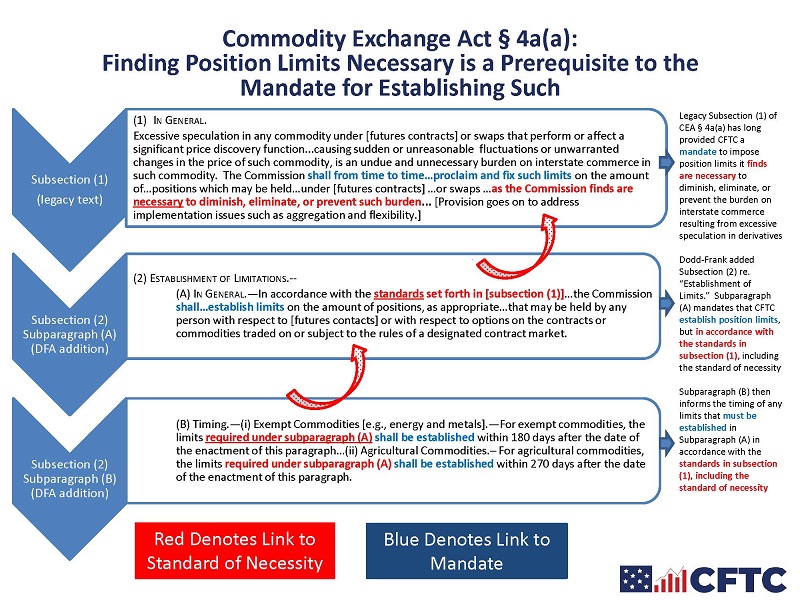
For purposes of this statutory analysis, please refer to the attached diagram entitled “Commodity Exchange Act § 4a(a): Finding Position Limits Necessary is a Prerequisite to the Mandate for Establishing Such.” This diagram walks through some of the statutory text in CEA Section 4a(a) that is relevant to the question of whether a finding of necessity is a prerequisite to the Commission’s mandate of imposing position limits.
Subsection (1) of Section 4a(a) (quoted at the top of the diagram) is legacy text that has been in the CEA for decades. As noted above, it has long mandated that the Commission impose position limits that it finds necessary to diminish, eliminate, or prevent the burden on interstate commerce resulting from excessive speculation in derivatives. Subsection (2) of Section 4a(a), on the other hand, was added to the CEA by the Dodd-Frank Act.
In my view, Subsections (1) and (2) are linked, and cannot each be considered in isolation, because the Dodd-Frank Act specifically tied them together. First, Subparagraph (A) of Subsection (2) (quoted in the middle of the diagram) links the Commission’s obligation to set position limits to the “standards” set forth in Subsection (1) – including the standard of finding necessity as a prerequisite to the mandate of imposing position limits. Then, Subparagraph (B) of Subsection (2) (quoted at the bottom of the diagram) links the timing of issuing position limits to the limits required under Subparagraph (A) – which, as noted, is connected to the standards set forth in Subsection (1), including the standard of finding necessity.
In sum, the new timing provisions in Subparagraph (2)(B) (at the bottom of the diagram) apply to the requirement in Subparagraph (2)(A) (in the middle of the diagram). Subparagraph (2)(A), in turn, informs how Congress intended the Commission to establish limits, i.e., in specific accordance with the standards in Subsection (1) (at the top of the diagram) – which includes the necessity standard. They are all linked.
Yet, some have relied in isolation on the “shall . . . establish limits” wording in Subparagraph (A) of Subsection (2) to argue that the Dodd-Frank Act imposed a mandate on the Commission to establish position limits even in the absence of a finding of necessity. Some also have pointed to the timing provisions in Subparagraph (B) of Subsection (2) to argue that the Dodd-Frank Act imposed a mandate on the Commission to establish position limits because Subparagraph (B) twice says that position limits “shall be established.” I agree that, under Subparagraph (B), position limits “shall be established” as required under Subparagraph (A) – but as noted, Subparagraph (A) states that the Commission shall establish limits “[i]n accordance with the standards set forth in [subsection (1)].” This latter point cannot be overlooked or ignored.
Some also have asked why Congress would add all this new language to CEA Section 4a(a) if not to impose a new mandate. Yet, it makes perfect sense to me that while expanding the Commission’s authority to regulate swaps in the Dodd-Frank Act, Congress took the opportunity to review and enhance the Commission’s position limit authorities to ensure they were fit for purpose considering the addition of the new expanded authorities, including how swaps would be considered in the context of position limits. The timing of the review period was spelled out and the manner in which the Commission would go about establishing limits was refined to account for this massive change in oversight.
But never did anyone suggest that the legacy language in Subsection (1) of Section 4a(a), including the required prerequisite of a necessity finding, had effectively been eliminated and replaced with a new mandate that would apply even in the absence of a necessity finding.
Subsequent History
Finally, as noted above, the court in ISDA v. CFTC instructed the Commission to use its “experience and expertise” to resolve the ambiguity it found in the statute. That experience and expertise cannot look only to the era in which these position limit provisions were enacted. We are where we are, and so the application of the Commission’s experience and expertise must include a consideration of the substantial changes in the markets since that time.
Given the intervention of a global financial crisis, it is hard to recall that the Dodd-Frank Act amendments to the CEA’s position limit provisions were borne at a time of skyrocketing energy prices during 2007-2008. The price of oil climbed to over $147 a barrel in July 2008, which represented a 50% increase in one year and a seven-fold increase since 2002.[x] Gas prices at the pump peaked at over $4 a gallon in June and July of 2008.[xi]
Some at the time charged that these price spikes were caused by excessive speculation in futures contracts on energy commodities traded on U.S. futures exchanges – another topic of debate on which I will save my views for another day. But not surprisingly, legislation soon followed. By the end of 2008, the House of Representatives had passed amendments to the CEA’s position limit provisions,[xii] and after the Senate failed to act, the issue was subsequently addressed in the Dodd-Frank Act.
How times have changed. The United States, due to a boom in oil and natural gas production relating to shale drilling and the development of liquefied natural gas, will soon become a net energy exporter.[xiii] Although no new federal position limits have been imposed, prices of energy commodities have generally dropped and stabilized, and cries of excessive speculation in the derivatives markets are rare. Also, our derivatives markets have grown substantially. Global trading in listed futures and options increased from 22.4 billion contracts in 2010 to a record 34.47 billion contracts in 2019. Global open interest increased to a record 900 million contracts from 718.5 million in 2010.[xiv]
Applying our experience and expertise, what these developments teach us is that economic conditions change over time. Technology marches on. Markets evolve. And prices fluctuate in response to a myriad of influences. Having lived through the energy price increases of the mid-2000s, I do not minimize the pain they caused, or the importance of the Commission taking appropriate steps to prevent excessive speculation in derivatives markets that can contribute to a burden on interstate commerce. Given the history of the past decade, however, I do not believe Congress intended, based on the moment in time of 2007-2008, to forever lock our derivatives markets into a straightjacket, or to deny the Commission the flexibility to draw conclusions of necessity based on particular circumstances.
Returning to our zombie romance, I’m afraid I have not been fair to its author. That is because there is a second line to the quotation, which reads: “We are where we are, however we got here. What matters is where we go next.”[xv]
It is my fervent hope that the majority of comment letters we receive on today’s proposal provide constructive input on where the proposal would take us next with respect to position limits – and not simply fan the flames of the necessity debate. And it is the topic of where we go next that I will now turn.
What Position Limits Are Necessary?
Having concluded that the CEA mandates the Commission to impose position limits that it finds are necessary, the question then becomes: What position limits are necessary?
In the 2013 Proposal, the Commission’s necessity finding determined that federal spot month position limits were necessary for 28 core referenced futures contracts on various agricultural, energy, and metals commodities. In the 2016 Re-Proposal, the Commission utilized the same necessity finding to determine that federal spot month limits were necessary for 25 of the 28 core referenced futures contracts for which they had been found necessary in 2013.[xvi] And today’s proposal, although utilizing a different approach to the necessity finding, determines that federal spot month limits are necessary for the same 25 core referenced futures contracts for which they were found to be necessary in the 2016 Re-Proposal.
In other words, three different iterations of the Commission have found federal spot month position limits to be necessary for these 25 core referenced futures contracts. That degree of consistency alone demonstrates the reasonableness of this determination.
To be sure, both the 2013 Proposal and the 2016 Re-Proposal found federal position limits for non-spot months to be necessary for these 25 contracts, whereas today’s proposal does so for only the nine legacy agricultural contracts that are currently subject to federal non-spot month limits. Yet, the necessity findings in the 2013 Proposal and the 2016 Re-Proposal were based largely, if not entirely, on just two episodes: 1) the activity of the Hunt Brothers in the silver market in 1979-1980; and 2) the activity of the Amaranth hedge fund in the natural gas market in the mid-2000s.
The Hunt Brothers silver episode and Amaranth natural gas episode occurred over 30 and over 15 years ago, respectively. It also should be noted that the Commission settled enforcement actions against both the Hunt Brothers and Amaranth charging that they had engaged in manipulation and/or attempted manipulation.[xvii] Since that time, Congress has provided the Commission with enhanced anti-manipulation enforcement authority as part of the Dodd-Frank Act, which the Commission has used aggressively and serves as an effective tool to deter and combat potential manipulation involving trading in non-spot months.
Again, I do not minimize the seriousness of the Hunt Brothers and Amaranth episodes, both of which had significant ramifications. But I am comfortable with the proposal’s determination that two dated episodes of manipulation during the past 30 years do not establish that it is necessary to take the drastic step of restricting trading (and liquidity) in non-spot months by imposing position limits for the core referenced futures contracts in these two commodities – let alone for the other 14 contracts at issue. I therefore support publishing the necessity finding in the proposal before us – including the limitation on proposed non-spot month limits to the nine legacy agricultural contracts – for public comment.
Setting Limit Levels
With respect to setting position limit levels, the Commission’s historical practice has been to set federal spot month levels at or below 25 percent of deliverable supply based on estimates provided by the exchanges and verified by the Commission. Yet, some of the deliverable supply estimates underlying the existing federal spot month limits on the nine legacy agricultural futures contracts have remained the same for decades, notwithstanding the revolutionary changes in U.S. futures markets and the explosive growth in trading volume over the years. These outdated delivery supply estimates require updating.
The proposal adheres to the Commission’s historical approach, which is reasonable given the Commission’s years of experience administering federal spot month limits on the legacy agricultural contracts. And it provides a long-overdue update to deliverable supply estimates for those legacy contracts to reflect the realities of today’s markets. The proposed spot month limits for the 25 core referenced futures contracts are based on deliverable supply estimates of the exchanges that know their markets best, but that have been carefully analyzed by Commission staff to assure that they strike an appropriate balance between protecting market integrity and restricting liquidity for bona fide hedgers.
For limit levels outside the spot month, the Commission historically has used a formula based on 10% of open interest for the first 25,000 contracts, with a marginal increase of 2.5% of open interest thereafter. Again, the proposal reasonably adheres to this general formula with which the Commission is familiar in proposing non-spot month limits for the nine legacy agricultural contracts, but it would apply the 2.5% calculation to open interest above 50,000 contracts rather than the current level of 25,000 contracts.
Open interest has roughly doubled since federal limits were set for these markets, which has made the current non-spot month limits significantly more restrictive as the years have gone by. Nevertheless, I appreciate that such a change to established limits may raise concern. I am therefore pleased that the proposal includes a question asking whether the proposed increases in federal non-spot month limits should be implemented incrementally over a period of time, rather than immediately at the effective date. (There is additionally a question seeking input on the impact of increases in non-spot month limits for convergence that is of great interest to me.)
Finally, it is important to remember that the 16 core referenced futures contracts for which federal non-spot month limits are not being proposed remain subject to exchange-set position limit levels or position accountability levels.[xviii] The Commission has decades of experience overseeing accountability levels implemented by exchanges, including for all 16 contracts that would not be subject to federal limits outside the spot month under this proposal. Position accountability enables the exchange to obtain information about a potentially problematic position while it is at a relatively low level, and to require a trader to halt increasing that position or to reduce the position if the exchange considers it warranted. Exchange position accountability rules, in combination with market surveillance by both the exchanges and the Commission and the Commission’s enhanced anti-manipulation authority granted by the Dodd-Frank Act, provide a robust means of detecting and deterring problems in the outer months of a contract. The proposal reasonably continues to rely on these tools in the non-legacy contracts.
Undoubtedly, there will be those who believe the proposed spot and non-spot month limits are too high, and others who consider them too low. I look forward to receiving public comments along these lines, but expect that any such comments will include market data and analysis for the Commission to consider in developing final rules.
Bona Fide Hedging Transactions and Positions
The CEA provides that the Commission’s position limit rules shall not apply to bona fide hedging transactions or positions. It gives the Commission the authority to define “bona fide hedging transactions and positions” with the purpose of “permit[ting] producers, purchasers, sellers, middlemen, and users of a commodity or a product derived therefrom to hedge their legitimate anticipated business needs . . .”[xix] This serves as a statutory reminder of the fundamental point that the Commission is imposing speculative position limits, and since bona fide hedging is outside the scope of speculative activity, it is by definition outside the scope of the position limit rules.
The Commission’s current definition of the term “bona fide hedging transactions and positions” is set out in what is referred to as “Rule 1.3(z).” In addition to providing a definition, Rule 1.3(z) also identifies certain specific “enumerated” hedging practices that the Commission recognizes as falling within the scope of that definition and therefore not subject to position limits. Other “non-enumerated” hedging practices can still be recognized as bona fide hedging, but only after a Commission review process.
I am delighted that the proposal before us recognizes an expanded list of enumerated bona fide hedging practices than are currently recognized in Rule 1.3(z). This is entirely appropriate. Hedging practices at companies that produce, process, trade, and use agricultural, energy, and metals commodities are far more sophisticated, complex, and global than when the Commission last considered Rule 1.3(z). This is yet one more instance where the Commission’s position limit rules simply have not kept pace with developments in, and the realities of, the marketplace. In addition, the proposal would expand federal limits to contracts in commodities not previously subject to federal limits, and thus common hedging practices in the markets for those commodities must be considered for inclusion in the list of enumerated bona fide hedges.
I am particularly pleased that, at my request, the proposal recognizes anticipatory merchandising as an enumerated bona fide hedge. After all, the CEA itself identifies anticipatory merchandising as bona fide hedging activity,[xx] and the Commission has previously granted non-enumerated hedge recognitions for anticipatory merchandising. There is no policy basis for distinguishing merchandising or anticipated merchandising from other activities in the physical supply chain. Although there must be appropriate safeguards against abuse, where merchandisers anticipate taking price risk, they should have the same opportunity as others in the physical supply chain to manage their risk through recognized risk-reducing transactions that qualify as bona fide hedging.
Although the proposal refers to enumerated bona fide hedges as “self-effectuating” for purposes of federal limits, this is a bit of a misnomer. Even if a hedge is enumerated, the trader still must receive approval from the relevant exchange to exceed the exchange-set limits.[xxi] This, too, is entirely appropriate. The exchanges know their markets, and they are very familiar with current hedging practices in agricultural, energy, and metals commodities, and thus are well-suited to apply the enumerated bona fide hedges in real-time. And, as noted above, Congress has declared it a purpose of the CEA to serve the public interest with respect to derivatives trading “through a system of effective self-regulation of trading facilities . . .”[xxii]
I find perplexing what the proposal refers to as a “streamlined” process for recognizing non-enumerated bona fide hedging practices with respect to federal position limits. Pursuant to proposed 150.9, if an exchange recognizes a non-enumerated practice as a bona fide hedge for purposes of the exchange’s position limits, that recognition would apply to the federal limits as well, unless the Commission notifies the exchange and market participant otherwise. The Commission would have 10 business days for an initial application, or 2 business days in the case of a sudden or unforeseen increase in the applicant’s bona fide hedging needs, to approve or reject the exchange’s bona fide hedging recognition.
I do not believe this “10/2-Day Rule” is workable in practice for either market participants or the Commission because it is both too long and too short. It is too long to be workable for market participants that may need to take a hedging position quickly, and it is too short for the Commission to meaningfully review the relevant circumstances and make a reasoned determination related to the exchange’s recognition of the hedge as bona fide.
My preference would have been to propose that recognition of non-enumerated hedges be the responsibility of the exchanges that, again, are most familiar both with their own markets and with the hedging practices of participants in those markets. The Commission would monitor this process through our routine, ongoing review of the exchanges. I welcome public comment on the proposal’s legal discussion of the sub-delegation of agency decision making authority as relevant to this question, and on how the proposed 10/2-Day Rule might be improved in a final rulemaking to make the process workable for market participants and the Commission alike.
A Word about Economically Equivalent Swaps
CEA Section 4a(a)(5) provides that “[n]otwithstanding any other provision” in Section 4a, the Commission’s position limit rules shall establish limits, “as appropriate,” with respect to economically equivalent swaps, and that such limits must be “develop[ed] concurrently” and “establish[ed] simultaneously” with the limits imposed on futures contracts and options on futures contracts.[xxiii] I share the view that Section 4a(a)(5) thereby requires that this rulemaking encompass economically equivalent swaps, although I invite public comment from those who believe another interpretation may be permissible and appropriate.
The proposal sets forth a narrow definition of the term “economically equivalent swap,” which I believe is appropriate. A measured approach is reasonable given that: 1) the Commission’s regulatory regime for swaps remains in its relative infancy; 2) swaps have never been subject to position limits, be it federal or exchange-set limits; and 3) the implications of imposing position limits on economically equivalent swaps cannot be predicted with any degree of confidence at this time. Further, a measured approach is more workable because it is the Commission, rather than an exchange, that will be responsible for administering the new position limits regime for swaps given that: 1) many swaps trade over-the-counter (“OTC”) so there is no exchange to fulfill this responsibility; and 2) for swaps traded on swap execution facilities (“SEFs”), those SEFs lack the information about a trader’s swap positions on other SEFs and OTC that would be necessary to fulfill this responsibility.
That said, the proposed definition of an “economically equivalent swap” is broader than that used in the European position limits regime. In Europe, economic equivalence requires identical terms; the proposal, by contrast, requires only that material terms be identical. I look forward to receiving comment on this distinction, and the experience that market participants have had with the European application of position limits to swaps.
Conclusion
The fact that the Commission has been trying to update these rules for nearly a decade demonstrates the challenge presented by position limits. I am extremely grateful to the many members of our staff in the Division of Market Oversight, the Office of General Counsel, and the Chief Economist’s Office who have dedicated a significant portion of their lives to helping us try to meet that challenge. I also appreciate the efforts of my fellow Commissioners as well.
Each of us has committed that we would work to finish a position limits rulemaking. The time has come. Overall, today’s proposal is reasonable in design, balanced in approach, and workable for both market participants and the Commission. I therefore support it.
I ask market participants to view the proposal in that spirit. Please provide us with your constructive input on how we can make a good proposal even better.
[i] CEA Section 4a(a), 7 U.S.C. § 6a(a).
[ii] Section 4a(c) of the CEA further requires that the Commission’s position limit rules “permit producers, purchasers, sellers, middlemen, and users of a commodity or a product derived therefrom to hedge their legitimate anticipated business needs . . .” CEA Section 4a(c), 7 U.S.C. § 6a(c).
[iii] CEA Section 3(b), 7 U.S.C. § 5(b).
[iv] See Dodd-Frank Wall Street Reform and Consumer Protection Act, Public Law 111-203, 124 Stat. 1376 (2010) (“Dodd-Frank Act”).
[v] “Position Limits and the Hedge Exemption, Brief Legislative History,” Testimony of General Counsel Dan M. Berkovitz, Commodity Futures Trading Commission, before Hearing on Speculative Position Limits in Energy Futures Markets at 1 (July 28, 2009) (“Today, I will provide a brief legislative history of the mandate in the CEA concerning position limits and the exemption from those limits for bona fide hedging transactions. . . . Since its enactment in 1936, the Commodity Exchange Act (CEA) . . . has directed the Commodity Futures Trading Commission (CFTC) to establish such limits on trading ‘as the Commission finds are necessary to diminish, eliminate, or prevent such burden [on interstate commerce].’ The basic statutory mandate in Section 4a of the CEA to establish position limits to prevent such burdens has remained unchanged over the past seven decades) (emphasis added), available at https://www.cftc.gov/PressRoom/SpeechesTestimony/berkovitzstatement072809; see also, id. at 5 (“By the mid-1930s . . . Congress finally provided a federal regulatory authority with the mandate and authority to establish and enforce limits on speculative trading. In Section 4a of the 1936 Act (CEA), the Congress . . . . directed the Commodity Exchange Commission [the CFTC’s predecessor agency] to establish such limits on trading ‘as the commission finds is [sic] necessary to diminish, eliminate, or prevent’ such burdens . . .”) (emphasis added).
[vi] Isaac Marion, Warm Bodies and The New Hunger: A Special 5th Anniversary Edition, 97, Simon and Schuster (2016).
[vii] International Swaps and Derivatives Association v. U.S. Commodity Futures Trading Commission, 887 F.Supp. 2d 259, 281-282 (D.D.C. 2012) (emphasis in the original) (“ISDA v. CFTC”), citing PDK Labs. Inc. v. U.S. DEA, 362 F.3d 786, 794, 797-98 (D.C. Cir. 2004).
[viii] Position Limits for Derivatives, 78 Fed. Reg. 75680, 75685 (proposed Dec. 12, 2013) (“2013 Proposal”).
[ix] Position Limits for Derivatives, 81 Fed. Reg. 96704, 96716 (proposed Dec. 30, 2016) (“2016 Re-Proposal”).
[x] Rebeka Kebede, Oil Hits Record Above $147, Reuters Business News, July 10, 2008, available at https://www.reuters.com/article/us-markets-oil/oil-hits-record-above-147-idUST14048520080711.
[xi] Leigh Ann Caldwell, Face the Facts: A Fact Check on Gas Prices, CBS News Face the Nation, March 21, 2012, available at https://www.cbsnews.com/news/face-the-facts-a-fact-check-on-gas-prices/.
[xii] Commodity Markets Transparency and Accountability Act of 2008, H.R. 6604, 110th Cong. § 8 (2008).
[xiii] Tom DiChristopher, US to Become a Net Energy Exporter in 2020 for First Time in Nearly 70 Years, Energy Dept. Says, CNBC Business News, Energy, Jan. 24, 2019, available at https://www.cnbc.com/2019/01/24/us-becomes-a-net-energy-exporter-in-2020-energy-dept-says.html.
[xiv] Futures Industry Association, Global Futures and Options Trading Reaches Record Level in 2019, Jan. 16, 2020, available at https://fia.org/articles/global-futures-and-options-trading-reaches-record-level-2019.
[xv] See fn. 6, supra, at 97.
[xvi] The 2016 Re-Proposal did not propose that federal position limits be imposed on three cash-settled futures contracts (Class III Milk, Feeder Cattle, and Lean Hogs) that were included as core referenced futures contracts in the 2013 Proposal. See 2016 Re-Proposal, 81 Fed. Reg. at 96740 n.368.
[xvii] The 2016 Re-Proposal acknowledged that “both episodes involved manipulative intent.” 2016 Re-Proposal, 81 Fed. Reg. at 96716.
[xviii] The use of position accountability in lieu of hard limits is expressly permitted by the CEA for both designated contract markets, CEA Section 5(d)(5), 7 U.S.C. § 7(d)(5), and swap execution facilities, CEA Section 5h(f)(6), 7 U.S.C. § 7b-3(f)(6).
[xix] CEA Section 4a(c)(1), 7 U.S.C. § 6a(c)(1).
[xx] CEA Section 4a(c)(2)(A)(iii)(I), 7 U.S.C. § 6a(c)(2)(A)(iii)(I) (bona fide hedging transaction or position is a transaction or position that, among other things, “arises from the potential change in the value of . . . assets that a person owns, produces, manufactures, processes, or merchandises or anticipates owning, producing, manufacturing, processing, or merchandising . . .” (emphasis added)).
[xxi] Further, the absence of Commission approval of an enumerated bona fide hedge does not mean that the Commission has no access to data about the position or insight into the hedger’s trading activity.
[xxii] See fn. 3, supra.
[xxiii] CEA Section 4a(a)(5), 7 U.S.C. § 6a(a)(5).
Statement of Concurrence by Commissioner Rostin Behnam Regarding Proposed Rule on Swap Execution Facilities
Statement of Concurrence by Commissioner Rostin Behnam Regarding Proposed Rule on Swap Execution Facilities
January 30, 2020
I respectfully concur in the Commission’s proposal to amend certain swap execution facility (SEF) requirements and real-time reporting requirements. A little more than a year ago, the Commission issued a proposal that would have constituted a complete overhaul of the existing regulatory framework for SEFs.[1] As I stated in my concurrence to the 2018 SEF proposal, I do not believe that such an overhaul is necessary.[2] However, despite my opposition to the overhaul, I supported issuing the SEF proposal for public comment because it contained several policy changes which separately warranted further consideration. Market participants have spent a great deal of resources to build systems and businesses that comply with our existing SEF rules. Fundamental changes amounting to an overhaul of the entire system should only be done in circumstances where there is a regulatory concern that necessitates action.[3] Accordingly, in the past I have suggested we should focus on targeted reforms, such as codifying existing no-action relief for SEFs.[4] I warned that we should not allow issues with the broader vision of the 2018 SEF proposal to distract us from making targeted changes.[5]
Today, the Commission proposes to limit changes to our existing SEF rules, specifically focusing on the codification of long-standing no-action relief regarding package transactions, error trades, and block trades. While I support today’s proposal, I do have some concerns where I think we deviate from the path of targeted codification. The provisions in today’s proposal regarding package transactions and block trades basically mirror the existing no-action relief.[6] However, the proposal regarding error trades does not.[7]
DMO currently provides no-action relief from the required methods of execution under § 37.9 for trades intended to resolve error trades.[8] The existing relief provides a number of conditions, including a requirement that a SEF determine (either prior to execution or within 24 hours after) that an error has occurred. Among other things, the no-action relief requires that a SEF have error trade rules that account for whether a transaction cancellation or price adjustment will adversely impact market integrity or facilitate market manipulation or other illegitimate activity.[9] None of these conditions appear in the error trade rules proposed today, and under the proposal SEFs will no longer have any obligation to determine whether a trade is an error trade – the determination can instead be left entirely to the parties to the trade. I look forward to comments regarding whether this “principles-based” approach goes too far and fails to give market participants sufficient clarity regarding error trades.
I support targeted, thoughtful reform of our SEF regulations, and I particularly applaud staff’s efforts to provide market participants with greater legal certainty through the codification of our existing no-action relief. I look forward to the comments.
[1] Swap Execution Facilities and Trade Execution Requirement, 83 FR 61946 (proposed Nov. 30, 2018).
[2] Rostin Behnam, Statement of Concurrence of Commissioner Rostin Behnam Regarding Swap Execution Facilities and Trade Execution Requirement (Nov. 5, 2018), https://www.cftc.gov/PressRoom/SpeechesTestimony/behnamstatement110518a.
[3] Rostin Behnam, Sowing the Seeds of Success in 2020, Remarks of CFTC Commissioner Rostin Behnam at the 2019 ISDA Annual General Meeting, Grand Hyatt Hong Kong, Hong Kong (Apr. 9, 2019), https://www.cftc.gov/PressRoom/SpeechesTestimony/opabehnam13
[4] Id.
[5] Id.
[6] See CFTC No-Action Letter No. 17-55, Re: Extension of No-Action Relief from Sections 2(h)(8) and 5(d)(9) of the Commodity Exchange Act and from Commission Regulations 37.3(a)(2) and 37.9 for Swaps Executed as Part of Certain Package Transactions (Oct. 31, 2017); CFTC No-Action Letter No. 17-60, Re: Extension of No-Action Relief for Swap Execution Facilities from Certain “Block Trade” Requirements in Commission Regulation 43.2 (Nov. 14, 2017).
[7] See CFTC No-Action Letter No. 17-27, Re: No-Action Relief for Swap Execution Facilities and Designated Contract Markets in Connection with Swaps with Operational or Clerical Errors Executed on a Swap Execution Facility or Designated Contract Market (May 30, 2017); CFTC No-Action Letter No. 20-01 (“NAL No. 20-01”), Re: Supplemental No-Action Relief for Swap Execution Facilities and Designated Contract Markets in Connection with Swaps with Operational or Clerical Errors Executed on a Swap Execution Facility or Designated Contract Market (Jan. 8, 2020).
[8] NAL 17-27.
[9] Id.
Statement of Commissioner Brian D. Quintenz in Support of Proposed Rule: Amendments for Certain Swap Execution Facility Requirements and Real-Time Reporting Requirements
Statement of Commissioner Brian D. Quintenz in Support of Proposed Rule: Amendments for Certain Swap Execution Facility Requirements and Real-Time Reporting Requirements
January 30, 2020
I support today’s proposal that seeks to resolve through rulemaking three issues currently addressed in staff no-action letters. I believe this proposal is an important first step to provide market participants with much needed regulatory certainty while also promoting swap execution facility (SEF) participation, though regulatory certainty over additional current market practices is necessary as well.
Staff initially granted these requests for relief in 2013 and 2014, as SEFs were first coming into compliance with the Commission’s then-new SEF regulatory framework. With the benefit of six-plus years of implementation experience, and multiple extensions of each of these no-action letters, it is long overdue for the Commission to codify and clarify its policy on each of these important issues.
First, the proposal would amend part 37 regulations to permit the swap components of certain categories of package transactions to be executed on-SEF through flexible means of execution, rather than via the required methods of execution under Rule 37.9.[1] In addition, the proposal would also include an exemption from the trade execution requirement for swap transactions that are executed as a component of a new issuance bond package transaction. These amendments recognize the need to provide flexible means of execution for swaps that are negotiated and executed concurrently with other components of a larger, integrated transaction.
Second, the proposal adopts a principles-based approach regarding SEF policies to correct operational or clerical errors.[2] The proposal directs SEFs to adopt fair, transparent, and consistent policies and procedures that allow for the timely resolution of error trades. SEFs would be permitted to allow market participants to execute offsetting or correcting trades through any method of execution offered by the SEF. I believe these amendments will facilitate the prompt identification and correction of error trades, thereby minimizing market participants’ exposure to market, credit, and operational risks.
Thirdly, the proposal recognizes the difficulties associated with performing a pre-trade execution credit check on block trades occurring away from a SEF’s trading system or platforms.[3] Accordingly, it would permit block trades to be executed on a trading system of the SEF that is not an order book, thereby allowing FCMs to conduct pre-execution credit screenings. The proposal also continues to allow block trades to be executed away from the SEF.
This proposal should in no way preclude the Commission from considering additional SEF no-action letters and policy issues through rulemaking. For example, codifying the current no-action letter providing relief from the trade execution requirement for inter-affiliate swaps, or providing greater clarity about permissible methods of execution and minimum SEF trading functionality are prime examples. In order to truly foster and promote market liquidity, transparency, innovation, and competition in the SEF marketplace, I believe these outstanding issues should be addressed. I will support today’s proposal but remain hopeful that these and other important areas can be addressed through rulemaking in the near future.
[1] These amendments address the relief currently provided by CFTC No-Action Letter 17-55 (Oct. 31, 2017).
[2] These amendments address the relief currently provided by CFTC No-Action Letters 17-27 (May 30, 2017) and 20-01 (Jan. 8, 2020).
[3] These amendments address the relief currently provided by CFTC No-Action Letter 17-60 (Nov. 14, 2017).
Statement of Chairman Heath P. Tarbert in Support of Proposed Rule on Swap Execution Facilities
Statement of Chairman Heath P. Tarbert in Support of Proposed Rule on Swap Execution Facilities
January 30, 2020
Before the 2008 financial crisis, swaps were executed bilaterally “over the counter,” rather than on a centralized exchange. When crafting the Dodd-Frank Act in 2010, Congress faced a key decision: Should it require swaps to trade like futures, via a centralized exchange order book visible to the entire market of potential buyers and sellers? Or should it retain the old bilateral, off-exchange trading practices?
This was a difficult decision. After all, the crisis highlighted the need for more effective price discovery in our swaps markets.[1] For more than a century, centralized exchanges have supported price discovery in futures products by providing a liquid, transparent market for buyers (longs) and sellers (shorts) to come together and transact. On the other hand, swaps are not futures. Many swaps products are executed only episodically through the negotiation of bespoke terms. In the 1990s and 2000s, this was done primarily through various brokers and dealers providing quotes to one another on the telephone or over email. Hence, anonymous electronic trading via a central limit order book (“CLOB”) has not been viable for much of the swaps market.[2] Even relatively standardized swaps are not typically as liquid as futures contracts and historically did not trade via the CLOB as futures do.
The Creation of SEFs
Ultimately, Congress sought a golden mean that would balance these competing concerns. The Dodd-Frank Act gave birth to the concept of swap execution facilities (“SEFs”). SEFs are platforms on which certain standardized swaps are required to trade.[3] They resemble centralized exchanges, but have more flexibility in execution methods to accommodate the unique trading characteristics of swaps. In this regard, Congress took an evolutionary rather than a revolutionary approach, recognizing that mandating too much change too quickly could diminish rather than foster liquidity.
In implementing the evolutionary approach of the Dodd-Frank Act, the CFTC required swaps that must be executed on-SEF to trade via the CLOB or a request for quote to at least three SEF participants (“Required Execution Methods” or “Required Methods”).[4] By contrast, swaps voluntarily traded on a SEF (“on-SEF”) may be executed by any method the parties choose.[5]
The SEF regulatory regime has generally worked well.[6] But rarely is statutory implementation perfect on the first attempt. Some requirements are suitable for the swaps market as a whole but do not work well for particular types of transactions. CFTC staff has addressed such issues through a series of no-action letters, many of which have been in place for over six years. With the benefit of this experience, now is the time to begin codifying these no-action letters, with tweaks and refinements where needed.
Through today’s proposal, we continue to strive for the golden mean that strikes the optimal balance between the features of the old bilateral swaps world and those of the anonymous, exchange-traded futures model. In short, we aim to facilitate a natural progression toward more standardized and liquid products with tighter spreads. At the same time, we recognize that certain products that benefit the market do not lend themselves to the Required Execution Methods.
Specifically, this proposal codifies staff no-action letters in three areas: (1) package transactions; (2) error trades; and (3) block trades.
Package Transactions
A “package transaction” typically involves multiple component financial instruments, to be executed simultaneously (or nearly so), with each component transaction contingent on the others. Pricing for certain components of the package is often based on the prices of other components. Certain components of the transaction often hedge other components. Executing these instruments in package form can improve execution pricing and efficiency, reduce execution costs, and mitigate execution risk, as compared with executing each instrument separately (known as “legging” into the transaction).
In layman’s terms, a package transaction is conceptually similar to booking a flight and hotel for an overnight trip. Each booking’s utility is contingent on the other—making concurrent booking desirable—and there are often opportunities to improve cost and efficiency by bundling the bookings through a travel broker. As a practical matter, the derivatives market is no different.
The proposed rule before the Commission today addresses package transactions that include both (i) one or more swaps that are required to trade on-SEF pursuant to the Required Execution Methods, and (ii) one or more instruments that are not. The Required Execution Methods are suitable for swaps required to trade on-SEF, when such swaps are executed as standalone transactions. But when these swaps are executed as part of a package, they often take on the trading characteristics of the less-liquid instruments in the package, thereby making it unfeasible to execute these swaps via the Required Methods.
This is a part of the market that is itself evolving.[7] However, several types of package transactions include swaps that must trade via the Required Methods under CFTC rules, but currently cannot do so as part of a package. And it is not clear that they will be able to do so in the foreseeable future. Accordingly, today’s proposed rule would codify the no-action relief allowing swap components of those packages to trade through any execution method, provided that the trade occurs on-SEF.[8] I support this reform because it recognizes the progress made toward centralized exchange-type trading for swaps without forcing the market too far ahead of its natural evolutionary process. In addition, we must work to ensure our rules reflect actual market practice and functioning. We cannot rely on staff no-action relief to bridge the gaps forever.
Error Trades
The CFTC, in accordance with the Commodity Exchange Act, has long taken a principles-based regulatory approach to the futures markets.[9] In granting the CFTC jurisdiction over swaps, the Dodd-Frank Act did not repudiate this principles-based tradition, but instead reinforced it. Section 733 of the Act sets forth core principles for SEFs and expressly affords SEFs “reasonable discretion” in determining how to comply.[10]
In this spirit, the proposal sets out a principles-based approach to addressing error trades. It gives SEFs the flexibility to determine the most suitable error trade rules for their markets and participants. At the same time, as I have said repeatedly, principles-based regulation is not a euphemism for “deregulation” or a “light-touch” approach.[11] Accordingly, under our proposal a SEF must require its participants to inform it of error trades and correcting trades, so the SEF can maintain orderly markets and guard against false error claims.[12]
Block Trades
In addition to establishing core principles for SEFs, Congress also set forth two overarching goals for the SEF regulatory regime: (i) promoting the trading of swaps on SEFs, and (ii) enhancing pre-trade price transparency in the swaps markets.[13] Since their inception, our swaps rules have mirrored analogous futures rules in requiring block trades to occur “away from” a SEF’s trading platform.[14] This “away from” language makes sense for our futures markets. No participant would want to trade a block on a futures market because of the market’s relatively small trade sizes and mandatory use of a CLOB. The moment a block trader enters his or her very large order, the market will likely move against them. Hence, traders would prefer to negotiate the transaction bilaterally, off the exchange.
But swaps have far larger average trade sizes and often already trade via private requests for quotes to particular dealers. Imposing the “away from” requirement artificially forces block trades off-platform, undermining Congress’s unambiguous goal of promoting swap trading on SEFs. Moreover, forcing block trades off-SEF prevents clearing brokers from completing required pre-execution credit checks for cleared swaps, since those checks currently are done only on-SEF.[15] Pre-execution credit checks are critical to straight-through trade processing, which mitigates counterparty credit risk and enhances execution certainty by minimizing the time between execution and clearing. For these reasons, I support codifying staff no-action relief that currently allows block trades to take place on-SEF.
Conclusion
I expect the proposal, if finalized, will provide certainty and clarity to SEFs and their participants. CFTC staff has provided important relief over the last six years. There is great value in memorializing their no-action positions in a Commission rule.
Furthermore, I remain open to dialogue on further fine-tuning of our SEF rules, consistent with Congress’s mandate as well as the CFTC’s priorities and resources. I therefore will consider introducing further proposals that have the backing of a broad-based consensus of market participants and stakeholders. Swaps markets will benefit most from evolution, not revolution.
[1] See Committee on Cap. Mkts. Reg., The Global Financial Crisis: A Plan for Regulatory Reform 55 (May 2009) (“With the real-time availability of both pre-trade quotes and post-trade contract prices, an exchange would thus provide an important source of price discovery that would complement the OTC market and enhance its liquidity.”); Fed. Reserve Bank of Chicago, Derivatives Overview in Understanding Derivatives: Markets and Infrastructure 9-11 (2013) (“OTC markets also exhibit low levels of transparency compared with futures markets . . . . Further, OTC markets provide limited price discovery; indeed, OTC trading relies heavily on price information generated by exchange-traded markets.”).
[2] E.g., J. Christopher Giancarlo, Commissioner, CFTC, Pro-Reform Reconsideration of the CFTC Swaps Trading Rules: Return to Dodd-Frank (2015). CLOBs are the modern computerized exchanges that have replaced the open-outcry trading pits of yesteryear.
[3] Specifically, swaps that are required to be centrally cleared must be traded on-SEF unless no SEF makes that swap available to trade. Commodity Exchange Act (“CEA”) § 2(h)(8), 7 U.S.C. § 2(h)(8). The swaps that are required to be cleared are generally the most standardized and liquid classes of swaps.
[4] 17 C.F.R. § 37.9(a).
[5] Id. § 37.9(c).
[6] See, e.g., Lynn Riggs, et al., CFTC, Swap Trading after Dodd-Frank: Evidence from Index CDS, at 6, 52 (Aug. 17, 2019) (finding that SEF-traded index credit default swap markets are working relatively well following the Dodd-Frank swap trading reforms, though there is always room for improvement); Evangelos Benos, Richard Payne, & Michalis Vasios, Centralized Trading, Transparency, and Interest Rate Swap Market Liquidity: Evidence from the Implementation of the Dodd-Frank Act, Bank of England Staff Working Paper No. 580, at 31 (May 2018) (finding liquidity improvement for swaps subject to the SEF trading mandate).
[7] CFTC staff has allowed the relief for certain package transactions to expire as swaps markets and market infrastructure have progressed such that the swap component of these package transactions can be executed through the required methods of execution. See, e.g., CFTC No Action Letter (“NAL”) No. 14-12; NAL No. 14-62; NAL No. 14-121; NAL No. 14-137; NAL No. 15-55; NAL No. 16-76; NAL No. 17-55.
[8] The proposal would also allow any swap that is part of a package that also includes a new bond issuance to trade off-SEF via any means of execution.
[9] E.g., Remarks of CFTC Chairman Heath P. Tarbert at the 2019 Annual Robert Glauber Lecture at Harvard University’s Institute of Politics (Oct. 24, 2019).
[10] CEA § 5b(f), 7 U.S.C. § 7b-3(f) (setting forth core principles for SEFs and providing that a SEF “shall have reasonable discretion in establishing the manner in which [it] complies with the core principles”).
[11] Tarbert, supra note 9; Heath P. Tarbert, Fintech Regulation Needs More Principles, Not More Rules, Fortune (Nov. 19, 2019), https://fortune.com/2019/11/19/bitcoin-blockchain-fintech-regulation-ctfc/.
[12] Such notice need not be separate from the error trade correction process. In addition, while the proposal grants flexibility as to the means of correcting error trades, it does prescribe standards for the timeframe for doing so as to cleared swaps. While I encourage public comment on this point, I tentatively believe such timelines are necessary to promote straight-through processing of swap trades for clearing, which is important for the financial integrity of those trades.
[13] CEA § 5b(e), 7 U.S.C. § 7b-3(e).
[14] 17 C.F.R. § 43.2.
[15] See, e.g., CFTC NAL 17-60.
Statement of Dissent by Commissioner Rostin Behnam Regarding Volcker Covered Funds Proposal
Statement of Dissent by Commissioner Rostin Behnam Regarding Volcker Covered Funds Proposal
January 30, 2020
I respectfully dissent as to the Commission’s decision to propose more revisions to the Volcker Rule. The Volcker Rule, in simple terms, contains two basic prohibitions for banking entities: (1) they may not engage in proprietary trading; and (2) they cannot have an ownership interest in, sponsor, or have certain relationships with a covered fund. Last September, the Commission, along with other Federal agencies[1], approved changes that significantly weakened the prohibition on propriety trading by narrowing the scope of financial instruments subject to the Volcker Rule.[2] Today, the Commission and the other agencies take aim at the second prohibition, and propose to significantly weaken the prohibition on ownership of covered funds. When the agencies approved the changes on proprietary trading in September, the late Paul Volcker himself sent a letter to the Chairman of the Federal Reserve stating that the amended rule “amplifies risk in the financial system, increases moral hazard and erodes protections against conflicts of interest that were so glaringly on display during the last crisis.”[3] I can imagine that he would say something very similar about the further changes that we propose today, particularly the erosion of the existing protections regarding conflicts of interest. I fear that, if we continue to roll back the Volcker Rule, we will soon reach a stage where, sadly, there is nothing left.
[1] The Office of the Comptroller of the Currency, Treasury; the Board of Governors of the Federal Reserve System,; the Federal Deposit Insurance Corporation; and the Securities and Exchange Commission.
[2] Prohibitions and Restrictions on Proprietary Trading and Certain Interests in, and Relationships With, Hedge Funds and Private Equity Funds, 84 FR 61974 (Nov. 14, 2019).
[3] Jesse Hamilton and Yalman Onaran, “Vocker the Man Blasts Volcker the Rule in Letter to Fed Chair,” Bloomberg (Sep. 10, 2019), https://www.bloomberg.com/news/articles/2019-09-10/volcker-the-man-blasts-volcker-the-rule-in-letter-to-fed-chair.
Statement of Dissent by Commissioner Rostin Behnam Regarding Position Limits for Derivatives; Proposed Rule
Statement of Dissent by Commissioner Rostin Behnam Regarding Position Limits for Derivatives; Proposed Rule
January 30, 2020
Introduction
The ceremony for the 92nd Academy Awards will air in a little over a week. I haven’t seen too many movies this year given my two young girls and hectic work schedule, but I did see “Ford v Ferrari.”[1] “Ford v Ferrari” earned four award nominations, including best motion picture of the year. The film tells the true story of American car designer Carroll Shelby and British-born driver Ken Miles who built a race car for Ford Motor Company and competed with Enzo Ferrari’s dominating and iconic red racing cars at the 1966 24 Hours of Le Mans.[2] This high drama action film focuses foremost on the relationship between Shelby and Miles—the co-designers and driver of Ford’s own iconic GT40—and their triumph over the competition, the course, the rulebook, and the bureaucracy. Even if you aren’t a car enthusiast, the action, acting, and accuracy of the story are well worth your time. However, there is a lot more to this movie than racing.
There is a great scene where Miles is talking to his son about achieving the “perfect lap” –no mistakes, every gear change, and every corner perfect. In response to his son’s observation that you can’t just “push the car hard” the whole time, Miles agrees, pensively staring down the track towards the setting sun. He says, “If you are going to push a piece of machinery to the limit, and expect it to hold together, you have to have some sense of where that limit is.”
It’s been nine years since the Commission first set out to establish the position limits regime required by amendments to section 4a of the Commodity Exchange Act (the “Act” or “CEA”)[3], under the Dodd-Frank Wall Street Reform and Consumer Protection Act of 2010.[4] While I would like to be in a position to say that today’s proposed rule addressing Position Limits for Derivatives (the “Proposal”) is leading us towards that “perfect lap,” I cannot. While the Proposal purports to respect Congressional intent and the purpose and language of CEA section 4a, in reality, it pushes the bounds of reasonable interpretation by deferring to the exchanges[5] and setting the Commission on a course where it will remain perpetually in the draft, unable to acquire the necessary experience to retake the lead in administering a position limits regime.
In 2010 and the decades leading up to it, Congress understood that for the derivatives markets in physical commodities to perform optimally, there needed to be limits on the amount of control exerted by a single person (or persons acting in agreement). In tasking the Commission with establishing limits and the framework around their operation, Congress was aware of our relationship with the exchanges, but nevertheless opted for our experience and our expertise to meet the policy objectives of the Act.
Right now, we are pushing to go faster and just get to the finish line, making real-time adjustments without regard for even trying for that “perfect lap.” It is unfortunate, but despite the Chairman’s leadership and the talented staff’s hard work, I do not believe that this Proposal will hold itself together. I must therefore, with all due respect, dissent.
Deference to our Detriment
While I have a number of concerns with the Proposal, my principal disagreement is with the Commission’s determination to in effect disregard the tenets supporting the statutorily created parallel federal and exchange-set position limit regime, and take a back seat when it comes to administration and oversight. In doing so, the Commission claims victory for recognizing that the exchanges are better positioned in terms of resources, information, knowledge, and agility, and therefore ought to take the wheel. While the Commission believes it can withdraw and continue to maintain access to information that is critical to oversight, I fear that giving way absent sufficient understanding of what we are giving up, and planning for ad hoc Commission (and staff) determinations on key issues that are certain to come up, will let loose a different set of responsibilities that we have yet to consider.
I believe the Proposal has many flaws that could be the subject of dissent. I am focusing my comments on those issues that I think are most critical for the public’s review. Based on consideration of the Commission’s mission, and Congressional intent as evinced in the Dodd-Frank Act amendments to CEA section 4a and elsewhere in the Act, I believe that (1) the Commission is required to establish position limits based on its reasoned and expert judgment within the parameters of the Act; (2) the Commission has not provided a rational basis for its determination not to propose federal limits outside of the spot month for referenced contracts based on commodities other than the nine legacy agricultural commodities; and (3) the Commission’s seemingly unlimited flexibility in proposing to (a) significantly broaden the bona fide hedging definition, (b) codify an expanded list of self-effectuating enumerated bona fide hedges, (c) provide for exchange recognition of non-enumerated bona fide hedge exemptions with respect to federal limits, and (d) simultaneously eliminate notice and reporting mechanisms, is both inexplicably complicated to parse and inconsistent with Congressional intent.
The Commission is Required to Establish Position Limits
The Proposal goes to great lengths to reconcile whether the CEA section 4a(a)(2)(A) requires the Commission to make an antecedent necessity finding before establishing any position limit,[6] with the implication that if a necessity finding is required, then the Commission could rationalize imposing no limits at all. I do not believe it was necessary to rehash the legislative and regulatory histories to determine the Commission’s authority with respect to CEA section 4a. Nor do I believe it was worthwhile here to reply in such great depth to the U.S. District Court for the District of Columbia’s opinion vacating the Commission’s 2011 final rulemaking on Position Limits for Futures and Swaps.[7] The Proposal uses a tremendous amount of text to try and flesh out what is meant by “necessary”, and yet I fear it does not demonstrate the Commission’s “bringing its expertise and experience to bear when interpreting the statute,” giving effect to the meaning of each word in the statute, and providing an explanation for how any interpretation comports with the policy objectives of the Act as amended by the Dodd-Frank Act, as directed by the District Court.[8] The Commission ought to avoid the temptation to retract when doing so requires the torture of strawmen. Not only do we look complacent, but we invite criticism for our unnecessary affront to the sensibilities of the public we serve.
Looking back at the record, what is necessary is that the Commission complies with the mandate.[9] In response to the District Court’s directive, the Commission could have gone back through its own records to the 2011 Proposal. If it had done so, it would have found that the Commission provided a review of CEA section 4a(a)—interpreting the various provisions, giving effect to each paragraph, acknowledging the Commission’s own informational and experiential limitations regarding the swaps markets at that time, and focusing on the Commission’s primary mission of fostering fair, open and efficient functioning of the commodity derivatives markets.[10] Of note, “Critical to fulfilling this statutory mandate,” the Commission pronounced, “is protecting market users and the public from undue burdens that may result from ‘excessive speculation.’”[11] Federal position limits, as predetermined by Congress, are most certainly the only means towards addressing the burdens of excessive speculation when such limits must address a “proliferation of economically equivalent instruments trading in multiple trading venues.”[12] Exchange-set position limits or accountability levels simply cannot meet the mandate.
In exercising its authority, the Commission may evaluate whether exchange-set position limits, accountability provisions, or other tools for contracts listed on such exchanges are currently in place to protect against manipulation, congestion, and price distortions.[13] Such an evaluation—while permissible—is just one factor for consideration. The existence of exchange-set limits or accountability levels, on their own, can neither predetermine deference nor be justified absent substantial consideration. The authority and jurisdiction of individual exchanges are necessarily different than that of the Commission. They do not always have congruent interests to the Commission in monitoring instruments that do not trade on or subject to the rules of their particular platform or the market participants that trade them. They do not have the attendant authority to determine key issues such as whether a swap performs or affects a significant price discovery function, or what instruments fit into the universe of economically equivalent swaps. They are not permitted to define bona fide hedging transactions or grant exemptions for purposes of federal position limits. It is therefore clear that CEA section 4a, as amended by the Dodd-Frank Act “warrants extension of Commission-set position limits beyond agricultural products to metals and energy commodities.”[14]
Unsupportable Deference
In spite of all of this—the foregoing mandate; the clear Congressional intent in CEA section 4a(a)(3)(A); and the Commission’s real experience and expertise (including its unique data repository)—the Commission only proposes to maintain federal non-spot month limits for the nine legacy agricultural contracts (with questionably appropriate modifications), “because the Commission has observed no reason to eliminate them.”[15] Essentially, in the Commission’s reasoned judgment, “if it ain’t broke, don’t fix it.” And so, the Commission, in keeping with this relatively riskless course of action, similarly was able to conclude that federal non-spot month limits are not necessary for the remaining 16 proposed core referenced futures contracts identified in the Proposal.
The Commission provides two reasons in support of its determination, and neither sufficiently demonstrates that the Commission utilized its experience and expertise. Rather, the Commission backs into deferring to the exchanges’ authority to establish position limits or accountability levels. This course of action ignores the reality that Commission-set position limits serve a higher purpose than just addressing threats of market manipulation[16] or creating parameters for exchanges in establishing their own limits.[17] The Proposal advocates that there is no need to disturb the status quo, despite the fact that we have nothing to compare it to. The Commission places a higher value on minimizing the impact on industry—which it appears to have not quantified for purposes of the Proposal—than actually evaluating the appropriateness of limits in light of the purposes of the Act and as described in CEA section 4a(a)(3).
The first reason the Commission submits in defense of not proposing federal limits outside of the spot month for the 16 aforementioned contracts is that “corners and squeezes cannot occur outside the spot month…and there are other tools other than federal position limits for deterring and preventing manipulation outside of the spot month.”[18] The “other tools” include surveillance by the Commission and exchanges, coupled with exchange-set limits and/or accountability levels. As laid out in several paragraphs of the Proposal, the Commission would maintain a window into the setting of any limits or accountability levels that in its view are “an equally robust” alternative to federal non-spot month speculative position limits. In describing how accountability levels implemented by exchanges work, the Commission touts the flexibility in application because they provide exchanges—and not the Commission—the ability to ask questions about positions, determine if a position raises any concerns, provide an opportunity to intervene—or not—etc.[19]
While all of this reads well, it ignores Congressional intent. The Proposal never considers that Congress directed the Commission to establish limits—not accountability levels. Given the Commission’s “decades of experience in overseeing accountability levels implemented by the exchanges,” Congress would have been well aware that this alternative path would be a viable option if it were truly as robust in choosing the legislative language. But the Commission has failed to make that case. Foremost, federal position limits are aimed at diminishing, eliminating, and preventing sudden and unwarranted price changes. These sudden price changes may occur regardless of manipulative, intentional or reckless activity—both within and outside of the spot month. The Commission provides no explanation regarding how exchange-set limits or accountability levels would compare, in terms of effectiveness, to federal position limits, which among other things, must apply in the aggregate as mandated by CEA section 4a(a)(6). It is difficult to measure the robustness of a regime when there is nothing to compare it to. As well, the Commission’s observation that exchange-set accountability levels have “functioned as-intended” until this point time, ignores the wider purpose and function of aggregate position limits established by the Commission, and is shortsighted given the ever expanding universe of economically equivalent instruments trading across multiple trading venues. Not to belabor the point, but it seems odd to conclude that Congress envisioned that its painstaking amendments to CEA section 4a were a directive for the Commission to check the box that the current system is working perfectly.
The Commission’s second reason is that layering federal non-spot limits for the 16 contracts on top of existing exchange-set limit/accountability levels may only provide minimal benefits—if any—while sacrificing the benefits associated with flexible accountability levels.[20] The Commission, again, ignores that Congress was clearly aware of the possible layering effect, and did not find it to be comparable let alone as robust.[21] Moreover, the Commission fails to support or otherwise quantify its argument with data. Presumably, the Commission could calculate anticipated non-spot month position limits—based on the formula in the proposed part 150.2(e) (and described in section II.B.2. e. of the Proposal)—for the 16 proposed core referenced futures contracts that have never been subject to such limits. The Commission could have based its determination on aggregate position data it collects through surveillance, and it could have provided a rough estimate of the potential impact that limits may have, absent consideration of any of the proposed enumerated bona fide hedges or spread exemptions. While I am not sure such evidence if presented would have changed my mind, it certainly would have been helpful in determining the reasonableness of the Commission’s determination.
What if?
When muscles are overly flexible, they require appropriate strength to ensure that they can perform under stress. In addition to largely deferring to the exchanges in addressing excessive speculation outside of the spot-month for the majority of the 25 core referenced futures contracts, the Proposal also incorporates flexibility in a multitude of other ways. The Proposal would provide for significantly broader bona fide hedging opportunities that will be largely self-effectuating; it would defer to the exchanges in recognizing non-enumerated bona fide hedging; and it would eliminate longstanding notice and reporting mechanisms. In proposing these various provisions, the Proposal flexes and contorts to accommodate each piece. In doing so, it seems the Commission will be left insufficient strength to accomplish its mandated role of exercising appropriate surveillance, monitoring, and enforcement authorities—and this will be to the detriment of the derivatives markets and the public we serve.
The main point to get across here is that while I support enhancing the cooperation between the Commission and the exchanges, the Commission here is cooperating by dropping back and promising to remain in the draft—never able to fully compete, or take advantage of a “slingshot effect.” We will simply never gain the necessary direct experience with the new regime. The Commission lacks experience in administering spot month limits for 16 of the 25 core referenced futures contracts and lacks familiarity with both common commercial hedging practices for the 16 contracts and the proliferation of the use of the dozen or so self-effectuating enumerated hedges and spread exemptions (also largely self-effectuating) being proposed. While prior drafts of the Proposal admitted this as recently as two weeks ago, the Commission determined to change course and quickly let go of the line. The Commission’s decision to essentially give up primary authority to recognize non-enumerated bona fide hedges, and to rely on the exchanges to collect and hold relevant cash market data for the Commission’s use only after requesting it, seems both careless and inconsistent with Congressional intent.
For example, while the Proposal provides the Commission with the authority to reject an exchange’s granting of a non-enumerated bona fide hedge recognition, this determination must be in the form of a “Commission action,” and it must take place in the span of ten business days (or two in the case of sudden or unforeseen circumstances). Furthermore, the Proposal offers no guidance as to what factors the Commission may consider, or the criteria it may use to make the determination. This narrow window of time likely will not provide Commission staff with a reasonable timeframe to prepare the necessary documentation for the full Commission to deliberate and either request additional information, stay the application, or vote to accept the recognition.[22] It seems more likely that the Commission will be unable to act within the ten or two-day window and the recognition will default to being approved. Regardless of what the Commission determines—even if it ultimately determines that a position for which an application for a bona fide hedge recognition does not meet the CEA definition of a bona fide hedge or the requirements in proposed part 150.9(b)—the Commission could not determine that the person holding the position has committed a position limits violation during the Commission’s ongoing review or upon issuing its determination. I have so many “what ifs” in response to this set up that I feel trapped.
In the Proposal, the Commission requires exchanges to collect cash-market information from market participants requesting bona fide hedges, and to provide it to the Commission only upon request. The Proposal also eliminates Commission Form 204, which market participants currently file each month when they have bona fide hedging positions in excess of the federal limits. This form is a necessary mechanism by which market participants demonstrate cash-market positions justifying such overages. These changes may be well-intentioned, but they are ill-conceived in consideration of the various changes being proposed to the federal position limits regime.
Foremost, under the Proposal, the Commission would receive a monthly report showing the exchange’s disposition of any applications to recognize a position as a bona fide hedge (both enumerated and non-enumerated) or to grant a spread or other exemption (including any renewal, revocation of, or modification of a prior recognition or exemption).[23] While the Proposal argues that the monthly report would be a critical element of the Commission’s surveillance program by facilitating its ability to track bona fide hedging positions and spread exemptions approved by the exchanges,[24] it would not itself appear to be useful in discerning any market participants ongoing justification for, or compliance with, self-effectuating or approved bona fide hedge, spread, or other exemption requirements. While the contents of the report may prompt the Commission to request records from the exchange, it is unclear what may be involved in the making of, and response to, such requests—including time and resources on both sides. Not to mention that the Proposal opines that exchanges would only collect responsive information on an annual basis,[25] and part 150.9(e) does not require exchanges to notify the Commission of any renewal applications. Of course, the Proposal posits that the Commission would likely only need to make such requests “in the event that it noticed an issue that could cause market disruptions.”[26] My guess is that our surveillance staff and Division of Enforcement may have other ideas, but I will leave that with the “what ifs.”
Conclusion
The 24 Hours of Le Mans awards the victory to the car that covers the greatest distance in 24 hours. While the Proposal shoots for victory by similarly attempting to achieve a great amount over a short time period, I am concerned that all of it will not hold together. The Proposal attempts to justify deferring to the exchanges on just about everything, and in-so-doing it pushes to the back any earnest interpretation of the Commission’s mandate or the guiding Congressional intent. This is not cooperation, this is stepping-aside, backing down, giving way, and getting comfortable in the draft. I am not comfortable in this or any draft. It’s my understanding that the Commission has the tools and resources to develop a better sense of where federal position limits ought to be in order to achieve the purposes for which they were designed, while maintaining our natural, Congressionally-mandated lead. The Proposal fails to recognize that Congress already set the course in directing us that our derivatives markets will operate optimally with limits—we just need to provide a sense of where they are. Perhaps the Proposal was just never aiming for the “perfect lap.”
[1] Ford v Ferrari (Twentieth Century Fox 2019).
[2] Ford v Ferrari, Fox Movies, https://www.foxmovies.com/movies/ford-v-ferrari (Last visited Jan. 28, 2020, 1:55 PM).
[3] See Position Limits for Derivatives, 76 FR 4752 (proposed Jan. 26, 2011) (the “2011 Proposal”).
[4] The Dodd-Frank Wall Street Reform and Consumer Protection Act, Pub. L. 111-203 § 737, 124 Stat. 1376, 1722-25 (2010) (the “Dodd-Frank Act”).
[5] As in the Proposal, unless otherwise indicated, the use of the term “exchanges” throughout this statement refers to designated contract markets (“DCMs”) and swap execution facilities (“SEFs”).
[6] See Proposal at III.
[7] Int’l Swaps & Derivatives Ass’n v. CFTC, 887 F. Supp. 2d 259 (D.D.C. 2012).
[8] Id. at 284.
[9] The Proposal’s analysis in support of its denial of a mandate misconstrues form over substance and assumes the answer it is looking for by providing a misleading recitation of Michigan v. EPA, 135 S.Ct. 2699 (2015). In doing so, the Proposal seems to suggest that the Commission is free to ignore a Congressional mandate if it determines that Congress is wrong about the underlying policy. See Proposal at III.D.
[10] 76 FR at 4752-54.
[11] Id. at 4753.
[12] Id. at 4754-55.
[13] See 76 FR at 4755.
[14] Id.
[15] Proposal at II.B.2.d.
[16] See 7 U.S.C. 7(d)(5) and 7b-3(f)(6).
[17] See, e.g., 7 U.S.C. 6a(e).
[18] Proposal at II.B.2.d.
[19] See id.
[20] See id.
[21] See, e.g.7 U.S.C. 6a(e) (providing, among other things and consistent with core principles for DCMs and SEFs, that exchange-set position limits shall not be higher that the limits fixed by the Commission).
[22] See Proposed part 150.9(e).
[23] See Proposed Commission regulation 150.5(a)(4).
[24] See Proposal at II.D.4.
[25] See Proposal at I.B.7.a. and b.
[26] Id. As well, the Proposal opines that the Commission’s reliance on the “limited circumstances” set forth in proposed part 150.9(f)under which it would revoke a bona fide hedge recognition granted by an exchange would be rarely exercised, suggesting a preference to defer to the judgment of the exchange. See Proposal at II.G.3.f.
Statement of Commissioner Dan M. Berkovitz on Amendments to Certain Swap Execution Facility Requirements and Real-Time Reporting Requirements
Statement of Commissioner Dan M. Berkovitz on Amendments to Certain Swap Execution Facility Requirements and Real-Time Reporting Requirements
January 30, 2020
I am voting in favor of today’s proposed rule that would amend certain Commission rules in parts 36, 37, and 43 relating to package transactions, block trades, and error transactions on swap execution facilities (“SEFs”) (“Proposal”). Today’s amendments largely codify longstanding no-action letters for limited categories of swaps transactions regarding the required methods of execution. Generally, I support the codification of no-action letters where, based on experience, doing so is consistent with our statutory mandate, protects customers, provides market participants with a greater level of certainty, and promotes market integrity.
Package Transactions
This Proposal would amend part 37 to allow the swap components of certain package transactions—including those that are illiquid and bespoke and therefore not suitable for trading on-SEF—to be executed on-SEF but through flexible methods of execution. In addition, the Proposal amends part 36 to exempt from the trade execution requirement a swap in a package transaction involving a bond sold in the primary market (“new issuance bond transaction”), which also is not conducive to trading on-SEF.
Beginning in 2014, the Commission issued a series of no-action letters specifying permissible methods of execution for certain package transactions, which have enabled market participants and the agency to apply the trading mandate to these transactions in a phased manner. As the market infrastructure for the trading and clearing of swaps has improved, the trading mandate has been applied to the packages involving more liquid and standardized swap components.[1] The remaining package transactions that would be covered by today’s Proposal represent a small percentage of swaps trading on the most active SEFs.
I encourage the industry to continue to develop systems that allow for increased execution of package trade swap components on-SEF. I also appreciate the Staff’s commitment, if this rule is finalized, to continue to evaluate the categories of package transactions subject to the rule and revise the rule as necessary in the future to reflect developments in trading methodologies.
Error Trades
The Proposal also would amend part 37 to enable SEFs to permit market participants to use flexible methods of execution to correct error trades, and would require a SEF to establish error trade policies that largely track the conditions set forth in prior no-action letters. Notably, the Proposal would require market participants to provide prompt notice of an error trade to the SEF, enabling the SEF to fulfill its self-regulatory obligations. It would not alter the requirement that SEFs must adopt rules declaring that trades rejected from clearing are deemed void ab initio. The Proposal also includes the requirement under CFTC No-Action Letter No. 17-27 that after submitting one error trade, market participants will not be able to submit a second new trade with the original terms. These conditions facilitate a SEF’s direct supervision of its markets, protect against abuse, and promote fair competition.
Block Trades
The Proposal would revise the definition of “block trade” in Commission Regulation 43.2 to permit SEFs to offer non-Order Book methods of execution for market participants to execute swap block trades on-SEF. Like package transactions, block trades encompassed within the Proposal are a small percentage of the number of swaps traded. A significant benefit of this Proposal is that it would facilitate pre-trade credit checks by SEFs for block trades, in accordance with the SEF core principles.
It is my preliminary view that this Proposal would provide certainty to market participants and increase trading efficiencies, while not compromising the Congressional goal of moving standardized OTC derivative contracts to exchanges or electronic trading platforms. I look forward to public comments on the anticipated effects of these amendments, and I thank the staff of the Division of Market Oversight for their work on this Proposal.
[1] For example, U.S. Dollar Spreadover package transactions account for nearly seventy percent of interest rate swaps trading in the inter-dealer swap market. No-action letters for these package transactions have expired and market participants now actively trade the swap component of these packages through required methods of trading. See Proposed Rule, Sect. II.A.1 and n.33.
Dissenting Statement of Commissioner Dan M. Berkovitz Regarding Proposed Rule on Position Limits for Derivatives
Dissenting Statement of Commissioner Dan M. Berkovitz Regarding Proposed Rule on Position Limits for Derivatives
Introduction
I dissent from today’s position limits proposal (“Proposal”). The Proposal would create an uncertain and unwieldy process with the Commission demoted from head coach over the hedge exemption process to Monday-morning quarterback for exchange determinations.[1] The Proposal would abruptly increase position limits in many physical delivery agricultural, metals, and energy commodities, in some instances to multiples of their current levels. It would provide no opportunity for the Commission to monitor the effect of these increases, or to act if necessary to preserve market integrity. The Proposal provides inadequate explanation for other key approaches in the document, including the use of position accountability rather than numerical limits for energy and metals commodities in non-spot months. The Proposal also ignores Congress’s mandate in the Dodd-Frank Act, and reverses decades of legal interpretations of the Commodity Exchange Act (“CEA”) by the Commission and the courts regarding the Commission’s authority and responsibility to impose position limits. It would require, for the first time, the Commission to find that position limits are necessary for each commodity prior to imposing limits.
I Support an Effective Position Limits Framework with Transparency and Certainty
Position limits is one of the last remaining items in the Commission’s reform agenda arising from the Dodd-Frank Act. In the wake of the 2008 oil price spike to $147 per barrel, the Amaranth hedge fund’s dominance of the natural gas futures and swaps market, the rise of commodity index funds, and the financial crisis, Congress mandated that the Commission promptly establish, as appropriate, position limits and hedge exemptions for exempt and agricultural commodities and economically equivalent swaps. We must not forget the lessons from the financial crisis or prior episodes of excessive speculation, nor be lulled back into the belief that unfettered markets yield optimal outcomes. A meaningful, effective position limits regime was important to the reform agenda in 2010, and it must remain our goal today.
I support an effective position limits regime that includes both effective limits on speculative positions and appropriate bona fide hedge exemptions to meet market participants’ legitimate commercial needs. Position limits are critical to preventing market manipulation or distortion due to excessively large speculative positions. Together, position limits and bona fide hedge exemptions promote the market integrity and the price discovery process, while enabling producers, end-users, merchants, and others to use the futures and swaps markets to manage their commercial risks. The Dodd-Frank Act, adopted by Congress in 2010 in the midst of the financial crisis, affirmed Congress’s commitment to federal speculative position limits and its determination that the Commission should act decisively to address excessive speculation in physical commodity markets.
Since joining the Commission, I have traveled the country to meet with market participants in many segments of the physical commodity markets. I have been to soybean farms and rice mills in Arkansas, feedlots in Colorado, dairy co-ops and cornfields in Minnesota, and grain mills and elevators in Kansas, Arkansas, Colorado, and Minnesota. I have met with coffee and cocoa graders in New York, energy companies in Texas, cotton merchandisers from Tennessee, and many others to understand how end-users participate in our markets. I have visited the CME in Chicago, ICE in New York, and the Minneapolis Grain Exchange in Minneapolis. The fundamental purpose of the commodity markets we oversee is to enable end-users to manage the price risks they face in their businesses. I am committed to ensuring that this rule is workable for end-users and provides them with sufficient clarity, predictability, and transparency.
In my view, a position limits rule must meet three basic criteria. First, the rule must provide effective limits on speculative positions. Second, the rule must recognize legitimate bona fide hedging activities. The Commission should provide market participants with certainty regarding which activities constitute bona fide hedging and establish a workable, transparent process for qualifying additional types of activities as bona fide hedging. Such a process should recognize both the traditional role of the Commission in determining, generally, which activities constitute bona fide hedging, and the role of the exchanges in determining whether the specific activities of particular commercial market participants fall within such bona fide hedging categories as determined by the Commission.
Third, from a legal perspective, a final rule must recognize that Congress has authorized and directed the Commission to promulgate position limits—without a predicate finding that position limits are necessary to prevent excessive speculation—and that the Commission has the flexibility to determine the appropriate tools and limits to accomplish that Congressional directive.
Unfortunately, the Proposal fails to satisfy any of these criteria. The Proposal would greatly increase position limits in many physical delivery agricultural, metals, and energy commodities in spot and individual non-spot months, with no opportunity to monitor for or guard against adverse market impacts. Although I am pleased that the Proposal would no longer recognize risk management exemptions as bona fide hedges for physical commodities,[2] the higher limits allowed under the Proposal could accommodate substantially more speculative positions,[3] with potentially adverse impacts on markets. There is solid evidence that the financialization and growth of commodity index investments can raise commodity prices and negatively affect end-users in the real economy.[4]
The Proposal departs from the well-established roles of the Commission and exchanges in the bona fide hedge framework. As affirmed by the Dodd-Frank Act, it is the Commission’s responsibility to define what constitutes a bona fide hedge.[5] For practical reasons, including limited Commission resources, I support delegating to exchanges the authority to determine whether a particular position, under the particular facts and circumstances presented, constitutes a bona fide hedge as defined by the Commission. The exchanges are well suited for this role and have decades of experience in making such determinations. However, the initial legal and policy determination of what types of positions constitute bona fide hedges must remain the Commission’s responsibility.
The Proposal carries forward all of the bona fide hedges currently enumerated in the Commission’s rules, adds several additional categories to the list of enumerated hedges, and opens the door to an unlimited number of additional, undefined non-enumerated exemptions. The Proposal states, “the proposed enumerated hedges are in no way intended to limit the universe of hedging practices which could otherwise be recognized as bona fide.”[6] The “universe” is a very large place indeed.
On the other hand, the Proposal does not address practices that market participants have urged the Commission to recognize as bona fide hedges, including practices currently recognized by the exchanges. The Proposal thus deprives end-users and other market participants of legal certainty regarding what constitutes a bona fide hedge for various practices currently permitted by the exchanges as bona fide hedges.
Rather than determine whether to recognize these practices as bona fide hedges through notice and comment in today’s rulemaking, the Proposal contemplates that additional non-enumerated bona fide hedges should first be considered by the exchanges, and then reviewed by the Commission during a cramped 10-day retrospective review period.[7] Determination of what constitutes a bona fide hedge for non-enumerated hedges would begin anew each time that an exchange must decide whether a purported bona fide hedge held by a market participant is consistent with the CEA, and then await the Commission’s retrospective review. Market participants should be able to discern whether particular types of practices qualify as bona fide hedging by reading the Commission’s rules and regulations rather than by engaging lawyers and lobbyists to guide them through an opaque, non-public process through the halls of the Commission’s headquarters in Washington DC.
The Commission has almost 40 years of experience with exchange implementation of position limits for energy and metals commodities, and more for agricultural commodities. Based on this experience, I support many of the types of bona fide hedges that exchanges recognize in these markets today. However, the Commission should recognize these exemptions in its own rules through prospective, notice and comment rulemaking, not delegate these determinations to the exchanges.
The legal analysis in this Proposal is a convoluted and confusing legal interpretation of the Dodd-Frank Act that defies Congressional intent. It is implausible that in the aftermath of the financial crisis and the run-up to oil at $147 per barrel, Congress made it more difficult for the Commission to impose position limits. Yet that is the result of the Commission’s revisionist interpretation that a predicate finding of necessity (i.e., that position limits are necessary) is required for the imposition of a position limit for each commodity. Moreover, the Proposal’s finding of necessity for the 25 core reference futures contracts subject to the rule is unpersuasive both economically and legally, and is highly unlikely to survive legal challenge. The necessity finding largely consists of general economic statistics about the importance of the physical commodities underlying these futures contracts to commerce, together with statistics about open interest and trading volume in those futures contracts. These statistics bear little rational relationship to why position limits are necessary to prevent excessive speculation in derivative contracts for these commodities. For example, the imposition of limits on cocoa futures is justified on the basis that “in 2010 the United States exported chocolate and chocolate-type confectionary products worth $799 million to more than 50 countries around the world.”[8] There is a simpler, more logical, and defensible path forward, as I will outline later in this statement.
I thank the Commission staff for working with my office on the Proposal. Although I am not able to support it as currently formulated, I look forward to working with my colleagues and staff to improve the Proposal so that it effectively protects our markets from excessive speculation and provides end-users and other market participants with the regulatory certainty they need. I encourage market participants to comment on the Proposal.
Additional Flaws in the Proposal
1. No Phase-In for Large Increase in Speculative Position Limits
The Proposal would generally increase existing federal or exchange spot month position limits for 25 physical delivery agricultural, metals, and energy commodities by a factor of two or more.[9] It would substantially increase existing federal single month and all months combined limits for the nine legacy agricultural commodities. As examples, spot month limits on ICE’s frozen concentrated orange juice contract would increase from 300 to 2,200 contracts, and single month and all months combined limits on CBOT soybean meal would increase from 6,500 to 16,900 contracts.[10] Single month and all months combined limits for CBOT corn would increase to 57,800 contracts.[11] The proposed increases are largely due to increases in deliverable supply, and the new spot and non-spot month limits continue to reflect the Commission’s 25% and 10% / 2.5% of deliverable supply formulas.
The Proposal does not provide for phasing in the new, higher limits or for otherwise providing a transition period.[12] It presents no analysis of the market’s ability to absorb these large increases without disruption, and no analysis of how large new speculative positions may affect the price discovery process.
Large increases in the amounts of speculative activity in individual non-spot months have the potential to disrupt the convergence process and distort market signals regarding storage of commodities. The Proposal provides no analysis of whether these potential price distortions and their attendant detrimental consequences could be avoided by distributing the large increases in the numerical limits across several non-spot months, rather than permit such large positions in individual months. Instead, the Proposal would codify an abrupt increase 365 days after publication of any final rule in the Federal Register. A transition period or lower individual spot month limits would give the Commission the time and ability to mitigate any issues that may arise if markets are unable to absorb the higher limits in an orderly manner, and prevent disruption if necessary. It is a prudent measure that the Commission should adopt in any final rule.
2. Absence of Non-Spot Month Limits for Exempt and Certain Agricultural Commodities
I am concerned with the Proposal’s failure to adopt federal non-spot limits for 16 energy, metals, and certain agricultural commodities included in the Proposal.[13] CEA section 4a(a)(3) directs that the Commission “shall set limits” on positions held not only in the spot month, but also “each other month” and “for all months,” “as appropriate.”[14] Despite this directive, the Proposal does not adopt non-spot month limits for these commodities. It includes virtually no analysis of why the Commission believes that non-spot limits are not appropriate.
Exchanges have demonstrated an ability to manage speculation and maintain orderly markets with position accountability in non-spot months. However, experiences such as the collapse of the Amaranth hedge fund in 2006 demonstrate how large trades in the non-spot month can also distort markets, widen spreads, and increase volatility.[15] I believe the exchanges have learned from the Amaranth experience and that position accountability can be an effective tool, where appropriate. The Proposal, however, also fails to demonstrate why accountability levels, rather than numerical limits, are appropriate in light of the statutory directives in the CEA. It provides no discussion of the effect of applying the 10/2.5% formula to the energy and metals contracts covered by the Proposal, and why the application of this traditional formula would not be appropriate. Similarly, there is no analysis regarding the numerical limits that could result from applying the four factors specified in 4a(a)(3), and why such numerical limits would not be appropriate.
3. Definition of Economically Equivalent Swap
The Proposal would define an economically equivalent swap as a swap that “shares identical material contractual specifications, terms, and conditions with the referenced contract . . . .”[16] The Proposal offers several rationales for this narrow definition that could potentially lend itself to evasion through financial engineering. One such rationale is that it would reduce market participants’ ability to net down their speculative positions through swaps that are not materially identical. While this and other rationales proffered in the Proposal have merit, the Commission must also ensure that economically equivalent swaps are not structured in a manner to evade federal or exchange regulation through minor modifications to material terms. I invite public comment on this issue.
4. The Proposal’s Necessity Finding Misconstrues the CEA as Amended by the Dodd-Frank Act
The Proposal states that, for any particular commodity, “prior to imposing position limits, [the Commission] must make a finding that they are necessary.”[17] This is a reversal of prior Commission determinations.[18] Neither the statutory language of CEA section 4a(a)(2), nor the district court’s decision in ISDA v. CFTC, compels this outcome.[19] The Commission should not adopt it.
Title VII of the Dodd-Frank Act amended CEA section 4a and directed in 4a(a)(2)(A) that “the Commission shall” establish position limits for agricultural and exempt physical commodities “as appropriate.”[20] In ISDA v. CFTC, the district court directed the Commission to resolve a perceived ambiguity in section 4a(a)(2)(A) by bringing the Commission’s “experience and expertise to bear in light of the competing interests at stake . . . .”[21] That experience includes over 80 years of position limits rulemakings, as described below. It provides ample practical and legal bases to determine that Congress intended the Commission to adopt federal position limits for certain commodities pursuant to CEA section 4a(a)(2).
Starting in 1936, and across multiple iterations of the CEA and its predecessors, the CEA has consistently and continuously reflected Congress’s finding that excessive speculation in a commodity can cause sudden, unreasonable, and unwarranted movements in commodity prices that are undue burden on interstate commerce.[22] Congress also has declared that “[f]or the purpose of diminishing, eliminating, or preventing such burden,” the Commission shall . . . proclaim and fix such [position] limits” that the Commission finds “are necessary to diminish, eliminate, or prevent such burden.” In plain English, Congress has found that excessive speculation is a burden on interstate commerce, and the CFTC is directed to impose position limits that are necessary to prevent that burden. Congress did not direct the Commission to study excessive speculation, to prepare any reports on excessive speculation, or to second-guess Congress’s finding that excessive speculation was a problem that needed to be prevented. Rather, Congress directed the Commission to impose position limits that the Commission believed were necessary to accomplish the statutory objectives.
Following the passage of the 1936 Act, the Commission set position limits for grains in 1938, cotton in 1940, and soybeans in 1951. As the Proposal recognizes, in these rulemakings the Commission did not publish any analyses or make any “necessity finding,” other than to include a “recitation” of the statutory findings regarding the undue burdens on commerce that can be caused by excessively large positions. These rulemakings then set numerical limits on the amounts of commodity futures contracts that could be held.
Court decisions from the 1950s through the 1970s in cases involving the application of the position limits rules reflect a common-sense reading: the statute mandates that the Commission establish position limits, while providing the Commission with discretion as to how to craft those limits. In Corn Refining Products v. Benson,[23] defendants challenged the suspension by the Secretary of Agriculture of their trading privileges on the Chicago Board of Trade for violating position limits in corn futures on the grounds that the statutory prohibition only applied to speculative positions. The U.S. Court of Appeals for the Second Circuit denied the appeal, stating in part:
The discretionary powers of the Commission and the exemptions from the ‘trading limits’ established under the Act are carefully delineated in § 4a. The Commission is given discretionary power to prescribe ‘* * * different trading limits for different commodities, markets futures, or delivery months, or different trading limits for the purposes of buying and selling operations, or different limits for the purposes of subparagraphs (A) (i.e., with respect to trading during one business day) and (B) (i.e., with respect to the net long or net short position held at any one time) of this section * * *’ . . . .
Although § 4a expresses an intention to curb ‘excessive speculation,’ we think that the unequivocal reference to ‘trading,’ coupled with a specific and well-defined exemption for bona-fide hedging, clearly indicates that all trading in commodity futures was intended to be subject to trading limits unless within the terms of the exemptions.[24]
In United States v. Cohen,[25] the defendant challenged his criminal conviction for violating CEC trading limits in potato futures contracts. In upholding the conviction, the court of appeals stated that “[t]rading in potato futures, as for other commodities, is limited by statute and by regulations issued by the Commission. The statute here requires the Commission to fix a trading limit . . . .”[26] The court of appeals further observed: “Congress expressed in the statute a clear intention to eliminate excessive futures trading that can cause sudden or unreasonable fluctuations.”[27]
In CFTC v. Hunt,[28] the Hunt brothers challenged the validity of the agency’s position limit on soybeans of three million bushels on the basis that the agency “made no analysis of the relationship between the size of soybean price changes and the size of the change in the net position of large traders. They argue[d] that there is no direct relationship between these phenomena, and, therefore, the regulation limiting the positions and the trading of the large soybean traders is unreasonable.”[29] Fundamentally, the Hunts alleged that the agency failed to demonstrate that the limits were a reasonable means—or, alternatively put, “necessary”—to prevent unwarranted price fluctuations in soybeans. “The essence of the Hunts’ attack on the validity of the regulation is their substantive contention that there is no connection between large scale speculation by individual traders and fluctuations in the soybean trading market.”[30]
The U.S. Court of Appeals for the Seventh Circuit denied the Hunt brothers’ challenge. It held, “[t]he Commodity Exchange Authority, operating under an express congressional mandate to formulate limits on trading in order to forestall the evils of large scale speculation, was deciding on whether to raise its then existing limit on soybeans. . . . There is ample evidence in the record to support the regulation.”[31]
The Hunt case also illustrates the difference between the requirement for a predicate finding of necessity and the requirement that the Commission’s rulemakings be supported by sufficient evidence. Under the Administrative Procedure Act (“APA”), the Commission’s regulations must not be “arbitrary, capricious, an abuse of discretion, or otherwise not in accordance with law.”[32] To make this finding, “the court must consider whether the decision was based on a consideration of the relevant factors and whether there has been a clear error of judgment.”[33]
In 1981, following the silver crisis of 1979-1980, the Commission adopted a seminal final rule requiring exchanges to establish position limits for all commodities that did not have federal limits.[34] In the final rulemaking, the Commission determined that predicate findings are not necessary in position limits rulemakings. It affirmed its long-standing statutory mandate going back to 1936: “Section 4a(1) represents an express Congressional finding that excessive speculation is harmful to the market, and a finding that speculative limits are an effective prophylactic measure.”[35] The 1981 final rule found that “speculative position limits are appropriate for all contract markets irrespective of the characteristics of the underlying market.”[36] It required exchanges to adopt position limits for all listed contracts, and it did so based on statutory language that is nearly identical to CEA section 4a(a)(1).[37]
In the 1981 rulemaking, the Commission also responded to comments that the Commission had failed to “demonstrate[] that position limits provided necessary market protection,” or were appropriate for futures markets in “international soft” commodities, such as coffee, sugar, and cocoa. The Commission rejected comments that it was required to make predicate necessity findings for particular commodities. The Commission stated:
The Commission believes that the observations concerning the general desirability of limits are contrary to Congressional findings in sections 3 and 4a of the Act and considerable years of Federal and contract market regulatory experience. . . .
* * *
As stated in the proposal, the prevention of large and/or abrupt price movements which are attributable to extraordinarily large speculative positions is a Congressionally endorsed regulatory objective of the Commission. Further, it is the Commission’s view that this objective is enhanced by speculative limits since it appears that the capacity of any contract market to absorb the establishment and liquidation of large speculative positions in an orderly manner is related to the relative size of such positions, i.e., the capacity of the market is not unlimited.[38]
In the “Legal Matters” section of the preamble, the Proposal would jettison the interpretation that has prevailed over the past four decades as the basis for the Commission’s position limits regime. Relying on a non sequitur incorporating a double negative, the Preamble brushes off nearly forty years of Commission jurisprudence:
[B]ecause the Commission has preliminarily determined that section 4a(a)(2) does not mandate federal speculative limits for all commodities, it cannot be that federal position limits are ‘necessary’ for all physical commodities, within the meaning of section 4a(a)(1), on the basis of a property shared by all of them, i.e., a limited capacity to absorb the establishment and liquidation of large speculative positions in an orderly fashion.[39]
In 2010, Congress enacted Title VII of the Dodd-Frank Act and amended CEA section 4a by directing the Commission to establish speculative position limits for agricultural and exempt commodities and economically equivalent swaps.[40] Congress also set forth criteria for the Commission to consider in establishing limits, including diminishing, eliminating, or preventing excessive speculation; deterring and preventing market manipulation; ensuring sufficient liquidity for bona fide hedgers; and ensuring that price discovery in the underlying market is not disrupted.[41] Congress directed the Commission to establish the required speculative limits within tight deadlines of 180 days for exempt commodities and 270 days for agricultural commodities.
It defies history and common sense to assert that the amendments to section 4a enacted by Congress in the Dodd-Frank Act made it more difficult for the Commission to impose position limits, such as by requiring predicate necessity findings on a commodity-by-commodity basis. This is particularly true given Congress’s repeated use of mandatory words like “shall” and “required” and the tight timeframe to respond to the new Congressional directives. In light of the run up in the price of oil and the financial crisis that precipitated the legislation, it is unreasonable to interpret the Dodd-Frank amendments as creating new obstacles for the Commission to establish position limits for oil, natural gas, and other commodities whose significant price fluctuations had caused economic harm to consumers and businesses across the nation. The Commission’s interpretation is revisionist history.
The Commission’s necessity finding that follows its legal analysis is sure to persuade no one. Unless substantially modified in the final rulemaking, it will likely doom this regulation as “arbitrary, capricious, or an abuse of discretion” under the APA. The necessity finding for the 25 core referenced futures contracts selected for this rulemaking boils down to simplistic assertions that the futures contracts and economically equivalent swaps for these contracts “are large and critically important to the underlying cash markets.”[42] As part of the necessity finding for these 25 commodities, the Proposal presents general economic measures, such as production, trade, and manufacturing statistics, to illustrate the importance of these commodities to interstate commerce, and therefore for the need for position limits. On the other hand, the Proposal fails to present any rational reason as to why the economic trade, production, and value statistics for commodities other than the 25 core referenced futures contracts are insufficient to support a similar finding that position limits are necessary for futures contracts in those other commodities.
For example, the Proposal justifies the exclusion of aluminum, lead, random length lumber, and ethanol as examples of contracts for which a necessity finding was not made on the basis that the open interest in these contracts is less than the open interest in the oat futures contracts. This comparison has no basis in rationality. The need for position limits for commodity futures contracts in aluminum, lead, lumber, and ethanol is not in any way rationally related to the open interest in those commodity futures contracts relative to the open interest in oat futures. The Proposal is rife with other such illogical statements.
Fundamentally, general economic measures of commodity production, trade, and value are irrelevant with respect to the need for position limits to prevent excessive speculation. The Congress has found that position limits are an effective prophylactic tool to prevent excessive speculation for all commodities. The Congressional findings in CEA section 4a regarding the need for position limits are not limited to only the most important or the largest commodity markets. General economic data regarding a commodity in interstate commerce is irrelevant to the need for position limits for futures contracts for that commodity.
The collapse of the Amaranth hedge fund in 2006 is another strong example of why a position limits regime is necessary to prevent excessive speculation, in this case in non-spot months. Amaranth was a large speculative hedge fund that at one point held some 100,000 natural gas contracts, or approximately 5% of all natural gas used in the U.S. in a year. As the Commission has explained in other position limits proposals since 2011, the collapse of Amaranth was a factor in the Dodd-Frank’s amendments to CEA section 4a.
The Commission has ample practical experience and legal precedent to resolve the perceived ambiguity in CEA section 4a(a)(2) as instructed by the district court in ISDA v. CFTC without making the antecedent necessity finding now incorporated in the Proposal. Our remaining task is to design the overall position limits framework, including determining the appropriate limit levels, defining bona fide hedges through prospective rulemaking, and appropriately considering other options such as position accountability and exchange-set limits.
Conclusion
In CEA section 4a, Congress directed the Commission to establish position limits and appropriate hedge exemptions to prevent the undue burdens on interstate commerce that result from excessive speculation. Congress has also entrusted to the Commission’s discretion the appropriate regulatory tools to meet this mandate. Congress’ overarching policy directive for position limits is straightforward and has been remarkably consistent for 84 years. The Commission has had ten years, three prior proposals, one supplemental proposal, and hundreds of pages of comment letters to define bona fide hedge exemptions. Now is the time to finish the job, and to do it the right way.
[1] See Position Limits for Derivatives (“Proposal”) at rule text section 150.9(e).
[2] See Proposal at preamble section II(A)(1)(c)(ii)(1). This change comports with amendments to the definition of bona fide hedging in CEA section 4a(c)(2) made by the Dodd-Frank Act.
[3] Proposal at preamble section II(A)(1)(c)(ii)(1).
[4] See, e.g., Ke Tang & Wei Xiong, Index Investment and Financialization of Commodities, 68 Financial Analysts Journal 54, 55 (2012); Luciana Juvenal & Ivan Petrella, Speculation in the Oil Market, Federal Reserve Bank of St. Louis, Working Paper 2011-027E (June 2012), available at http://research.stlouisfed.org/wp/2011/2011-027.pdf.
[5] See CEA § 4a(c); 7 U.S.C. § 6a(c).
[6] Proposal at preamble section II(A)(1)(c)(i) (emphasis added).
[7] The Proposal would establish two distinct processes for recognition of non-enumerated hedges. One process would be Commission-based, but the Proposal anticipates that this process would rarely, if ever, be used by market participants. See Proposal at rule text section 150.3. The other, in proposed § 150.9(e), would require the Commission to retroactively review bona fide hedge exemptions approved by an exchange. See Proposal at rule text section 150.9(e). Such review would need to be conducted within business10 days, would involve the five-member Commission itself, and could be stayed for a longer period.
[8] Proposal at preamble section III(F)(3).
[9] See Proposal at preamble section I(B).
[10] Id. Other notable examples include increased spot limits for ICE U.S. Sugar No. 11 (SB) from 5,000 to 25,800 contracts; increased spot month limits for ICE Cotton No. 2 (CT) from 300 to 1,800 contracts; increased single month and all months combined limits for CBOT Soybean Oil (SO) from 8,000 to 17,400 contracts; and increased single month and all months combined limits for ICE Cotton No. 2 (CT) from 5,000 to 11,900 contracts.
[11] Id. Although the proposed new limit for CBOT Corn (C) is less than twice the current limit (57,800 contracts proposed versus 33,000 contracts currently), it would still be a significantly larger position limit and the largest single month and all months combined limit in the Proposal.
[12] See Proposal at rule text section 150.2 and Appendix E.
[13] See Proposal at rule text section 150.5(b)(2), providing for exchange-set position limits or position accountability in non-spot months contracts not subject to federal speculative position limits.
[14] CEA § 4a(a)(3); 7 U.S.C. § 6a(a)(3).
[15] See Excessive Speculation In the Natural Gas Market, Staff Report with Additional Minority Staff Views, Permanent Subcommittee on Investigations, United States Senate (2007).
[16] Proposal at preamble section (II)(A)(4) and proposed rule text section 150.1.
[17] Proposal at preamble section III(D). The Proposal also states that “[t]he Commission will therefore determine whether position limits are necessary for a given contract, in light of those premises, considering facts and circumstances and economic factors.” Proposal at preamble section III(F)(1).
[18] The Proposal acknowledges “this approach differs from that taken in earlier necessity findings.” Proposal at preamble section III(F)(1). Specifically, the Proposal identifies different approaches taken in position limit rulemaking undertaken by the Commission’s predecessor agency, the Commodity Exchange Commission (“CEC”) from 1938 through 1951, the Commission’s 1981 rulemaking that required exchanges to impose position limits for each contract not already subject to a federal limit, and the proposed rulemakings in 2013 and 2016. Id.
[19] Int’l Swaps and Derivatives Ass’n (“ISDA”) v. CFTC, 887 F. Supp. 2d 259 (D.D.C. 2012).
[20] CEA § 4a(a)(2)(A); 7 U.S.C. § 6a(a)(2)(A).
[21] ISDA, 887 F. Supp. 2d at 281.
[22] Commodity Exchange Act of 1936, P.O. 76-675, 49 Stat. 1491 § 5.
[23] 232 F.2d 554 (2d Cir. 1956).
[24] Id. at 560 (emphasis added).
[25] 448 F.2d 1224 (2d Cir. 1971).
[26] Id. at 1225-6 (emphasis added).
[27] Id. at 1227 (emphasis added).
[28] 591 F.2d 1211 (7th Cir. 1979).
[29] Id. at 1216.
[30] Id.
[31] Id. at 1218 (emphasis added).
[32] 5 U.S.C. § 706(2)(A).
[33] Hunt, 591 F.2d at 1216. In the proposed regulation increasing the speculative position limits for soybeans from 2 million to 3 million bushels, the Commission’s predecessor, the Commodity Exchange Authority (“Authority”), did not make a soybean-specific finding that the limit of three million bushels was necessary to prevent undue burdens on commerce. Rather, the Authority relied on its 1938 and 1951 position limit rulemakings for the general principle that “the larger the net trades by large speculators, the more certain it becomes that prices will respond directly to trading.” Corn and Soybeans, Limits on Position and Daily Trading for Future Delivery, 36 FR 1340 (Jan. 28, 1971). The Authority then stated that its analysis of speculative trading between 1966 and 1969 “ did not show that undue price fluctuations resulted from speculative trading as the trading by individual traders grew larger.” Id. Following a public hearing, the Authority adopted the proposed increase. See 36 FR 12163 (June 26, 1971). For the past 82 years, the Commission has relied on this general principle to justify its position limits regime.
[34] During the silver crisis, the Hunt brothers and others attempted to corner the silver market through large physical and futures positions. The price of silver rose more than five-fold from August 1979 to January 1980.
[35] See Establishment of Speculative Positon Limits, 46 FR 50938, 50940 (Oct. 16, 1981) (“1981 Position Limits Rule”).
[36] 1981 Position Limits Rule at 50941.
[37] In the proposed regulation, the Commission noted that as of April 1975, position limits were in effect for “almost all” actively traded commodities then under regulation. Speculative Position Limits, 45 FR 79831, 79832 (Dec. 2, 1980).
[38] 1981 Position Limits Rule at 50940.
[39] Proposal at preamble section III(F)(1).
[40] See CEA § 4a(a)(2); 7 U.S.C. § 6a(a)(2);CEA § 4a(a)(5); 7 U.S.C. § 6a(a)(5).
[41] See CEA § 4a(a)(3); 7 U.S.C. § 6a(a)(3).
[42] Proposal at preamble section III(F)(2).
Dissenting Statement of Commissioner Dan M. Berkovitz Regarding Volcker Covered Funds Proposal
Dissenting Statement of Commissioner Dan M. Berkovitz Regarding Volcker Covered Funds Proposal
January 30, 2020
Let’s start by calling the Volcker Covered Fund Proposal (“Proposal”) what it is: a regulatory rollback.[1] Virtually every change in the Proposal creates a new exclusion from the rules, or eliminates or reduces existing requirements. The changes to the regulations run counter to the statutory purpose of prohibiting banks from owning hedge funds and private equity funds. The Proposal fails to analyze or discuss the risks inherent in the banking activities it would permit. It presents a thin veneer of a rationale for many of the changes that were precipitated by complaints from the banking industry. The agencies should be making reasoned decisions to improve the effectiveness of the regulations for the purposes mandated by Congress, not implementing industry-driven rollbacks. I therefore dissent.
The general purpose of the Volcker Rule is to eliminate excessive risk taking by banks that enjoy the benefits of U.S. taxpayer support while still preserving their ability to undertake banking activities that serve the public interest.[2] The covered fund provisions are intended to prevent banking entities from circumventing the proprietary trading prohibition in the Volcker rule through covered fund investments and limit bank involvement in covered funds so that the banks are not expected to bail out the funds if they lose money.[3]
While a few of the proposed changes are consistent with this statutory purpose because they correct unintended consequences from the original regulation, the Proposal goes much further than reasonably necessary and appears to create substantial loopholes without effectively analyzing the potential risks. There is no quantitative analysis of those risks. The rationales provided to support these rollbacks are qualitative, legalistic, and summary in nature. They purport to provide “clarity,” allow banks to “diversify” investments, or improve bank competitiveness—none of which advance the goals articulated by Congress.
I am concerned that the proposed changes, along with the other regulatory reductions implemented in the proprietary trading provisions of the Volcker regulations in November 2019,[4] may together substantially reduce the safety measures instituted in the Dodd-Frank Act. Are the large banks that are subject to Volcker profitable? Definitely. Are the banks less competitive as compared to their international competitors? No.[5] Do we need to give them more rein to take on more risk? A case for that has not been made. I fear that we are putting the United States taxpayer at risk of once again bailing out the banks when we as regulators fail to take a reasoned, thoughtful approach; one that seeks to reach an appropriate balance of free markets with regulatory guard rails for risk-taking. After all, the banks that are subject to the Volcker regulations are insured by the FDIC and/or have access to Federal Reserve Bank support. We should have a say in the risks they take when the U.S. taxpayer is standing behind them.
Specific Changes of Concern
Much of the Proposal addresses regulations that will not impact, or will have only indirect impacts on, the CFTC’s core mandate to regulate the derivatives markets. Nonetheless, I cannot vote in favor of proposed regulations that are presented to this agency for review that broadly fail to follow congressional intent—limiting risky behavior by banks connected with hedge funds and private equity funds.
The Proposal states: “The proposed rule is intended to improve and streamline the covered fund provisions and provide clarity to banking entities so that they can offer financial services and engage in other permissible activities in a manner that is consistent with the requirements of section 13 of the BHC Act.”[6] This benign façade masks the true purpose and effect of the Proposal, which is a regulatory rollback. It adds five new, substantive exclusions from covered funds regulation;[7] expands three existing and significant exclusions; reduces what constitutes “ownership” in a covered fund in numerous ways; and significantly reduces limitations on banking relationships with covered funds.
The Volcker covered fund provisions could benefit from tailored revisions to fix some unintended consequences. The so called “super 23A” provisions restrict regular bank clearing activities for certain covered funds for which an affiliate provides services, such as investment management. Clearing services are not risk-taking activities. As another example, the existing regulations inadvertently convert some foreign covered funds into banking entities subject to the entire rule set when the statute intended to exclude those activities if they take place outside the United States. The Proposal would properly address these issues. Unfortunately, it also goes much further in proposing regulatory reductions without careful consideration of the risks involved.
I will discuss three particular provisions to illustrate my concerns. First, the Proposal would exclude “venture capital funds” from the covered funds definition with some minor limitations that are not based on the risks involved. The Proposal acknowledges that, as stated in the final release for the current Volcker regulations, venture capital funds are private equity funds. The Proposal states that the venture capital fund exclusion is based in part on several statements by members of Congress regarding venture capital funds. However, a close reading of the four statements cited in the Proposal shows that three of the four do not call for a complete exclusion of venture capital funds. Congress could have excluded venture capital funds if that were the intent. It did not.
The justification for the broad venture capital fund exclusion is flimsy. The Proposal asserts the exclusion could “promote and protect the safety and soundness of banking entities and the financial stability of the United States” by allowing banks to “diversify their permissible investment activities.”[8] Unfortunately, virtually no analysis or information is provided as to whether such “diversification” is in fact a good thing. Allowing banks to invest in anything and everything would greatly increase diversification, but that absurd approach would not likely protect the safety and soundness of banks or our financial system.
A simple Google search reveals data indicating that venture capital investments historically have been high risk. One study found that about 75% of venture capital-backed firms in the United States did not return capital to investors.[9] A 2013 article in the Harvard Business Review noted that “VC funds haven’t significantly outperformed the public markets since the late 1990s, and since 1997 less cash has been returned to VC investors than they have invested.”[10] The author goes on to note that “[v]enture capital investments are generally perceived as high-risk and high-reward. The data in our report reveal that although investors in VC take on high fees, illiquidity, and risk, they rarely reap the reward of high returns.” Although venture capital performs an important function in providing capital to new technologies, and has been critical in boosting our economy and global competitiveness, I do not think we should be permitting such investments by banks backed by U.S. taxpayers without analyzing the risks involved.
The Proposal would add another new exclusion from covered fund regulation for “customer facilitation vehicles.” This exclusion is concerning because it is not well defined and could potentially become an end run around the Volcker rule. In effect, a bank could be the counterparty for the instruments in the vehicle sold to customers and thereby take on substantial risks permitted as a result of the exclusion. These risks are not addressed in the Proposal.
The Proposal states that such funds or “vehicles” would be used to facilitate customer needs. The brief example given is of accommodating a bank customer that wants to purchase structured notes issued through a vehicle, not the bank, “for certain legal, counterparty risk management, or accounting reasons specific to the customer.”[11] However, unlike the “credit fund exclusion,” which limits the assets that may be held in such funds, the Proposal has no restrictions as to what instruments can be in the vehicle and whether the banking entity can be the counterparty for those instruments. A portfolio of complex derivatives or synthetic “investments” could be placed in the vehicle with the bank taking the other side of the trades.
Furthermore, the Proposal acknowledges that the so called “customer facilitation” vehicles can in fact be ginned up by the banks themselves and that “marketing” the vehicles to the customers is not restricted. In effect, a bank could now create a fund of investments that it wants to hold, put the underlying instruments into a “vehicle” and then market the other side of the investments to customers in the form of security ownership in the vehicle. This exclusion has the potential to create a large loophole for creative bankers to exploit.
Finally, there is a special exclusion created for billionaires: the new “Family Wealth Management Vehicles” exclusion. This provision would exclude so called “family offices” from Volcker covered funds regulation. Unlike the prior two examples, this exclusion is not likely to materially increase undesirable risk taking by banks.[12] Rather, it is concerning because it allows banks and wealth vehicles to avoid Volcker compliance. In my view, wealth vehicles for ultra-wealthy individuals do not need special regulatory relief.
As I noted recently in a statement opposing family office exemptions from several CFTC rules, family offices are not used by ordinary families who may have a modest degree of wealth. Rather, the extraordinarily wealthy—including hedge fund operators, bankers, and super wealthy entrepreneurs—create these organizations to preserve, grow, and pass on their wealth to their descendants.[13] According to the Global Family Office Report 2019, “[t]he average family wealth of those surveyed for this report stands at USD 1.2 billion, while the average family office has USD 917 million in [assets under management].”[14] The aggregate amount of wealth managed by family offices is staggering. By one estimate, the total assets under management by family offices is over $4 trillion, and the number of family offices has grown ten-fold in the last decade.[15] A recent Forbes article noted that “[f]amily offices are now capable of making transactions that were traditionally reserved for big companies or private-equity firms and therefore are becoming a disruptive force in the market-place.”[16]
Furthermore, there are indications that family offices for U.S. persons may be located in offshore tax havens to avoid paying U.S. taxes.[17] Financial regulators should not provide special and favorable regulatory treatment to benefit those who seek to avoid paying their fair share of U.S. taxes.
Conclusion
The Volcker Rule and related regulations are complicated. The regulations deserve careful, reasoned reassessment to maintain their effectiveness. Unfortunately, the Proposal is neither reasoned nor careful. It ignores the risk-reducing public policy for the Volcker rule and effectively acknowledges the fact that this rollback is driven by complaints from the very banks the rule is intended to make safer. No effort is made to assess the risks that the Proposal will now allow banks to assume. I cannot support the proposed changes to the Volcker rule because they do not conform to the statutory mandate for the rule and the Proposal does not carefully analyze the effect of the changes on the safety and soundness of our financial system. I therefore dissent.
[1] “Rollback” is defined as “reduc[ing] (something, such as a commodity price) to or toward a previous level on a national scale.” https://www.merriam-webster.com/dictionary/rollback.
[2] See Statement of Sen. Dodd, 156 Cong. Rec. S6242 (July 26, 2010) (“The purpose of the Volcker rule is to eliminate excessive risk taking activities by banks and their affiliates while at the same time preserving safe, sound investment activities that serve the public interest.”).
[3] The classic example of this risk is the collapse of two Bear Stearns-sponsored hedge funds in 2007. Bear Stearns provided loans intended to shore up two Cayman Islands hedge funds established by Bear Stearns. Bear Stearns was not legally obligated to back the funds financially, but as a business matter, it felt compelled to support them because of its sponsorship of the funds. Those actions were part of a chain of events that eventually led to the fire sale of Bear Stearns to J.P. Morgan in March 2008. To entice J.P. Morgan to buy a distressed Bear Stearns, the Federal Reserve System provided financial support for the purchase. See Reuters, Timeline: A dozen key dates in the demise of Bear Stearns (Mar. 17, 2008), available at https://www.reuters.com/article/us-bearstearns-chronology/timeline-a-dozen-key-dates-in-the-demise-of-bear-stearns-idUSN1724031920080317.
[4] Prohibitions and Restrictions on Proprietary Trading and Certain Interests in, and Relationships with, Hedge Funds and Private Equity Funds, 84 FR 61974 (Nov. 14, 2019).
[5] U.S. banks are the strongest in the world. The recent Global League Tables ranking global banks by amount of banking business activity shows that three or four U.S. banks are in the top five banks in almost every category, including for banking business in foreign markets. See GlobalCapital.com, Global League Tables, available at https://www.globalcapital.com/data/all-league-tables.
[6] Proposal, section II.
[7] While the Proposal lists four exclusions, the parallel investments permission is, in effect, an exclusion from regulation.
[8] Proposal, section III.C.2.
[9] Deborah Gage, The Venture Capital Secret: 3 out of 4 Start-Ups Fail, Wall Street Journal (Sept. 20, 2012), (citing research by Shikhar Ghosh, a senior lecturer at Harvard Business School), available at https://www.wsj.com/articles/SB10000872396390443720204578004980476429190.
[10] Diane Mulcahy, Six Myths About Venture Capitalists, Harvard Business Review (May 2013), available at https://hbr.org/2013/05/six-myths-about-venture-capitalists.
[11] Proposal, section III.C.4.
[12] The Proposal would only allow a de minimis investment in such vehicles by banking entities.
[13] Registration and Compliance Requirements for Commodity Pool Operators (CPOs) and Commodity Trading Advisors: Family Offices and Exempt CPOs, 84 FR 67355, 67369 (Dec. 10, 2019). According to one guide to family offices:
[T]he modern concept of the family office developed in the 19th century. In 1838, the family of financier and art collector J.P. Morgan founded the House of Morgan to manage the family assets. In 1882, the Rockefellers founded their own family office, which is still in existence and provides services to other families.
EY Family Office Guide, Pathway to successful family and wealth management, at 4, available at https://www.ey.com/en_us/tax/family-office-advisory-services.
[14] Campden Research and UBS, The Global Family Office Report 2019, at 10, available at https://www.ey.com/en_us/tax/family-office-advisory-services.
[15] Francois Botha, The Rise of the Family Office: Where Do They Go Beyond 2019?, Forbes (Dec. 17, 2018), available at https://www.forbes.com/sites/francoisbotha/2018/12/17/the-rise-of-the-family-office-where-do-they-go-beyond-2019/#426044f55795.
[16] Id (emphasis added).
[17] Kirby Rosplock, The Complete Family Office Handbook, A Guide for Affluent Families and the Advisors Who Serve Them, at 5 (Bloomberg Press 2014).