Address by Chairman James E. Newsome before the International Swaps and Derivatives Organization at the Energy and Developing Products Conference, Houston, Texas

Address by Chairman James E. Newsome before the International Swaps and Derivatives Organization at the Energy and Developing Products Conference, Houston, Texas

March 26, 2003

Thank you, Bob, for that kind introduction. It is an honor to address this distinguished group. Today, I would like to mention some of the most recent things we’ve done in the way of modernizing our rules and our oversight approach, efforts that bring us even closer to my goal of fully implementing the Commodity Futures Modernization Act. I’d also like to talk a bit about our ongoing enforcement efforts, including the actions announced yesterday in Washington. Finally, I want to share with you several of my own thoughts on where we go from here.

Rule Modernization

Very quickly following passage of the CFMA, the Commission implemented a variety of rule modernizations that affected exchanges and other trading platforms. We were also able, with a bit more effort and through joint efforts with the SEC, to put in place last year the rules necessary to allow trading to begin in single stock futures, at least for those listed domestically. Congress also directed us to review rules affecting futures market intermediaries, from futures commission merchants to pool operators and trading advisors. After soliciting input from market participants through hearings and roundtables, we recently published a number of modernization proposals for public comment. Some of these initiatives address issues that have challenged us for years and they will involve rule changes that affect not only our registrants but also mutual funds, insurance companies, and banks.

Some of these rule changes will provide much-needed clarity, certainty, and operational flexibility for market intermediaries, such as FCMs. Some directly reflect my belief that firms should not be unnecessarily impeded in their pursuit of overseas customers who want to trade on U.S. markets. I have spoken before of my commitment to lowering unnecessary barriers to cross-border transactions and I intend to continue with that effort.

Pool operators and trading advisors also found rule proposals in the Federal Register that will provide them greater operational flexibility. The Commission has proposed an exemption from registration requirements for entities that restrict participation to highly sophisticated persons or that limit trading activity to a de minimus level. We also proposed to lift restrictions on the ability of otherwise-regulated institutions - such as banks, mutual funds, and insurance companies - to make greater use of the risk management tools provided by our markets.

More Effective Oversight

In addition to modernizing rules, we are also looking at how we approach our oversight responsibilities with an eye toward increasing our effectiveness and making best use of taxpayer resources. For example, we announced last month that we have authorized the National Futures Association to perform additional front-line review functions because we have been very pleased with the success of past delegations to NFA. Another big change in our oversight holds particular promise, and that is risk-based auditing, which has been very successful for banking regulators and is now well accepted by the financial institutions themselves. In a risk-based audit of an FCM, for example, CFTC staff will focus their resources on areas that could pose the greatest danger to the safety of customer funds or the financial integrity of a the registered firm. This change is expected to better focus the resources of both the CFTC and the self-regulatory organizations for maximum effectiveness. The first major risk-based audit got underway just yesterday in Chicago, in fact, and I will monitor its progress with interest.

Enforcement Matters

There is a major aspect of our oversight that will not be changing, however, and that is our firm commitment to bring our investigative and enforcement capabilities fully to bear on anyone who attempts to compromise the integrity, efficiency, or reliability of these critically important markets. Derivatives -- both on-exchange transactions and over-the-counter contracts -- now serve the risk management needs of businesses, investors, and financial institutions in virtually every sector of the economy. As Chairman Greenspan and others have observed, the increased use of derivatives can quite reasonably be said to have made the financial system more flexible, resilient, and efficient, which in turn has benefited the economy as a whole. The Commission’s recognition of just how important these risk management markets really are only strengthens our determination to protect them from attempts at fraud, abuse, and manipulation.

In December, we ordered a $5 million civil monetary penalty against Dynegy and West Coast Power in connection with false reporting and attempted manipulation. On March 12th, we filed a three-count complaint against Enron in federal court here in Houston. Our complaint charges Enron with manipulating the price of Henry Hub natural gas, with operating an unregistered futures exchange, and with offering off-exchange agricultural futures. Yesterday, the Commission allowed El Paso Merchant Energy to enter into a consent order that penalizes it in the amount of $20 million for the reporting of false information to certain energy price reporting indices. I should note that the penalty imposed upon El Paso reflects, in part, the Commission’s recognition of El Paso’s cooperation during the CFTC investigation of this particular conduct and its agreement to continue cooperating in related matters. In addition to these three cases, our Enforcement Division is actively engaged in other investigations in the energy sector, which may result in further charges being filed. As I have said before, our efforts to modernize rules to allow greater flexibility and innovation in legitimate business endeavors will be accompanied by a determination to use strong enforcement actions to deter unethical and illegal activity.

During these investigations, we have cooperated with other regulators and enforcement authorities and will continue to do so. The cases are complex and require substantial time and resources to develop, but it is my goal to identify the wrongdoers, and, just as importantly, to exonerate those not involved, as expeditiously as possible so that these markets can work toward restoring the confidence of market participants and the public. I know that many within the energy sector have been and are hard at work in this effort and should be commended for the things that have been implemented or proposed thus far, including various initiatives on best practices, standards of ethical conduct, and, where appropriate, greater transparency.

Energy Conference

Let me also point out that investigations and enforcement cases are not the only ways in which we are cooperating with other agencies. A couple of weeks ago, we jointly hosted with the Federal Energy Regulatory Commission a conference to discuss possible solutions to credit risk problems in the energy sector. I greatly appreciate the participation of key market participants, some of whom are here today, in what turned out to be a very informative program. I was made even more keenly aware of the challenges facing those who very much need the risk management tools offered by OTC energy derivatives. As a follow-up to some of the things we heard at that conference, FERC Chairman Pat Wood and I wrote jointly to Congress to express our support for previously proposed amendments to certain portions of the bankruptcy code. The changes may help alleviate credit risk concerns in energy markets by ensuring the enforceability of acceleration and termination provisions, netting clauses, and other contractual safeguards in the event of counterparty’s insolvency. I know that this organization has also supported these legislative changes.

Certainty and Flexibility

A key reason that I have expressed my support for those particular amendments to the bankruptcy code -- most recently with Chairman Wood but also previously as a member of the President’s Working Group on Financial Markets -- is that they would provide market participants with greater certainty that key protections which they negotiate into their transactions and agreements will be honored and enforceable should a problem ever arise. I believe that the concept of legal certainty for counterparties is critically important to the smooth and efficient operation of markets. If laws, regulations, or policies are unclear, then market participants must factor that uncertainty into their decisions and this often results in missed opportunities, inefficient results, or misallocated resources.

Legal certainty is a concept that Congress directly addressed in the Commodity Futures Modernization Act. For example, a key provision of the CFMA assured market participants that their transactions cannot be voided or otherwise called into question, and that they themselves cannot be deemed to have violated the Commodity Exchange Act, solely because of a trading platform’s failures to comply with the Act or our regulations. In other words, market participants need not fear that transactions will be unwound just because we brought charges against EnronOnline. The fact that the CFMA provided this legal certainty while also bringing about much-needed regulatory flexibility was one of the main reasons that I have strongly commended Congress for its passage and have worked hard to fully implement it at the CFTC.

The approach to derivatives oversight adopted by the CFMA recognizes, for example, the different needs of retail and sophisticated market participants and the different levels of appropriate oversight for commercial and non-commercial markets. Notwithstanding the challenges that have arisen -- the type of challenges that might be expected as any industry undergoes major technological, competitive, and regulatory changes -- and which we are addressing head-on through our enforcement efforts, I continue to believe that one-size-fits-all regulations and prohibitions which ignore unique risk management needs are effective neither in maximizing the efficiency of our various markets nor in minimizing the risks to participants. Rather, I believe that a legal and regulatory environment in which oversight is focused on real risks and which permits valuable innovations in risk management while maintaining and enhancing workable safeguards is the best protection against systemic problems.

Let me conclude by assuring you that the Commission is attentive to all the various concerns that market participants and others have expressed about energy and energy derivatives markets. I have asked Commissioner Sharon Brown-Hruska -- who is here today and who brings the skills of a PhD economist to the Commission -- to take a leading role in working with me to evaluate legislative proposals and other issues that may arise with respect to the energy markets. I look forward to working actively with Commissioner Brown-Hruska as we continue to monitor these important markets closely.

Thank you for allowing me to update you on our efforts at the CFTC.

Address by Chairman James E. Newsome before the Annual Meeting of the National Energy Marketers Association, Washington, DC

Address by Chairman James E. Newsome before the Annual Meeting of the National Energy Marketers Association, Washington, DC

April 4, 2003

Thank you, Bo, for that kind introduction. It is an honor to address the National Energy Marketers Association. I know that you are discussing many important issues this week and I also know how hard many of you have been working on things like standards of conduct and best practices in disclosure and valuation. I do believe that to be an appropriate use of your time and resources. Since some of you may not be familiar with the Commodity Futures Trading Commission, I’d like to use my time here this morning to tell you generally how we do business. Specifically, I want to describe my market oversight philosophy and to bring you up to speed on where the Commission is in its efforts to address energy market issues, including our enforcement cases.

The CFTC oversees the futures trading industry, including exchanges and trading facilities, clearinghouses, and market intermediaries. Roughly 85% of the volume in futures trading is made up of contracts on financial products, with about 8% in agricultural contracts, and the remainder in metals and energy.

When I came to the Commission five years ago, I saw new trading platforms and trading technologies emerging rapidly and I noted that electronic trading was growing at a tremendous pace. These changes were beginning to bring new participants to the marketplace, increasing efficiency and liquidity, enhancing customer service, lowering many barriers to effective cross-border activity, and generally improving the availability and usefulness of risk management tools in more and more sectors of the economy. Yet it also quickly became apparent to me that certain aspects of the oversight structure were not facilitating this process, and were even stifling innovation and progress.

Fortunately, help was soon to be on the way in the form of the Commodity Futures Modernization Act, a much-needed law that I have consistently supported. The CFMA provided flexibility and achieved three primary objectives: rule modernization for market participants and exchanges, legal certainty for over-the-counter markets, and legalization of futures based on single stocks and narrow stock indices.

I have a relatively straightforward oversight philosophy that can be stated in two principles: For the legitimate efforts of market participants who through innovation and fair competition bring to the marketplace greater liquidity, more useful risk management tools, better use of technology, more efficient pricing, and enhanced customer service, I believe in providing the most flexible and responsive oversight structure possible, with simplified rules and streamlined processes. For those who attempt fraud or manipulation, however, I believe in prompt and aggressive exercise of our enforcement authority under the Commodity Exchange Act. In other words, the proper deterrent to wrongdoing, in my opinion, should not be additional prescriptive or burdensome regulations that adversely affect legitimate activity but, rather, strong enforcement actions against those who attempt to operate outside the established rules.

I do not subscribe to the idea of imposing new restrictions just to appear to be acting. The temptation to resort to prescriptive regulations that take a static view of markets and technology has traditionally been hard to resist for some regulators. I believe the key to success for an oversight agency such as ours that is witnessing great change in the marketplace is to pursue the same innovativeness and creativity that successful market participants rely upon in conducting their businesses. Fortunately, the CFMA has afforded the Commission the opportunity to do so through its targeted flexibility. The Act instituted principles-based rules that allow oversight to be tailored to the sophistication of market participants, the nature of the contracts being traded, and the manner in which they are traded. This framework reflects a common sense approach to market oversight.

I believe that the oversight approach called for by the CFMA empowers the Commission to fulfill its important public policy mission without stifling the innovation driven by new technologies or the evolving needs of market participants. For example, very quickly following passage of the CFMA, the Commission was able to implement a variety of rule modernizations that affected exchanges and other trading platforms. Congress also directed the CFTC to review its rules affecting market intermediaries, from futures commission merchants to commodity pool operators and trading advisors. After soliciting input from market participants through hearings and roundtables, we recently published a number of modernization proposals for public comment. Some of these initiatives address issues that have challenged us for years. Some involve rule changes that affect not only our registrants but also mutual funds, insurance companies, and banks. We are committed to this effort and encourage all who are interested to comment on our proposals.

Rules, however, are not the only thing we are trying to modernize. We are also looking at how we approach our oversight responsibilities with an eye toward increasing our effectiveness and making best use of taxpayer resources. For example, we recently commenced a new risk-based auditing program. This approach has been very successful for banking regulators and is now well accepted by the financial institutions themselves. In risk-based audits, CFTC staff will focus their resources on areas that could pose the greatest danger of giving rise to problems that might threaten the safety of customer funds or the financial integrity of a registered intermediary.

Notwithstanding some of the challenges that we have encountered, I continue to believe that one-size-fits-all regulations and prohibitions that ignore unique risk management needs are effective neither in maximizing the efficiency of our various markets nor in minimizing the risks to participants. Rather, I believe that a regulatory environment in which oversight boundaries are clearly defined and focused on real risks and which permits valuable innovations in risk management while maintaining and enhancing workable safeguards is not only the best protection against systemic problems, but also a good provider of legal and regulatory certainty for business decision-makers.

Our efforts to modernize CFTC rules to allow greater flexibility and innovation for legitimate business endeavors will continue to be accompanied by our determination to use strong enforcement actions to deter unethical and illegal activity. The risk management markets are critically important to the U.S. economy and we have been extremely active in addressing concerns. I believe that the increasingly more widespread use of derivatives to manage risks not only benefits the direct users of derivatives but also contributes to greater flexibility, resiliency and efficiency in the economy. My recognition of just how important these risk management markets really are only strengthens my determination to protect them from attempts at fraud, abuse, or manipulation. Accordingly, it has been my consistent policy to bring the Commission’s enforcement capabilities fully to bear on anyone who attempts to compromise the integrity, efficiency, or reliability of these markets.

At the end of last year, the Commission imposed a $5 million civil monetary penalty against Dynegy and West Coast Power in connection with false reporting and attempted manipulation. Last month, we filed a three-count complaint against Enron in federal court in Houston, including charges that Enron manipulated Henry Hub natural gas prices and operated an illegal futures exchange. Also last month, El Paso Merchant Energy entered into a consent order that penalizes it $20 million for the reporting of false information to certain energy price reporting indices. The penalty imposed upon El Paso reflects, in part, the Commission’s recognition of El Paso’s cooperation during the CFTC investigation of this particular conduct and its agreement to continue cooperating in related matters. In addition to these cases, our Enforcement Division is actively engaged in other energy sector investigations, which may result in further charges being filed.

During these investigations, we have cooperated with other regulators and enforcement authorities and will continue to do so. The cases are complex and require substantial time and resources to develop, but it is my goal to identify the wrongdoers, and, just as importantly, to exonerate those not involved, as expeditiously as possible so that these markets can work toward restoring the confidence of market participants and the public. I know that many within the energy sector have been, and are, hard at work in this effort and should be commended for the things that have been implemented or proposed thus far, including various initiatives on best practices, standards of ethical conduct, and, where appropriate, greater transparency.

Investigations and enforcement cases are not the only ways in which we are cooperating with other oversight agencies. Earlier this year, we jointly hosted with the Federal Energy Regulatory Commission a conference to discuss possible solutions to credit risk problems in the energy sector. I greatly appreciate the participation of market participants in what turned out to be a very informative program. I was made even more keenly aware of the challenges facing those who very much need the risk management tools offered by OTC energy derivatives. I believe that the CFMA opened the door to one potential solution in this area in that the clearing of OTC derivatives by the futures market clearinghouses can now be permitted. In fact, the Commission has been working since early last year with the New York Mercantile Exchange on initial efforts in this regard because with our experience we recognize that centralized clearing can do much to address counterparty credit concerns, which appear to be a key concern among potential users of the OTC energy markets.

As a follow-up to some of the things we heard at that conference, FERC Chairman Pat Wood and I wrote jointly to Congress to express our support for previously proposed amendments to certain portions of the bankruptcy code. Such changes may also help to alleviate credit risk concerns in certain energy markets by ensuring the enforceability of acceleration and termination provisions, netting clauses, and other contractual safeguards in the event of one counterparty’s insolvency.

A key reason that I have expressed my support for those particular amendments to the bankruptcy code -- most recently with Chairman Wood but also previously as a member of the President’s Working Group on Financial Markets -- is that they would provide market participants with a greater degree of certainty that the key protections which they carefully negotiate into their transaction agreements will be honored and enforceable should a problem ever arise. I believe that certainty for counterparties is critically important to the smooth and efficient operation of markets. If laws, regulations, or even enforcement policies are unclear, then market participants must factor that uncertainty into their decisions and this, in turn, can often result in missed opportunities, inefficient results, or misallocated resources.

As I mentioned earlier, certainty is a concept that Congress directly addressed through the Commodity Futures Modernization Act. A good example of how they did so is the section which provides assurance to market participants that their transactions cannot be voided or otherwise called into question -- and that they themselves cannot be deemed to have violated the Commodity Exchange Act or the Commission’s rules -- solely because a particular trading platform has failures to comply with all requirements. This means, for instance, that market participants who may have executed transactions through EnronOnline need not fear that those transactions will be unwound just because we brought charges against Enron.

Better certainty can also be provided to market participants by the oversight agencies. If doubts exist as to whether certain activities are appropriate, then I believe that oversight agencies, including our own, should do everything within their power to provide those answers rather than leaving potential market users in the dark. The bottom line is that it is my goal to act quickly and clearly on all fronts so that these markets can get back on their feet.

Let me conclude by assuring you that the Commission is attentive to all of the various concerns that market participants and others have expressed about energy and energy derivatives markets. I recently asked one of my fellow commissioners, Commissioner Sharon Brown-Hruska -- who will be speaking to you later today and who brings the skills of a PhD economist to the Commission -- to take a leading role in working with me to evaluate legislative proposals and other issues with respect to the energy markets. I will work actively with Commissioner Brown-Hruska as we continue to monitor these important markets closely.

Thank you for the invitation to be here this morning and for allowing me to update you on our efforts at the CFTC.

Address by Chairman James E. Newsome of the U.S. Commodity Futures Trading Commission before the Bond Market Association, New York, New York

Address by Chairman James E. Newsome of the U.S. Commodity Futures Trading Commission before the Bond Market Association, New York, New York

April 11, 2003

It is an honor to address the Bond Market Association this morning. Since some of you may not be very familiar with the Commodity Futures Trading Commission, I’d like to use my time here this morning to tell you generally how we do business. Specifically, I want to describe my philosophy of effective market oversight. I’d also like to describe some of our current efforts, including some of our rule modernization proposals and enforcement cases.

The CFTC oversees the trading of futures and options on commodities, including those based on tangible physical commodities, such as agricultural commodities, energy products, and metals, as well as contracts based on financial measures such as stock indices, foreign exchange rates, and government securities. Within our jurisdiction are not only the organized futures exchanges in New York, Chicago, and elsewhere but also the clearinghouses and futures commission merchants who process transactions, the commodity pool operators and commodity trading advisors that direct much of the trading activity, and a variety of newer trading platforms, such as all-electronic commercial derivatives markets that have developed up since passage of the Commodity Futures Modernization Act two-and-a-half years ago.

Today, roughly 80% of the volume in futures trading is made up of contracts based on financial measures. About 8% of the volume is in agricultural contracts, and the remainder in contracts on precious metals and energy products, such as crude oil and natural gas. I should note that ag contracts, which only a few decades ago constituted the entire futures market, are being traded just as actively today as they have ever been. It’s simply that financial contracts have grown astronomically since their initial introductions in the mid-1970s. And it is for this reason that the CFTC today is considered a financial regulator. I believe that the incredible growth in the trading of these contracts demonstrates that the derivatives markets are providing important risk management tools to an ever growing number of investors and businesses in virtually every sector of the U.S. economy.

The Commission is currently composed of four commissioners, including myself, but may have as many as five. Typically, there are two Democratic commissioners, two Republicans, and a Chairman that represents the party of the Presidency. However, as an independent regulatory agency, we have operated relatively free of partisanship, which is a point that makes us very proud. Recently, we reorganized and modernized the structure of the CFTC to make better use of our resources in overseeing these important and dynamic markets. Our Division of Market Oversight, which includes primarily economists, conducts ongoing market surveillance and other key functions, including reviews of contracts and exchange rules. Our other major regulatory unit is the Division of Clearing and Intermediary Oversight, which includes auditors and other staff who monitor the financial and operational integrity of the clearinghouses and their clearing members to ensure that customer funds are protected and that safeguards are in place to prevent individualized financial problems from being transmitted through the system. This division also handles the registration of FCMs, pools operators, and trading advisors. Supplementing the expertise of these two divisions is our Chief Economist’s Office, which provides key analysis to the other divisions and to the Commission, as well as our General Counsel’s Office, which provides legal expertise to the Commission and handles such matters as our appellate cases.

We have a very effective Division of Enforcement to investigate and bring cases against those who attempt to defraud customers, manipulate prices or supplies, or otherwise violate the Commodity Exchange Act and the Commission’s rules. We have also formed an External Affairs Office to respond to inquiries from the public, the press, and the Congress and to communicate our position on issues pending before the Congress or other agencies, including legislative matters that could affect the markets we oversee.

In addition to our individual efforts, the CFTC also works cooperatively with other financial regulators. As Chairman of the CFTC, I sit on the President’s Corporate Fraud Taskforce. I am also honored to be a member of the President’s Working Group on Financial Markets with Secretary Snow, Chairman Greenspan, and Chairman Donaldson. The members of the PWG were in immediate and constant contact following the September 11th attacks. I believe that coordination helped effect the smooth reopenings of the financial markets. In fact, I believe that this sort of coordinated decision-making, at the highest levels of government, should be brought to bear in the event of any major market crisis, a topic which I discussed with Bond Market Association representatives just last week. My experience has been that this coordinated approach has advantages, especially in markets that reach across regulatory jurisdictions or that can affect other markets in the financial system.

As I’ll discuss in a moment, the CFTC works cooperatively with other agencies in a variety of formal and informal ways to address circumstances in the derivatives markets. When I came to the Commission in 1998, I could see that new technologies promised rapid and meaningful improvements in the marketplace and that these changes could bring new participants, greater liquidity, and increased efficiency to the markets while also enhancing customer service, lowering barriers to effective cross-border business, and generally improving the availability and usefulness of risk management tools. Yet it also quickly became apparent to me that the regulatory structure did not always facilitate such progress. In fact, the regulatory structure in some cases stifled innovation and efficiency.

Fortunately, help soon arrived in the form of the Commodity Futures Modernization Act, a much-needed law that I consistently supported. The CFMA embodied three key objectives: rule modernization for both the trading platforms and the market users, legal certainty for the over-the-counter derivatives markets, and legalization of futures based on single stocks and narrow stock indices. The CFMA has also provided the Commission with the flexibility to modernize its oversight of these markets, something that I have greatly appreciated because it has allowed us to make key changes in how we approach the important task of protecting market participants and ensuring the integrity of the market mechanisms.

I have a straightforward market oversight philosophy that reflects two basic principles. First, for the legitimate business activities of those who, through innovation and fair competition, bring to the marketplace greater liquidity, more useful risk management tools, better use of technology, more efficient pricing, and enhanced customer service, I believe we should provide the most flexible and responsive oversight structure possible.

But, for those who attempt fraud or manipulation, I believe in the most prompt and aggressive exercise of our enforcement authority under the Commodity Exchange Act. More specifically, my view is that the proper deterrent to wrongdoing should not be more prescriptive or burdensome regulations that adversely affect legitimate activities but, instead, tough enforcement actions against those who would try to operate outside the established rules.

I have noticed that the temptation to resort to prescriptive regulations, which often take a very static view of markets or technology, has sometimes been hard to resist for regulators. I believe that successful market oversight requires an agency such as ours, one that is witnessing great change in the markets, to be innovative and to adapt to changing market realities. The CFMA affords the CFTC the opportunity to do so through its targeted flexibility; through principles-based rules, it allows oversight to be tailored to the nature of the particular contracts being traded, the sophistication of the market participants involved, and the manner in which those contracts are traded. Overall, the framework reflects a common sense approach to market oversight and empowers the Commission to fulfill its important public policy mission without stifling the innovation driven by new technologies or the evolving needs of market participants.

A good example is the first major set of rule modernizations that the Commission was able to implement very quickly after passage of the CFMA. These rule modernizations affected exchanges and other trading platforms. Congress also allowed the CFTC to review the rules affecting market intermediaries, such as futures commission merchants, pool operators, and trading advisors. After soliciting input from market participants through hearings and roundtables, we recently published a number of proposals for public comment, some of which address issues that have challenged the Commission for years. The proposed changes include rule modernizations affecting not only our traditional registrants but also changes to improve access to risk management tools for mutual funds, insurance companies, and banks. I would encourage each of you who may be interested to comment on these proposals because the insights and concerns of market participants are invaluable to the Commission as we seek to improve the way we oversee these markets.

My desire to pursue this continuous improvement in our oversight is due to my belief that one-size-fits-all regulations and inflexible prohibitions that ignore unique risk management needs are effective neither in maximizing the efficiency of our various markets nor in minimizing the risks to participants. Rather, I believe an oversight structure which permits innovation in risk management while maintaining and enhancing workable safeguards is not only the best protection against systemic problems, but also a good provider of legal and regulatory certainty for business decision-makers.

The increasingly more widespread use of derivatives to manage risk not only benefits direct users but also contributes to greater flexibility, resiliency, and efficiency in the economy. The importance of these markets only strengthens my determination to protect them from attempts at fraud, abuse, or manipulation. Our efforts to modernize CFTC rules to allow greater flexibility and innovation for legitimate business activities must be accompanied by our continuing determination to use strong enforcement actions to deter illegal activities. Accordingly, it has been my consistent policy to bring the Commission’s enforcement capabilities fully to bear on anyone who attempts to compromise their integrity, efficiency, or reliability.

In the short time since passage of the CFMA, which clarified our authority over illegal off-exchange forex bucket shops, the Commission has used that authority to bring almost two dozen cases. At the end of last year, the Commission imposed a $5 million civil monetary penalty against two firms in connection with false reporting and attempted manipulation. Last month, we filed a complaint in federal court in Houston against a former major energy trading company, alleging manipulation of natural gas prices and the online operation an illegal futures exchange. Also last month, another large energy trading firm entered into a consent order with the CFTC penalizing it $20 million for the reporting of false information to energy price reporting services. Our Enforcement Division is actively engaged in other energy sector investigations, which may result in further charges being filed.

During these investigations, the CFTC has cooperated closely with other regulators. The cases are complex and require substantial time and resources to develop, but it is my goal to identify the wrongdoers, and, just as importantly, to exonerate those not involved, as expeditiously as possible so that the energy and energy derivatives markets can work toward restoring the confidence of market participants and the public.

Investigations and enforcement cases are not the only ways in which we are cooperating with other oversight agencies. For example, earlier this year, we jointly hosted with the Federal Energy Regulatory Commission a conference on possible solutions to credit risk problems in the energy sector, at which I was made even more keenly aware of the challenges facing those who very much need the risk management tools offered by OTC energy derivatives. The CFMA made possible one potential solution, the clearing of OTC derivatives by futures market clearinghouses. The Commission has been working since early last year with the New York Mercantile Exchange, the Intercontinental Exchange, and EnergyClear on initial efforts in this area because we recognize that centralized clearing can do much to address counterparty credit concerns, which appear to be a key concern among potential market users.

As a follow-up to discussion at that conference, FERC Chairman Pat Wood and I wrote jointly to Congress to express our strong support for certain previously proposed amendments to the bankruptcy code that could help to alleviate counterparty credit risk concerns by ensuring the enforceability of acceleration and termination provisions, netting clauses, and other contractual safeguards in the event of one counterparty’s insolvency. I know that the Bond Market Association is very familiar with these particular legislative initiatives.

A key reason that I have expressed my support for those amendments -- most recently with Chairman Wood but also previously as a member of the President’s Working Group on Financial Markets -- is that they would provide market participants with a greater degree of certainty that the key protections which they carefully negotiate into their transaction agreements will be honored and enforceable should a problem ever arise. I believe that certainty for counterparties is critically important to the smooth and efficient operation of markets. If laws, regulations, or even enforcement policies are unclear, then market participants must factor that uncertainty into their decisions and this, in turn, can often result in missed opportunities, inefficient results, or misallocated resources.

In closing, let me express my high regard for the staff and leadership of the Bond Market Association. They do a good job of representing your interests in Washington. I have enjoyed our meetings and find their input and insights educational. Thank you again for the invitation to be here this morning and for allowing me to update you on our efforts at the CFTC.

Address by Chairman James E. Newsome before the Futures Industry Association Law and Compliance Luncheon, Chicago

Address by Chairman James E. Newsome before the Futures Industry Association Law and Compliance Luncheon, Chicago

May 28, 2003

It is an honor to address you this morning. Because I had the pleasure of addressing or meeting with many of you here today at your International Futures Conference in March, I’d like to update you on some of the things that were discussed then, as well as to talk about some of other things going on in the industry and at the Commission. Many of you have heard me speak before and know that I feel strongly about my regulatory philosophy. It is this philosophy that guides how I want to address the issues that come before the Commission, including those I will discuss here today.

I was an early and strong supporter of the Commodity Futures Modernization Act of 2000 and its three key objectives: modernizing rules affecting trading platforms and market intermediaries, providing legal certainty for over-the-counter derivatives, and permitting futures based on single stocks or narrow stock indices. As the CFTC has pursued implementation of those objectives, I have followed a straightforward oversight philosophy: for the legitimate business activities of those who through innovation and vigorous competition bring to the marketplace greater liquidity, more useful risk management tools, more efficient pricing, and enhanced customer service, I want to provide the most flexible and responsive oversight structure possible.

For those who would threaten the integrity of these important markets through attempts at fraud or manipulation, however, I believe in promptly and aggressively exercising our enforcement authority. In my opinion, the proper deterrent to wrongdoing should not be more prescriptive or burdensome regulations that adversely affect legitimate activities but, rather, tough enforcement actions against those who would try to operate outside the established rules. Those rules should lay out a basic legal framework without being overly prescriptive or unnecessarily burdensome. Then they must be enforced firmly.

That is why, at the same time the CFTC has been proposing numerous rule modernizations, we have also been quite aggressive on the enforcement front. For example, when Congress provided helpful legal certainty in the area of retail foreign exchange fraud, our Enforcement Division rose to the challenge and in just over two years has conducted numerous investigations and initiated almost three dozen formal actions, making a huge dent in this type of abuse. I am certain that legitimate market participants want and need a marketplace free from fraud and manipulation just as much as we do.

The Enforcement Division has also been active in the energy trading area and many of you are familiar with the multi-million dollar civil monetary penalties and other sanctions we have imposed within the last six months or so. We remain actively engaged in other energy sector investigations, which may result in further charges being filed, but let me take a moment here to make several important points about our energy cases. First, we continue to conduct these complex and resource-intensive investigations and to bring the necessary cases just as quickly as we possibly can so that, in addition to identifying the wrongdoers, we can also exonerate those who were not involved and allow these important risk management markets to work toward restoring the confidence of market participants and the public.

Second, I want there to be no confusion over our intentions when we bring charges against an entity with regard to illegal futures contracts. We approach the issues of whether the Commodity Exchange Act applies to, and whether we have jurisdiction over, any particular transaction solely on the basis of the economic substance of the transaction. Thus, where we have brought charges alleging operation of an unregistered futures exchange that involved the trading of contracts that may have been labeled or referred to as, quote, “swaps,” it is because the economic substance of those transactions was that of a futures contract. Let me assure you that we are not seeking to expand the scope of our jurisdiction over other transactions, such as the true swaps and forwards that the Congress has determined -- appropriately so, in my opinion -- to exclude under the Commodity Exchange Act. In the case of over-the-counter swaps, for example, such an exclusion was expressly provided by the Commodity Futures Modernization Act following recommendations from the President’s Working Group on Financial Markets, and this brought much-needed legal certainty for counterparties in this important sector of the risk management market.

Finally, I want each of the CFTC’s communications to clearly present our relevant goals, policies, and positions, and this includes even the orders we issue in our enforcement cases. Recently, for example, some in the industry questioned a particular recordkeeping violation that was cited in the Commission’s speaking orders in two energy cases. Let me assure you that while our aim is to be aggressive in enforcement actions, which may lead us to approach some factual circumstances in new ways, our goal is not to blur the lines of our jurisdictional boundaries. If it is ever the case that a Commission communication fails to clearly present our case, or is otherwise vague or confusing, we will appreciate hearing from concerned market participants and we will carefully consider ways to provide additional clarity.

I wanted to emphasize those points because I believe that legal certainty and regulatory clarity are critically important for the efficient and reliable operation of markets generally, but perhaps particularly important for many derivatives markets. If the enforceability of contracts is in doubt among counterparties or if laws, regulations, or even a regulator’s enforcement stance are unclear, then rational market participants must factor that uncertainty into their decisions and this, in turn, can result in unnecessary added costs, missed opportunities, inefficient results, and misallocated resources. I believe that is why Congress, with input from many of you, took care to provide additional legal certainty in various areas through the Commodity Futures Modernization Act and I am committed to adhering to that path as we move forward.

Of course, it is possible for the cause of legal certainty to be harmed as well as helped by governmental efforts, particularly if proposed solutions to perceived problems in the marketplace are pursued without adequate discussion, consideration, and debate. For example, I believe that the Commodity Futures Modernization Act reflected careful consideration and that its passage was preceded by informative discussions with and among the relevant financial regulators, in particular the members of the President’s Working Group on Financial Markets. I would therefore hope that any legislative amendments to the CFMA, particularly those that might impact legal certainty, would be pursued only after a full debate that included close consultation with the PWG. The importance of the over-the-counter risk management markets should not be overlooked nor should the fact that effective control mechanisms within the markets themselves have made defaults and other problems very rare.

I’d like to mention a few of the CFTC’s current efforts. The comment periods recently closed on a number of proposed rule changes that would modernize our oversight in the managed futures area and provide increased operational flexibility for futures commission merchants. My fellow commissioners and I are always grateful for the time and attention that market participants devote to providing us with invaluable feedback and suggestions when we solicit public comment on pending matters. This time was no different, as we received a large number of thoughtful comments.

As you know, the proposed rule changes included various improvements to the rules in the managed futures area, both on the operational side and in disclosure requirements for pool operators and on the trading side, with expanded exemptions from registration requirements for entities that are otherwise regulated, that restrict participation to certain sophisticated persons, or that have limited participation in the futures markets. I am hopeful that the final rules in this area may increase interest in the futures market by entities that have been hesitant to use them before. If that proves to be the case, then I believe that all market participants can benefit from greater activity and liquidity in the futures markets. I should point out that these changes should benefit not only the traditional futures products, but also the new security futures by broadening the scope of potential market users. The many comments that we received on these managed futures proposals were overwhelmingly in favor of making such changes and also contained some helpful technical suggestions that our staff are reviewing. I hope we will be able to finalize our rule modernizations in this area soon.

Last year, the Commission held a very productive roundtable discussion with market participants to discuss rule modernization for intermediaries, including futures commission merchants. Accordingly, our recent rule proposals also included things that I believe are responsive to concerns expressed at the roundtable. A good example is what we have proposed to do to make simplify the bunched order process and clarify respective responsibilities so that this mechanism’s promise of better executions and better pricing will be more accessible. Again, the comments we received were overwhelmingly in favor of the proposal.

We are hard at work examining other areas of potential rule modernization, including potential further refinements to the rules governing the investment of customer funds and moving to margin-based or risk-based capital requirements for FCMs. As I have mentioned on other occasions, rule modernizations are not the only changes we are making. We are also looking at how we approach all of our oversight responsibilities with an eye toward making changes wherever we can increase our effectiveness and make better use of taxpayer resources. For example, earlier this year we announced that we have authorized the National Futures Association to review annual financial reports filed by commodity pool operators because we have been pleased with the success of past delegations to the NFA. I expect that this latest change will not only improve efficiency but also provide our staff with prompt electronic access to information that will put them into an even better position to effectively oversee compliance.

We are also looking at other ways to modernize our oversight, including moving to risk-based audits and developing an oversight framework for futures clearinghouses. This type of move from a strictly compliance-based audit approach to a risk-based approach can better focus the resources of both the Commission and the self-regulatory organizations for maximum effectiveness. We recently initiated the first such examinations and the process still needs work, but appears to be on the right track. My desire to pursue ongoing improvement in our oversight is based on my firm belief that unnecessary regulations and inflexible prohibitions can impose substantial costs on market participants without achieving any increase in protections or reduction in risks. Simply stated, the goal is to eliminate all of these remaining outdated rules from the rulebook.

This might be a good point for me to mention my great satisfaction with the ability of both the CFTC and this industry’s self-regulatory organizations to work productively together and to confidently rely upon each other, something which I believe has been integral to the success of the futures markets. I remain optimistic that, even as the structure of the industry changes with developments such as demutualization and increasing competition, the Commission will be able to work with market participants to ensure that the principles of objectivity, confidentiality, and consistency continue to be adhered to as well as they have always been in this business. In this regard, just as I think it’s important for the Commission to review our own regulatory structure, I also believe it’s equally necessary for SROs, in consultation with us, to do the same. This is especially important, given the CFMA’s emphasis on self-regulation and the changing structure of the business. I have said before that it is prudent for an oversight agency to periodically ask whether the policies, practices, and systems that are in place to ensure market integrity continue to serve their purposes as well as they can and, accordingly, we will soon begin a review of the roles, responsibilities, and capabilities of SROs in the context of market changes. This should not be cause for alarm; rather, it should provide all market participants with the reassurance that we, like the exchanges, consider market integrity to be of paramount importance.

Let me conclude my remarks today by noting the exciting changes that are occurring in the business structure of the futures industry, particularly potential new relationships and arrangements that have been recently announced or proposed. It is my view that such developments directly reflect a competitive environment. The continuing and strong growth in futures trading across the board certainly seems to confirm that. I believe that such growth reflects increasingly widespread recognition of the benefits of futures-based risk management by businesses and investors that today represent virtually every sector of the economy. I have said before that I believe that true economic competition is a dynamic process, one that results in an ever-changing landscape as new entrants bring new products and ways of doing business to the market and existing competitors promptly respond with innovations of their own. I must add, however, that market access does not necessarily mean market success. It is our goal as a regulator to provide a level regulatory playing field so that new and existing competitors alike have an opportunity to compete. But the market itself must sort out the winners and losers. Ultimately, it is the market’s end users, the futures customers, who benefit most by this process.

Questions have been raised regarding new competitors and new market structures. Let me say that, as has been the case throughout my tenure, every market participant will be welcomed and treated fairly and consistently by the Commission. Let me also state my intention to continually approach each new circumstance or proposal with an open mind and a willingness to consider ways in which the CFTC can remove artificial barriers to competition, particularly outdated regulations that might constrain such things as product innovation, capital efficiency, or the cross-border flow of ideas and activity. I should say, however, that I may exercise a bit of caution about attempting to impose a premature regulatory solution that might later prove to be inefficient or ineffective.

I recently made the prediction that, ten years from now, we will all look back on this period in the evolution of the industry as an incredibly exciting time in which fundamental, maybe even monumental changes took place. What I sincerely hope will not be the case at that point is that any of you would look back and perceive the CFTC to be the primary driver of that change. I’ve said before, the kind of changes that improve efficiency and accessibility are most likely to result from the efforts of market participants themselves. The current debate over the optimal structure of the marketplace and its key institutions, particularly with respect to clearing and margin issues is a good example of a situation that, I believe, can best be resolved primarily through business decisions rather than regulatory mandates.

I see my role as one of working closely with all sectors of the industry as they cooperate to work out mutually beneficial solutions to the challenges that lie ahead. My door is always open and I hope that you will continue to provide us with the insights, wisdom, and suggestions that you have generously shared in the past. Thank you for inviting me to address you today.

Testimony by Chairman James E. Newsome before the Subcommittee on General Farm Commodities and Risk Management Committee on Agriculture, U.S. House of Representatives

Testimony by Chairman James E. Newsome before the Subcommittee on General Farm Commodities and Risk Management Committee on Agriculture, U.S. House of Representatives

June 5, 2003
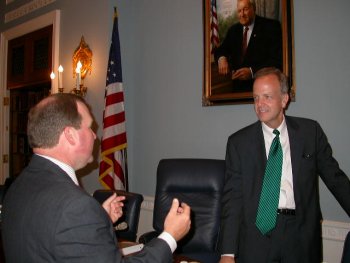
CFTC Chairman Newsome and Chairman Moran, Subcommittee on General Farm Commodities and Risk Management

Chairman Newsome speaks with
Subcommittee Chairman Moran before testifying

Thank you, Chairman Moran, and members of the Subcommittee. I appreciate your giving me the opportunity to testify on behalf of myself and my fellow Commissioners at the Commodity Futures Trading Commission: Commissioner Barbara Holum, who has served impressively at the Commission, taking on numerous responsibilities such as chairing our Global Markets Advisory Committee; Commissioner Walt Lukken, who brought to the Commission a wealth of experience gained on Capitol Hill, including active involvement in the development of the Commodity Futures Modernization Act of 2000 (the “CFMA”); and Commissioner Sharon Brown-Hruska, who brings the valuable skills of a Ph.D. economist to the Commission. The commodity futures and options markets play a critically important role in the U.S. economy. Today, I would like to describe the CFTC’s role in overseeing those markets and how both the markets and our oversight have developed in the two-and-a-half years since passage of the CFMA.

Background:

As you know, the Commission was created by Congress in 1974 to oversee the nation’s commodity futures and options markets. The Commission’s mission is twofold: to foster transparent, competitive, and financially sound commodity futures markets that operate free from manipulation or distortion, and to protect users of those markets from fraud and other abusive practices. There are important differences between the futures markets and the stock markets. While the stock markets provide a means of capital formation, a way for new and existing businesses to raise funds, the futures markets provide producers, distributors, and users of commodities throughout the economy with the means to manage their exposures to price risk.

Historically, commodity futures were traded primarily on agricultural products. These contracts gave farmers, ranchers, distributors, and users of everything from corn to cattle an efficient and effective set of tools to handle the price volatility often experienced in agricultural markets. Indeed, risk management efforts were seen as so successful in the agricultural sector that this model was eventually adapted for use in other sectors of the economy when, more than two decades ago, contracts were introduced to manage volatility in interest rates, stock market indices, and foreign currency exchange rates. Subsequently, new contracts were developed to provide risk management tools to producers, distributors, and users of energy and metal commodities.

These non-agricultural contracts, following the tradition of success seen in the agricultural futures markets, enjoyed rapid growth as their benefits were quickly recognized by a wide variety of market participants. And while the agricultural contracts continue to enjoy volume growth and are traded as actively today as ever before, the financial contracts based on interest rates, foreign currencies, and stock market indices have actually outgrown them in trading volume because they are useful to market participants in so many sectors of the economy. Because they have come to serve the risk management needs of businesses in virtually every sector of the economy over the last two decades, the volume of trading in the financial contracts is now almost nine times that in agricultural contracts. While farmers and ranchers continue to use futures contracts to effectively lock in the prices for their crops and livestock months before they come to market, manufacturers now can also use foreign currency contracts to reduce uncertainty over the prices they receive for finished products sold overseas. Mutual fund managers can use stock index contracts to protect against market volatility and effectively put a floor on portfolio losses. And corporations in every sector can use contracts on U.S. Treasury instruments to manage their exposure to interest rate volatility.

Although I have described the primary purpose of futures markets as mechanisms for risk management, it should be noted that many futures markets play another important role in the economy, that of price discovery. That is, businesses and investors that may not be direct participants in a particular futures market may nonetheless refer to the quoted prices of certain futures market transactions as reference points or benchmarks for other types of transactions and decisions. This is particularly important in many agricultural markets where no other means of price discovery exist outside of the quoted futures prices but it is also true in other sectors, including many energy markets.

How the CFTC Performs Its Mission:

In seeking to fulfill its mission, the Commission has traditionally focused on issues of integrity. We seek to protect the economic integrity of the futures markets so that they may operate efficiently, free from distortions or price manipulations. We seek to protect the financial integrity of the futures markets so that the insolvency of a single market participant does not become a systemic problem affecting other market participants or financial institutions. We seek to protect the operational integrity of the futures markets so that transactions are executed fairly, so that proper disclosures are made to existing and prospective customers, and so that fraudulent sales practices are not tolerated.

Economic Integrity

The Commission pursues these goals through a multi-pronged approach to market oversight. We seek to protect the economic integrity of the markets against attempts at distortion and manipulation through direct market surveillance and through oversight of the surveillance efforts of the exchanges themselves. The heart of the Commission’s direct market surveillance is a large-trader reporting system, under which clearing members of exchanges, commodity brokers (called “futures commission merchants” or “FCMs”), and foreign brokers electronically file daily reports with the Commission. These reports contain the futures and option positions of traders that hold positions above specific reporting levels set by CFTC regulations. Because a trader may carry futures positions through more than one FCM and because a customer may control more than one account, the Commission routinely collects information that enables its surveillance staff to aggregate information across FCMs and for related accounts.

Using these reports, the Commission’s surveillance staff closely monitors the futures and options market activity of all traders whose positions are large enough to potentially impact the orderly operation of a market. For contracts that settle through physical delivery, such as those in the agricultural futures complex, staff carefully analyze the potential adequacy of deliverable supplies. In addition, staff monitor futures and cash markets for unusual price relationships among contracts that can provide early indications of a potential problem.

The Commissioners and senior staff are kept apprised of significant market events and potential problems at weekly market surveillance meetings, and on a more frequent basis when needed. (For example, market surveillance staff have continuously monitored conditions in the cattle markets since the recent reports of the Canadian BSE diagnosis, just as they did last year with respect to the rumors of foot-and-mouth disease, which led to a Commission report on the event.) At the weekly market surveillance meetings, surveillance staff brief the Commission on broad economic and financial developments and on specific market developments in futures and options markets of particular concern. If indications of attempted manipulation are found, the Enforcement Division investigates and prosecutes alleged violations of the Commodity Exchange Act (the “Act” or “CEA”) or the Commission’s regulations. Subject to such actions are all individuals that are (or should be) registered with the Commission, those who engage in trading on any domestic exchange, and those who improperly market commodity futures or option contracts. The Commission has available to it a variety of administrative sanctions against wrongdoers, including revocation or suspension of registration, prohibitions on futures trading, cease and desist orders, civil monetary penalties, and restitution orders. The Commission may seek federal court injunctions, restraining orders, asset freezes, receiver appointments, and disgorgement orders. If evidence of criminal activity is found, matters may be referred to state authorities or the Justice Department for prosecution of violations of the Commodity Exchange Act (the “CEA”) and of state and federal criminal statutes, such as mail fraud, wire fraud, and conspiracy.

Over the years, the Commission has brought numerous enforcement actions and imposed sanctions against firms and individual traders for attempting to manipulate or distort market prices, including the well-publicized cases against those who attempted to manipulate prices in the copper and silver markets some years ago. More recently, the most prominent cases have involved problems in certain energy markets. Last year, we ordered a $5 million civil monetary penalty against two energy companies for false reporting and attempted manipulation. In March, we filed a three-count complaint against a major energy trading company charging manipulation of natural gas prices, operation of an unregistered futures exchange, and the offering of off-exchange agricultural futures. Also in March, the Commission finalized a consent order under which another energy company was penalized $20 million for the reporting of false information to certain energy price reporting indices.

Our Enforcement Division is engaged in other investigations in the energy sector, which may result in further charges being filed. However, I want to make clear that when the Commission brings charges against an entity with regard to illegal futures contracts, as in our Enron case, we approach the issues of whether the CEA applies to, and whether we have jurisdiction over, any particular transaction solely on the basis of the economic substance of the transaction. Thus, where we have brought charges alleging operation of an unregistered futures exchange that involved the trading of contracts that may have been labeled or referred to as, quote, “swaps,” it is because the economic substance of those transactions was that of a futures contract. Let me assure you, Mr. Chairman, that we are not seeking to expand the scope of our jurisdiction over other transactions, such as the true swaps and forwards that Congress has determined -- appropriately so, in my opinion -- to exclude under the CEA. In the case of over-the-counter (“OTC”) swaps, for example, such an exclusion was expressly provided by the CFMA following recommendations from the President’s Working Group on Financial Markets, and I believe that this brought much-needed legal certainty for counterparties in this important sector of the risk management market.

I wanted to emphasize that point because the Commission believes that legal certainty and regulatory clarity are critically important for the efficient and reliable operation of markets generally, but perhaps particularly important for many derivatives markets. If the enforceability of contracts is in doubt among counterparties or if regulations or regulatory enforcement policies are unclear, then rational market participants must factor that uncertainty into their decisions and this, in turn, can result in unnecessary added costs, missed opportunities, inefficient results, and misallocated resources. The CFMA provided much-needed legal certainty in a variety of areas, including the OTC markets. The importance of OTC risk management markets should not be overlooked nor should the fact that effective control mechanisms already at work within those markets themselves have made defaults and other problems there very rare.

The Commission’s aggressive enforcement actions in the energy sector reflect an approach to market oversight that emphasizes, as the proper deterrent to wrongdoing, tough enforcement actions against those who would try to operate outside the established rules. Simply issuing more numerous or more prescriptive regulations that could adversely affect legitimate activities is not the correct, or even an effective, deterrent. The established rules should lay out a basic legal framework without being overly prescriptive or unnecessarily burdensome and they should permit sufficient flexibility for market participants to innovate and compete in legitimate business endeavors, a process that can bring to the marketplace greater liquidity, more useful risk management tools, more efficient pricing, and enhanced customer service. But once established, the rules must be enforced, and enforced firmly.

The Commission has been successful in its recent enforcement efforts. For example, one of the many helpful clarifications provided by Congress through the CFMA was legal certainty for the Commission in the area of retail foreign exchange fraud. Our Enforcement Division has risen to the challenge and in just over two years has conducted numerous investigations and initiated almost three dozen formal actions, making a big dent in this type of abuse against futures market participants, particularly individuals.

Financial Integrity

In protecting the financial integrity of the futures markets, the Commission’s two main priorities are to avoid disruptions to the system for clearing and settling contractual obligations and to protect the funds that customers entrust to FCMs. Clearinghouses and FCMs are the backbone of the exchange system: together, they protect against the financial difficulties of one trader from becoming a systemic problem for other traders or the market as a whole. The Commission works with the exchanges and the National Futures Association (the “NFA”) to closely monitor the financial condition of FCMs. The Commission, the exchanges, and the NFA receive various monthly, quarterly, and annual financial reports from FCMs. The exchanges and the NFA also conduct annual audits and daily financial surveillance of their respective member FCMs. Part of this financial surveillance involves looking at each FCM’s exposure to potential losses from large customer positions that it may be carrying. One of the ways in which such positions are tracked is through the large trader reporting system. As an oversight regulator, the Commission primarily reviews the audit and financial surveillance work of the exchanges and the NFA but it also monitors the health of FCMs directly, as necessary and appropriate. The Commission also reviews clearinghouse procedures for monitoring risks, ensuring the adequacy of margin and capital requirements, and protecting customer funds.

As with attempts at manipulation, the Commission’s Enforcement Division investigates and prosecutes FCMs that are alleged to have violated financial and capitalization requirements or to have committed other supervisory or compliance failures in connection with the handling of customer business. Such cases can result in substantial remedial changes in the supervisory structures and systems of FCMs and can influence the way particular firms conduct business. This is an important part of the responsibility of the Commission to ensure that sound practices are followed by FCMs.

Operational Integrity

Protecting the operational integrity of the futures markets is also accomplished through various efforts by Commission staff. Commission rules provide for appropriate disclosure and customer account reporting, as well as fair sales and trading practices by registrants. The Commission also seeks to encourage appropriate sales practices by screening the fitness of industry professionals and by requiring proper supervision of such persons, and ensuring that adequate proficiency testing and continuing education take place. Extensive recordkeeping of all futures transactions is also required. To ensure compliance with these various requirements, the Commission directly monitors compliance but also supervises the work of exchanges and the NFA in enforcing the relevant requirements.

Just as with the Commission’s efforts to protect the economic and financial integrity of the futures markets, the Division of Enforcement also plays an important role in deterring behavior that could compromise the operational integrity of the markets. Enforcement investigates a variety of trade and sales practice abuses that affect customers. For example, the Commission brings actions alleging unlawful trade allocations, trading ahead of customer orders, misappropriating customer trades, and certain non-competitive trading. The Commission also takes actions against unscrupulous commodity professionals who engage in a wide variety of fraudulent sales practices against the public.

In addition to our individual efforts, the CFTC also works cooperatively with other financial regulators. As Chairman of the CFTC, I sit on the President’s Corporate Fraud Task Force. I am also a member of the President’s Working Group on Financial Markets with Secretary Snow, Chairman Greenspan, and Chairman Donaldson. My experience has been that the coordinated approach has many advantages, especially in markets that cross regulatory jurisdictions and with respect to issues that can affect multiple markets in the financial system.

Changes at the CFTC since the CFMA:

After passage of the CFMA, we reorganized and modernized the structure of the CFTC to make the most effective use of our resources in overseeing these important and dynamic markets. Our Division of Market Oversight, which includes primarily economists, conducts ongoing market surveillance and other key functions, including reviews of contracts and exchange rules. Our other major regulatory unit is the Division of Clearing and Intermediary Oversight, which includes auditors and other staff who monitor the financial and operational integrity of the clearinghouses and their clearing members to ensure that customer funds are protected and that safeguards are in place to prevent individualized financial problems from being transmitted through the system. This division also is responsible for the registration of FCMs, pools operators, and trading advisors. Supplementing the expertise of these two divisions is our Chief Economist’s Office, which provides key analysis to the other divisions and to the Commission, as well as our Office of General Counsel, which provides legal expertise to the Commission and handles such matters as our appellate cases. As noted above, a very effective Division of Enforcement investigates and brings cases against those who attempt to defraud customers, distort or manipulate prices, or otherwise violate the CEA and the Commission’s rules.

The Commission is looking at how we approach all of our oversight responsibilities with an eye toward making changes wherever we can increase our effectiveness and make better use of taxpayer resources, including such things as risk-based audits and developing, pursuant to Congressional direction through the CFMA, an oversight framework for futures clearinghouses. With the audits, the move from a strictly compliance-based approach to a risk-based approach can better focus the resources of both the Commission and the self-regulatory organizations for maximum effectiveness. We recently initiated the first such examinations and the process appears to be on the right track.

Passage of the CFMA two-and-a-half years ago initiated a period of intense effort at the Commission. Our first task, guided by schedules established within the legislation, was to modernize the rules affecting trading facilities, both traditional and the new electronic commercial markets now permitted by the CFMA. Despite the unexpected challenges the industry and the Commission faced following the September 11th attacks, those rule modernizations have been successfully accomplished. Working with the Securities and Exchange Commission (the “SEC”), the CFTC was also able to put into place the rules and other mechanisms to allow the launch of trading in domestic security futures.

Now the Commission is well underway with efforts to modernize the rules affecting clearinghouses, futures commission merchants, pooled investment managers, and other intermediaries in the futures markets. Through hearings, studies, and roundtables, the Commission has, as directed by Congress, undertaken a concerted examination of the rules currently imposed on intermediaries and we have identified a number of areas where key improvements can be made. These range from providing financial institutions that are primarily overseen by another regulator (such as banks, insurance companies, and mutual funds) with an opportunity to use the risk management tools offered in the futures markets without subjecting themselves to unnecessary duplicative regulation, to providing appropriate registration relief to pooled investment vehicles that restrict participation to sufficiently well sophisticated persons, to affording FCMs with greater operational flexibility so that they can provide their customers with more efficient trade executions. We have proposed a great number of rule modernizations in the Federal Register, received largely supportive and always insightful comments on these proposals, and implemented final rules in a number of areas. We are also well underway with efforts to design an effective oversight framework for clearinghouses which, as discussed below, occupy a new place in the regulatory landscape since passage of the CFMA.

Changes in the Marketplace since the CFMA:

The CFMA opened the door for great change in the markets as well as at the CFTC. The U.S. commodity futures and options markets continue to grow rapidly. Total volume rose by more than 33% from 2000 to 2001, and again by more than a third from 2001 to 2002, as increasing numbers of companies and investors avail themselves of the risk management tools offered by these markets. Financial contracts represent the largest portion of the market and continue to grow in volume. Of the ten most widely traded contracts, which together represent more than 80% of U.S. futures volume, seven are financial contracts (based on Eurodollars, Treasury instruments, the S&P 500, and the Nasdaq 100). The other three top-ten contracts are crude oil, natural gas, and corn. (Soybeans are close behind corn in the eleventh spot.) While the traditional U.S. futures exchanges are enjoying record volumes, not all the growth is taking place there. Newly designated contract markets (“DCMs”) that have been approved by the Commission since passage of the CFMA are achieving significant trading volumes with new products and platforms.

Security Futures

Perhaps one of the most visible categories of new products is, of course, the security futures category. Futures based on individual stocks or on narrow stock indices were prohibited from trading for almost twenty years prior to the CFMA. Three brand new exchanges have been created to host trading in these new contracts, offering equity investors and portfolio managers of all kinds access to useful new risk management tools. Security futures are treated as both futures and securities under the CFMA and, accordingly, both the CFTC and the SEC share oversight responsibility for their trading under a primary regulator and notice regulator regime intended to avoid duplicative or overly burdensome requirements on market participants. Some work still remains to be done, but we are optimistic that the two agencies can continue to cooperate to fully accomplish the purposes of the CFMA in this area.

I have been asked for my views on the growth thus far in trading of security futures. Prior to last year’s launch, I refrained from making forecasts of how popular these products would be because I felt that it was my role as a regulator to make sure that success would not be decided by regulators but by market participants in a marketplace made as free as possible from unnecessary, duplicative, or unduly restrictive regulations. Having said that, I would point out that other products in our markets have faced some initial skepticism and yet turned out to be quite successful. While I recognize that it may not be exactly an apples-to-apples comparison, I would note, for example, that average monthly volumes in the security futures offered thus far on Microsoft common stock have exceeded the volumes in the now hugely successful Treasury bond, Eurodollar, and crude oil contracts during corresponding periods after their introduction.

Other Changes

Strong trading growth and security futures are not the only changes that have been occurring recently. Other key trends in the futures markets include the continued migration of trading activity from open-outcry trading on the exchange floors to all-electronic trading from widely dispersed geographic locations, the transition from purely member-owned exchanges to publicly-held trading facilities, continued globalization of all financial markets, and, of particular note since passage of the CFMA, the decoupling of the trading activities hosted by exchanges from the clearance and settlement functions performed by clearinghouses. The CFMA made express provision for this last transformation and we are already starting to see activity in this area, with recent press announcements of new relationships among exchanges and clearinghouses that would have been hard to imagine only several years ago.

In fact, while the Commission has designated four new contract markets since passage of the CFMA, it is has accepted the registration of five additional derivatives clearing organizations, several of which were existing clearinghouses serving other financial market sectors outside of futures but several of which are new organizations not previously affiliated with any particular trading facility. The Commission has received expressions of interest or applications from numerous other trading facilities and clearing organizations and foresees that its oversight responsibilities in both areas will only increase as time goes on.

Not only does the Commission foresee more work ahead as volumes increase and as market participants are presented with greater choice in risk management products and trading platforms, and as clearing and settlement functions evolve, but the work is changing in ways that present new and exciting challenges for the Commissioners and the staff. Under the CFMA’s principles-based approach, which we have commended the Congress for adopting to replace an outdated regime of prescriptive and often obsolete regulations, the Commission works with exchanges, clearinghouses, and others who now have the flexibility to satisfy the fundamental objectives of the CEA in alternative ways, some traditional but some very new and unique. Gone is the era of cookie-cutter applications and Commission approvals that dictate the same approach for every institution. While I believe the new era will be one in which market users benefit greatly from innovative uses of technology, better customer service, greater liquidity, and more efficient transactions, I also believe that the Commission and its staff will have to work harder than ever to fulfill its important public mission.

Conclusion:

I am excited by the remarkable changes we have seen in just the short time since enactment of the Commodity Futures Modernization Act. I firmly believe that it was the right legislation to pass at the right time and that its principles-based approach has already proven to be a workable and effective means of overseeing markets that play a crucial role in the U.S. economy. The Commission stands ready to work with this Subcommittee, the Congress, other regulators, and market participants to ensure that our regulatory structure keeps up with developments in the marketplace and continues to make good sense. Thank you for the invitation to appear before your Subcommittee. I will be happy to answer any questions you may have.

Address by Chairman James E. Newsome before the Futures Industry Association/Futures Option Association, International Derivatives Conference

Address by Chairman James E. Newsome before the Futures Industry Association/Futures Option Association, International Derivatives Conference

June 10, 2003


CFTC Chairman James E. Newsome         Thank you, John. And thanks to Roy Leighton and Anthony Belchambers, as well. It is an honor to be with you again today. There are several issues I’d like to discuss this morning that I believe will be of interest to you. As the Commission continues to implement the Commodity Futures Modernization Act, we have initiated a number of rule modernizations and other efforts that will affect futures commission merchants. On the managed futures side, we have also undertaken some significant rule modernizations that will affect commodity pool operators and commodity trading advisors, as well as other pooled investment vehicles and institutional investors with an interest in the futures markets. With regards to derivatives markets generally, there are some things going on at the CFTC that I want to mention. For those who know me, you know that I believe strongly in my regulatory philosophy. It is this philosophy that guides how I hope to address the issues that come before the Commission, including those I will discuss this morning.

This philosophy led me to become an early and strong supporter of the CFMA and its three key objectives: modernizing rules affecting trading platforms and market intermediaries, providing legal certainty for over-the-counter derivatives, and permitting futures based on single stocks or narrow-based indices. As we have pursued implementation of those objectives, my relatively straightforward philosophy has guided our efforts: for the legitimate business activities of those who through innovation and vigorous competition bring to the marketplace greater liquidity, more useful risk management tools, and more efficient pricing, I want to provide the most flexible and responsive oversight structure possible.

But, for those who would threaten the integrity of these important markets through attempts at fraud or manipulation, I believe in promptly and aggressively exercising our enforcement authority. In my opinion, the proper deterrent to wrongdoing should not be more prescriptive regulations that can unduly burden legitimate business activity but, rather, tough enforcement actions against those who would try to operate outside the established rules. Those rules should lay out a basic legal framework and they should permit sufficient flexibility for market participants to innovate and compete in legitimate business endeavors. But once established, the rules must be enforced, and enforced firmly.

That is why, at the same time that our Divisions of Market Oversight and Clearing and Intermediary Oversight have been hard at work on numerous rule modernizations, our Division of Enforcement has been aggressively conducting investigations and initiating cases. For example, one of the many areas in which the CFMA provided legal clarity was with respect to our authority to go after unscrupulous people who engage in various forms of fraud and abusive sales practices against small investors, especially individuals, in the off-exchange foreign currency area. A particular court decision in the United States had created some uncertainty about our jurisdiction and a legislative remedy was needed. After Congress provided that clarification, our Enforcement teams reactivated in this area and in barely two years have conducted numerous investigations and initiated almost three dozen formal actions, making a huge dent in this type of abuse. This is the kind of effort I am certain that legitimate market participants appreciate because they want and need a marketplace free from fraud and manipulation just as much as we.

The Enforcement Division has also been active in the energy trading area. Many of you are familiar with the multi-million dollar civil monetary penalties and other sanctions we have imposed within the last six months or so. We remain actively engaged in other energy sector investigations, which may result in further charges being filed, but let me take a moment here to provide some perspective on our energy cases. We continue to conduct these complex and resource-intensive investigations and to bring the necessary cases as quickly as we possible so that, in addition to identifying the wrongdoers, we can also exonerate those not involved and allow these important risk management markets to work toward restoring the confidence of market participants and the public.

Also, I want there to be no confusion over our intentions when we bring charges against an entity with regard to illegal futures contracts. We approach the issues of whether the Commodity Exchange Act applies to, and whether we have jurisdiction over, any particular transaction on the basis of the economic substance of the transaction. Thus, where we have brought charges alleging operation of an unregistered futures exchange that involved the trading of contracts that may have been labeled or referred to as, quote, “swaps,” it is because the economic substance of those transactions was that of a futures contract. Let me assure you that we are not seeking to expand the scope of our jurisdiction over other transactions, such as the true swaps and forwards that the Congress has determined -- appropriately so, in my opinion -- to exclude under the Commodity Exchange Act.

I wanted to provide that perspective because I believe that legal certainty and regulatory clarity are critically important for the efficient and reliable operation of markets generally, but particularly important for many derivatives markets. If the enforceability of contracts is in doubt among counterparties or if laws, regulations, or even a regulator’s enforcement stance are unclear, then rational market participants must factor that uncertainty into their decisions and this, in turn, can result in unnecessary added costs, missed opportunities, inefficient results, and misallocated resources.

Therefore, the three principles that I believe should guide our efforts as we face the many new issues that arise in these dynamic markets are: regulatory flexibility, tough enforcement, and legal certainty. I’d like to take a moment to share with you a few of the CFTC’s current efforts and mention some issues on which our attention is focused. The public comment period that is an important part of our rulemaking process recently closed on a number of proposed changes to modernize our oversight in the managed futures area and provide increased operational flexibility for FCMs. My fellow commissioners and I are always grateful for the time and attention that market participants devote to providing us with invaluable feedback and suggestions when we solicit public comment on pending matters. As we hoped and expected, we received a number of thoughtful comments, some from people and organizations represented here today.

The proposals would provide operational flexibility for commodity pool operators, through such changes as reducing duplicative reporting requirements and permitting electronic distribution of statements. For pools that limit participation to sophisticated persons, the CFTC has for some time provided a more flexible set of requirements but we recently proposed a new exemption from registration for those that limit participation to certain highly sophisticated persons and those that restrict futures activity to certain de minimus levels. I am hopeful that, in addition to easing the regulatory burden on entities that currently use the futures markets, the final rules in this area may increase interest in the futures market by entities that have not used them before, which can ultimately benefit all market participants with greater market liquidity. We also proposed modernizing the exemption for certain otherwise-regulated entities -- such as banks, mutual funds, and insurance companies -- that wish to use the futures markets. These changes should benefit not only traditional futures contracts, but also our new security futures market by broadening the scope of potential users. The numerous comments we received were overwhelmingly in favor of both proposals and also contained helpful technical suggestions that our staff are reviewing. It is my hope that we will be able to finalize our rule modernizations in this area very soon.

Last year, the Commission held very productive public discussions on the need for rule changes for other intermediaries, including FCMs. Accordingly, our recent rule proposals also included things that I believe are responsive to those needs. A good example is what we proposed to simplify the bunched order process and clarify respective responsibilities so that this mechanism’s promise of better executions and better pricing will be more accessible and greater numbers of customers can benefit. The comments we received were overwhelmingly in favor of the proposal and I am happy to report that the Commission approved final rules in this area last week. We are currently at work examining other areas of potential rule modernization for FCMs, including further refinements to the rules governing the investment of customer funds and moving forward with margin-based or risk-based capital requirements.

But rule modernizations are not the only changes we are making. We are also well underway with various other efforts, including moving toward a risk-based approach to conducting audits and developing an appropriate oversight framework for futures clearinghouses. I believe that moving from a strictly compliance-based approach to a risk-based approach can better focus the resources of the Commission and the self-regulatory organizations for maximum effectiveness. We recently initiated the first such examinations and while the process still needs work, it appears to be on the right track.

The CFMA anticipated a decoupling of trading activities hosted by exchanges from clearance and settlement functions performed by clearinghouses and made express provision for such a transformation. We have developed a plan for an oversight framework that is appropriate for an environment in which the traditional one-to-one exchange and clearinghouse relationship is not necessarily the only structure in the marketplace. In fact, CFTC staff will be meeting with clearinghouses in New York later this week and in Chicago next week to discuss specifics. This is a timely issue because of recent press announcements of new relationships among exchanges and clearinghouses that would have been hard to imagine only several years ago.

Let me now take a moment to update you on our latest efforts to fully implement the CFMA’s provisions regarding security futures. As you know, the CFTC worked hard along with the SEC to adopt the rules that allowed security futures to begin trading on a domestic basis last year. But the Act also directed the two agencies to jointly develop rules to give foreign access. To date, we have not been able to reach agreement on the rules necessary to allow this activity. This may be due in part to the fact that the two agencies have developed very different oversight frameworks and philosophies to suit the different markets for which each has responsibility. As you well know, there are fundamental differences in both the economics and the public policy concerns of the equity capital markets and the risk management markets.

The CFTC has successfully tackled the foreign access issue on the futures side by allowing U.S. customers access to foreign terminals as long as they are overseen by a comparable foreign regulator. Our own experience at the CFTC with foreign access has been a positive one, which I believe is a testament to the wisdom of giving investors choices and to the robustness that results from allowing competition to flourish in these markets. While this is an issue that has perhaps far broader implications for the SEC, I am confident that under Chairman Donaldson’s leadership, we will make positive strides in this area. A resolution to this important issue is necessary so that our two agencies can comply fully with the Congressional intent of allowing U.S. market users to engage in global risk management activities. Toward that end, I asked Commissioner Walt Lukken to take a lead role for the CFTC in working with the SEC to finalize a full implementation of the CFMA. Commissioner Lukken has met with SEC Commissioner Paul Atkins over the past several weeks to discuss such matters, and I am looking forward to those efforts bearing fruit in the near future. My confidence is bolstered by the success of the two agencies last week in finalizing a draft agreement on the coordination of the oversight responsibilities of the primary and notice regulators regarding exchanges and firms handling domestic security futures. As you know, the Congress expressly directed through the CFMA that market participants not be subjected to duplicative or redundant oversight due to the Act’s treatment of security futures as both securities and futures and this clarification will help to avoid that problem.

My desire to pursue ongoing improvement in our approach to oversight is based in part on my recognition that the Commission faces a continuing increase in its workload as trading volumes increase, as market participants are presented with ever greater choices in risk management products and trading platforms, and as clearing and settlement functions evolve. Not only is there more work ahead, but the work is changing in ways that present new and exciting challenges for the Commissioners and the staff. In fact, while the Commission has designated four new contract markets since passage of the CFMA, it has also accepted the registration of five additional derivatives clearing organizations, including the London Clearing House, whom we were happy to welcome. We have also acknowledged four notices from markets of their intent to operate exempt electronic commercial markets. The Commission has received expressions of interest or applications from numerous other trading facilities and clearing organizations and foresees that its oversight responsibilities in both areas will only increase as time goes on.

Because the Congress introduced a principles-based approach to oversight with the CFMA, the Commission now works more closely than ever with the exchanges, clearinghouses, and firms, who now have great flexibility in how they choose to satisfy the fundamental objectives of the Commodity Exchange Act. Some are choosing to pursue very new and unique approaches. Gone, as it should be, is the era of cookie-cutter applications and Commission approvals that dictate the same approach for every institution. While I believe the new era will be one in which market users benefit greatly from innovative uses of technology, better customer service, greater liquidity, and more efficient transactions, I also believe that the Commission and its staff will have to work harder than ever to fulfill its important public mission to foster transparent, competitive, and financially sound markets that operate free from manipulation or distortion, and to protect users of those markets from fraud and other abusive practices.

The Commission could not realistically hope to serve that mission fully if we had not been able to work so productively and cooperatively with the this industry’s self-regulatory organizations and to confidently rely upon each other, something which I believe has been integral to the success of the futures markets. Even as the structure of the industry changes with developments such as demutualization and increasing competition, I am confident that this productive relationship will continue and that the principles of objectivity, confidentiality, and consistency can continue to be adhered to as well as they have always been in this business. In this regard, however, just as I think it’s important for the CFTC to review its own regulatory structure, I also believe it is equally necessary for SROs, in consultation with us, to do the same. This is especially important, given the CFMA’s emphasis on self-regulation and the changing structure of the business. Accordingly, I announced recently that we are beginning a review of the roles, responsibilities, and capabilities of SROs in the context of various market changes. Hopefully, this review should provide all market participants with the reassurance that we, like the exchanges, consider market integrity to be of paramount importance. I have spoken with several in the SRO community about this initiative, who have expressed their unqualified support for the effort.

Let me conclude today by noting the exciting changes that are occurring in the business structure of the futures industry, particularly new relationships and arrangements that have been recently announced or proposed. I believe these developments reflect the strong competitive forces that underlie these markets. I also believe that this is just one more demonstration that the CFMA was the right law at the right time, one which allows exchanges, clearinghouses, and firms to compete more vigorously both domestically and in an increasingly global environment, which helps to remove artificial barriers to competition for all competitors, and, ultimately, which benefits users of the risk management markets. The continuing and strong growth in futures trading across the board certainly seems to confirm that. I see ever more widespread recognition of the benefits of futures-based risk management by businesses and investors that today represent virtually every sector of the economy. True economic competition is a dynamic process, one that produces an ever-changing landscape as new entrants bring new products to market and devise new ways of transacting business while existing competitors respond with innovations of their own. I must point out, however, that I do not equate fair market access with guaranteed market success. It is my goal to ensure a level regulatory playing field so that all competitors, new and existing alike, have the opportunity to compete. But then, the market process must and will sort out the winners and losers. I am confident that it will be the end users, the futures customers, who benefit most by this process.

I see the Commission’s role as one of working closely with all sectors of the industry as they cooperate, ideally through business decisions made among business people, to work out mutually beneficial solutions to the challenges that lie ahead. I am greatly encouraged by efforts to improve capital efficiency such as those being made through the Clearing Link Committee hosted by the FIA which, I understand plans to hold weekly meetings among representatives of the exchanges and the FCMs. My door is always open if I can assist such endeavors and I hope that you will continue to provide us with the insights, wisdom, and suggestions that you have generously shared in the past. Thank you for inviting me here today.

Address by Chairman James E. Newsome before the Global Energy Management Institute University of Houston

Address by Chairman James E. Newsome before the Global Energy Management Institute University of Houston

July 9, 2003

Thank you Mark for that kind introduction. I am pleased to be here this morning to discuss the Commission’s role in overseeing derivatives activity in the energy markets. For those of you who may not be familiar with the Commodity Futures Modernization Act of 2000, I would like to highlight some of the important things that Congress did through the CFMA that relate to energy trading. I will also touch on various issues that have been raised by recent events in the energy sector, and the Commission’s response to those events. First, however, since some of you may not be familiar with Commission itself, I would like to give you a brief overview of our mission and how we operate.

The Commission was established in 1974 as an independent federal regulatory agency to oversee trading in futures contracts, and later to oversee options trading. It is comprised of up to five Commissioners appointed by the President, with the advice and consent of the Senate, and is governed by the Commodity Exchange Act. Typically, there are two Democratic commissioners, two Republicans, and a Chairman who represents the party of the President. As an independent agency, however, I am proud to say that the Commission has operated relatively free of partisanship. We currently have four commissioners on board – Barbara Holum, Walt Lukken, Sharon Brown-Hruska, and myself.

The Commission has two regulatory units. The Division of Market Oversight, which is comprised primarily of economists, conducts ongoing market surveillance to detect and prevent price distortion and manipulation, and also performs other key functions such as processing applications from new exchanges and reviewing new contracts and exchange rules. Our other regulatory unit, the Division of Clearing and Intermediary Oversight, employs auditors and other staff who monitor the financial and operational integrity of the clearinghouses and intermediaries, to ensure that customer funds are protected and that safeguards are in place to prevent the financial problems of a single entity from spreading throughout the system. This division also oversees the registration of futures commission merchants, commodity pool operators, and commodity trading advisors. Supplementing the expertise of these two divisions is our Chief Economist’s Office, which conducts research on important policy issues facing the Commission and provides expert economic analysis to the Commission and the other divisions. Our Division of Enforcement is charged with investigating potential violations of our Act and regulations and with prosecuting wrongdoers in administrative actions before the agency and in federal court proceedings. In addition, as in other agencies, we have an Office of General Counsel, an Office of External Affairs, and an Office of the Executive Director.

In addition to its individual efforts, the Commission works cooperatively with other financial regulators and criminal enforcement authorities. As Chairman of the CFTC, I sit on the President’s Corporate Fraud Taskforce, a group initiated by President Bush to coordinate investigations and enforcement actions among independent agencies, U.S. attorney’s offices, and the Justice Department. I also serve as a member of the President’s Working Group on Financial Markets, with the Secretary of the Treasury and the Chairmen of the Federal Reserve Board and the Securities and Exchange Commission. Over the past year or so, the Commission has also worked closely with the Federal Energy Regulatory Commission to seek solutions to problems in the energy sector.

The Commission’s mission is twofold: to foster competitive and financially sound markets and to protect market users and the public from fraud, manipulation and abusive trading practices. In seeking to fulfill that mission, the Commission focuses on issues of market integrity. We seek to protect the economic integrity of the markets so that they may operate free from manipulation; we seek to protect the financial integrity of the markets so that the insolvency of a single participant does not become a systemic problem affecting other market participants; and we seek to protect the operational integrity of the markets so that transactions are executed fairly and that proper disclosures are made to existing and prospective customers.

While a substantial portion of the Commission’s resources are devoted to the day-to-day oversight of registered exchanges, intermediaries, and derivatives clearing organizations, equally important is the CFTC’s role as a civil enforcement agency. If any indication of fraud or manipulation within our jurisdiction is found, the Commission will investigate and prosecute the parties involved. Our Enforcement Division, which makes up almost half of our staff, typically has over one hundred investigations open at any particular time. Over the years, the Commission has brought a number of actions for manipulations or attempted manipulations of commodity prices. The Sumitomo copper case and the Hunt brothers silver case are well-known examples. A variety of administrative sanctions are available to us, such as bans on futures trading, civil monetary penalties, and restitution orders. The Commission may also seek federal court injunctions, asset freezes, and orders to disgorge ill-gotten gains. If evidence of criminal activity is found, matters can and will be referred to state or federal authorities for prosecution under criminal statutes.

The Commission oversees the on-exchange trading of energy-related futures and option contracts based on products such as crude oil, natural gas, heating oil, propane, gasoline, and coal. Several U.S. exchanges are designated to trade energy products, but the overwhelming majority of on-exchange energy transactions are executed on the New York Mercantile Exchange. And, while the Commission does not directly regulate the OTC energy markets, we do have authority to prosecute fraud and manipulation occurring in those markets.

In 1974, when the Commission was founded, the vast majority of futures trading took place in the agricultural sector. These contracts gave farmers, ranchers, distributors, and end-users of everything from corn to cattle an efficient and effective set of tools to hedge against price volatility. Over the years, as the value of the risk management tools afforded by the futures markets became apparent, trading in financial, metal, and energy futures began, as manufacturers started using futures contracts to plan their raw material costs and to reduce uncertainty over the prices they received for finished products sold overseas. Mutual fund managers can now use stock index futures to protect against market volatility and to effectively put a floor on portfolio losses. And electric power generators can use futures contracts to secure stable pricing for their coal and natural gas needs. Although farmers and ranchers continue to use the futures markets as actively as ever to effectively lock in prices for their crops and livestock months before they come to market, financial contracts based on such things as interest rates, foreign currencies, treasury bonds, and stock market indices, have now far outgrown agricultural contracts in trading volume. Our latest statistics show that currently, approximately five percent of on-exchange derivatives activity is in the agricultural sector, while financial derivatives make up approximately eighty-six percent, and other contracts, such as those on metals and energy products make up about nine percent.

As these new on-exchange markets were developing, privately negotiated risk management arrangements between commercial counterparties became more prevalent off-exchange. Because these off-exchange arrangements contained elements similar to those found in futures contracts, which by law were required to be conducted on regulated exchanges, legal uncertainty arose over their status under the Commodity Exchange Act. The Commission responded to this uncertainty by providing exemptions from the on-exchange requirement for privately negotiated swaps and for certain energy contracts related to commercial delivery systems.

Nevertheless, the issue of legal uncertainty persisted. In 1999, the President’s Working Group on Financial Markets addressed the problem in a report on the OTC markets. The PWG recognized that this “cloud of legal uncertainty” – if not resolved by Congress – could discourage innovation and growth and damage U.S. leadership in these important markets by driving transactions off-shore. The PWG recommended, among other things, that Congress amend the Commodity Exchange Act to specifically exclude from the Commission’s jurisdiction certain types of OTC derivatives activity conducted by sophisticated counterparties, and it advised Congress to retain the exemptions from the Act that the Commission had previously granted, including those related to energy trading. In December 2000, after careful consideration of the issues in numerous public hearings, Congress did so in the CFMA.

The CFMA provided a new, flexible regulatory environment for on-exchange activity, and much-needed legal certainty for off-exchange activity. Marketplaces can now choose to operate under one of several levels of Commission oversight, depending on the products traded, the system in which they are traded, and the sophistication of the market participants. At each level of oversight for registered exchanges, prescriptive rules have been replaced by core principles governing operational integrity. For off-exchange activity, the CFMA established that the requirements of the Commodity Exchange Act do not apply to transactions in non-agricultural commodities when they are individually negotiated between eligible contract participants and are not executed on a trading facility. It also cleared the way for multilateral trading in energy products conducted between eligible commercial entities on electronic trading facilities, provided that that the trading facility complies with, among other things, certain notification requirements. The Commission refers to these trading facilities as exempt commercial markets, and the transactions conducted on them remain subject to the anti-fraud and anti-manipulation sections of our Act. Importantly, the CFMA provides that the failure of an exempt commercial market to properly comply with the requirements for operation cannot affect the legality, validity, or enforceability of the transactions conducted on the facility, or cause a participant on the system to be in violation of the Act. These important clarifications have provided market participants with greater certainty that their risk management agreements will be respected and enforceable, and that they cannot be voided under an argument that the transaction does not comply with the law.

I fully supported the CFMA because I believe in providing the most flexible and responsive regulatory regime possible for the legitimate efforts of market participants who, through innovation and fair competition, bring to the marketplace greater liquidity, more useful risk management tools, a better use of technology, more efficient pricing, and enhanced customer service. For those who choose to ignore the rules, however, or attempt to engage in fraud or manipulation, I can promise prompt investigations and an aggressive exercise of our enforcement authority under the Commodity Exchange Act. The derivatives markets are too important to the countless producers, distributors and end-users that rely upon them to manage their risks, and too important for the growth, stability, and resiliency of the economy as a whole, to tolerate any activity that would threaten their efficiency and reliability, or undermine trust in their integrity.

Some have argued that the flexible regulatory structure provided by the CFMA should be altered in light of recent events in the OTC energy markets, and various legislative proposals to do so have been advanced. While these market events have presented the Commission with a number of challenges, I have yet to see anything that changes my belief that the Commission already possesses the tools it needs to address misconduct occurring within its jurisdiction. In my opinion, the proper deterrent to such misconduct is a vigorous use of our enforcement authority, rather than the imposition of additional, prescriptive, or burdensome regulations that could adversely affect legitimate activity. I have said before that a regulatory structure that replicates the exchange-traded model is not appropriate for principal-to-principal trading between institutional counterparties, and we should approach any changes to the legal certainty in place for these specialized marketplaces with extreme caution. I would also like to point out that I am not alone among the federal financial regulators in believing that the legislative proposals that have been advanced could result in significant, negative unintended consequences for the risk management markets. On June 11th of this year, in response to a letter from Senators Crapo and Miller, the President’s Working Group on Financial Markets reiterated its unanimous view that, as demonstrated by actions taken by the CFTC, the SEC, FERC, and the Justice Department, wrongdoers in the energy markets are within the grasp of federal regulators, and that new legislation at this time would not be justified or advisable.

When the financial condition of Enron rapidly deteriorated a year and a half ago, there was immediate concern over whether the exchange-traded energy markets would suffer excessive price volatility, or reduced liquidity, if Enron’s large exchange-traded positions had to suddenly be unwound. As the Commission carefully monitored the situation and Enron voluntarily closed out its positions, these deep, liquid markets coped well. Prices did not spike and liquidity did not dry up. But, the difficulties of any large market participant will raise concerns about the ability of intermediaries carrying that trader’s positions to successfully manage them if the trader fails to meet margin calls. In the Enron situation, the Commission worked closely with the NYMEX clearinghouse and the affected FCMs to ensure that the winding down of Enron’s positions was accomplished quickly and smoothly. The system of financial controls in place was successful. There were no disruptions to the system of clearance and settlement, and each trader met its obligations.

Although I am keenly aware of the challenges facing users of OTC risk management tools, I would like to note some positive developments in the energy sector. In February of this year, the Commission jointly hosted a conference with FERC to consider possible solutions to credit risk problems. One potential solution discussed was the clearing of OTC energy derivatives by futures clearinghouses, which was made possible by the CFMA. The Commission has been working since early last year on efforts in this area. I also applaud efforts that have made within the industry to adopt new codes of ethics and best practices. There are other indications of movement toward improving systems to better detect wash trades and to establish dedicated compliance functions. I welcome such initiatives and encourage all market participants, especially operators of trading systems, to continue to pursue these and other efforts to restore confidence in the use of risk management mechanisms in the energy sector. I would also like to acknowledge recent efforts made by FERC and the industry to find solutions to the current problems associated with price reporting. I believe that these market initiatives, coupled with the appropriate use of the Commission’s enforcement authority, are critical to restoring confidence in the marketplace.

As most of you know, the Commission has opened a number of investigations relating to misconduct in the OTC energy markets, and has filed several enforcement actions. Two of those cases have been settled and resulted in significant monetary penalties. I am fully committed to resolving our other investigations as expeditiously as possible, so that wrongdoers are appropriately punished, and those that were not involved are exonerated.

In closing, I would like to emphasize that I firmly believe that legal and regulatory certainty is crucial to the effective operation of the derivatives markets. Unclear laws, regulations, or enforcement policies can result in inefficiencies, missed opportunities, and the misallocation of resources by market participants, who must factor such uncertainty into their business decisions. If Commission statements or actions fail to clearly present the Commission’s goals, policies, or positions, we would appreciate hearing from market participants and will carefully consider ways to provide additional clarity. Going forward, the Commission will continue its aggressive efforts in the enforcement area, so that those who operated outside of the law are identified and sanctioned, and just as importantly, so that companies that followed the rules are identified as well. In my opinion, that is not only our responsibility, but also the appropriate role for the CFTC. I encourage those of you in the industry to continue your efforts to reach consensus solutions to the challenges before you today.

Remarks by Chairman James E. Newsome before the National Corn Growers Association, Washington, DC

Remarks by Chairman James E. Newsome before the National Corn Growers Association, Washington, DC

July 15, 2003

Thank you for that kind introduction. It is an honor and a pleasure to be with you this morning. As Chairman of a Federal Financial Regulatory agency with a production agricultural background, it is a treat for me to have the opportunity to address the National Corn Growers Association.

I want to take a few moments this morning to discuss the origin and role of the Commodity Futures Trading Commission – To share some insights regarding the current activities and issues confronting the futures industry and some facts surrounding the Chicago Board of Trade corn futures contract and then finally, what I see as some of the issues on the near horizon for agricultural futures contracts.

The Commodity Exchange Act is over 75 years old and initially was overseen by the Commodity Exchange Authority of the USDA. However, with the growth of non-agricultural futures contracts the Congress decided in 1975 to create an independent agency with exclusive jurisdiction over the trading of futures and options on those futures and thus the CFTC. Today as the agriculture industry has for over 100 years – producers, processors and users of products ranging from metals to energy to financial items such as equity indexes, interest rates and foreign currencies can use futures to discover prices and manage risks. The purpose and goal of the Commission is to maintain market integrity by preventing manipulation and to protect market users from fraud and abusive trade practice.

The Commission consists of 5 Commissioners – all appointed by the President and confirmed by the Senate. There are typically 2 Republicans / 2 Democrats and the Chairman represents the party of the President. However, as an independent agency should, the Commission operates relatively free of partisanship. The Commission has 2 regulatory divisions – The Division of Market Oversight which oversees new exchange contracts and amendments to existing contracts and designations of new exchanges. Additionally the DMO oversees the daily surveillance of markets. The Division of Clearing and Intermediary Oversight oversees the trading firms and clearing houses to maintain financial integrity so that the failure of a single entity does not become systemic or spread to other market participants. As primarily an Enforcement Agency – our largest division – employing almost ½ of our staff is our Enforcement Division. Typically we have over 100 investigations ongoing at any one time – however because of increased energy activity we have been well above that level. Our staff is considered the U.S. governments best at manipulation cases (Hunt Brother’s silver/ Sumitomo copper). It is also an honor for me to represent agricultural and futures industry interest as a member of Presidents Financial Working Group and Corporate Fraud Task Force.

The futures industry is experiencing a period of tremendous growth across most product areas. Volume has increased almost 50 % over the last 2 years and topped 1 billion contracts traded for the first time in history last year. 85% of this volume is traded on the Chicago Mercantile Exchange and the Chicago Board of Trade. Roughly 80% of this volume is traded in the financial arena with approximately 10% in energy and metals and 10% in agricultural products. The S & P 500 Index and the Euro Dollar are the largest contracts traded while the CBOT corn contract is the largest agricultural contract with a volume of 18 million contracts traded in physical year 2002. Corn futures began trading on CBOT in 1859 and is one of the oldest futures contracts, along with CBOT oats and wheat. As you well know, the 2002/03 crop year production was the lowest in 5 years (9 billion bushels). Also, the 2003/04 crop year production is expected to be a record (over 10 billion bushels). Major contract changes were approved by the CFTC in 1998 and implemented in 2000. The changes deleted Toledo point delivery, added Illinois River delivery points and replaced warehouse receipts with shipping certificates as the delivery instrument. The market appears to be performing well since the changes were implemented. There have been no problem liquidations in the corn futures market in recent years. During 2000-01 period, cash –futures price relationships were wider than normal at expiration than in previous years due to large surpluses of corn. From 2002 to present, these cash-futures price relationships have returned to normal due to declining surpluses and an increased daily premium fee payable by shipping certificate holders approved by the CFTC and implemented by the CBOT in November 2001.

Finally, there are numerous issues faces the futures industry and the Commission. Global competition, electronic trading and rule modernizations are issues that face all market participants.

Issues related to agricultural contracts include:

  1. BSE issues and Country of Origin labeling implementation which could lead to major rule amendments to the CME Live Cattle Contract.
  2. Global concerns raised with regard to GMO grains are currently being addressed by the Minneapolis Grain Exchange in their wheat contracts and could continue with discussions by the KCBOT and the CBOT with regard to their grain contracts.
  3. The increasingly important role of futures contracts with regard to price discovery and our responsibility to prevent manipulation of those prices is not lost at the Commission. We are constantly seeking methods to improve market surveillance to your benefit.
  4. Increased production of ethanol and the possible need for a futures contract.

As always, as we address issues affecting your business – we appreciate and solicit your comment. Your comments are heard through your membership on our Agriculture Advisory Committee, the public comment process and through discussions with the NCGA staff.

Thank you for the opportunity to address you this morning.

Statement of CFTC/FERC Chairmen Regarding Energy Market False Reporting & CFTC/FERC Joint Statement Re: Results of Their Analyses of the Feb 2003 Natural Gas Price Spike

Statement of CFTC/FERC Chairmen Regarding Energy Market False Reporting & CFTC/FERC Joint Statement Re: Results of Their Analyses of the Feb 2003 Natural Gas Price Spike

July 23, 2003

Energy markets are vital to the U.S. economy. Well-functioning competitive markets require public confidence in the integrity of those markets and in the reporting of market transaction data.

In response to industry concerns, we wish to make absolutely clear that neither the Commodity Futures Trading Commission nor the Federal Energy Regulatory Commission has or will bring false-reporting cases against energy market participants where the false report is inadvertent or based solely on human error. We issue this joint statement to address the regulatory certainty concerns of market participants and encourage ongoing industry consensus solutions.

We look forward to increased reporting of transaction data by energy market participants as this will promote price discovery and the efficient operation of these markets. We will continue to monitor progress in this important endeavor.

Separately, FERC today is issuing a policy statement on price formation which will create a rebuttable presumption that market participants, by adhering to specified standards, are acting in good faith and will not be subject to investigation or administrative penalties for inadvertent errors.

JOINT STATEMENT OF THE FEDERAL ENERGY REGULATORY COMMISSION AND THE COMMODITY FUTURES TRADING COMMISSION TO ANNOUNCE RESULTS OF THEIR ANALYSES OF THE FEBRUARY 2003 NATURAL GAS PRICE SPIKE

The Federal Energy Regulatory Commission and the Commodity Futures Trading Commission today announced jointly that they had completed their respective investigations of trading behavior during the price spike observed in natural gas prices across the United States in late February 2003.

Neither investigation identified evidence of market manipulation.

FERC’s “Report on the Natural Gas Price Spike of February 2003” found that the sharp price rise across the United States during the week of February 24, 2003 reflected relatively high short-term demand in the eastern and the mid-continental United States along with reduced ability to deliver natural gas from storage characteristic of the then-prevailing low storage inventories. Additional increases in price for specific eastern and mid-continent markets reflected even tighter supply demand balances due to the exhaustion of market-area storage.

In addition, FERC examined records of transactions for that week subpoenaed from brokers – a sample which Staff estimates represents a majority of relevant transactions – and found no evidence of market manipulation. Markets appeared to work effectively throughout the spike, though the Report raises concerns about the “thinness” of some of these markets and the need to improve liquidity by attracting more traders into these markets.

The CFTC’s investigation focused on exchange-traded futures and options trading in natural gas during the week of February 24. Because large trader positions in futures and options are reported on a daily basis to the agency, the CFTC was able to monitor the activities of large traders while comparing the prices of the expiring March natural gas futures contract to a host of other related prices. Because of the high volatility, the agency also increased its level of direct surveillance of the NYMEX floor and looked intensively at the trading patterns of floor brokers and traders. The CFTC also obtained and listened to numerous audiotapes of conversations between clerks on the NYMEX floor and the customers who were using the markets during this week.

The CFTC found nothing in its analysis of large trader positions, prices, floor broker and trader activity, and trading tapes to suggest any manipulative activity in the natural gas futures and options market during the week of February 24, 2003.

The CFTC does not publicly release the information it obtains during its investigations. When it has reason to believe that wrongdoing has occurred, it initiates an enforcement proceeding.

The FERC report is available on its website (www.ferc.gov).

Address by Chairman James E. Newsome before the 24th International SFOA Bürgenstock Conference, The International Forum for Derivative Markets Re: Regulators Meeting, Bürgenstock, Switzerland

Address by Chairman James E. Newsome before the 24th International SFOA Bürgenstock Conference, The International Forum for Derivative Markets Re: Regulators Meeting, Bürgenstock, Switzerland

September 4, 2003

KEEPING PACE WITH CHANGE – THE NEW FRAMEWORK FOR FUTURES
REGULATION AND GLOBAL DEVELOPMENTS

It is an honor and a pleasure to address this group of distinguished derivatives regulators on the occasion of the 24th Annual Meeting and International Forum for Derivative Markets in Bürgenstock.

This conference is coming at a time when the use of markets for risk management has dramatically increased. In 2001, total world-wide contract volume in futures and options increased by 47 percent, and in 2002, by 37 percent. More than one billion futures contracts traded for the first time in history last year. Statistics based on the most recent survey by the Bank for International Settlements cited 140 trillion in notional value for derivatives. This growth reflects various trends:

  • the growth in the use of narrow-based indexes and single stock futures, in which volume more than doubled last year;
  • increased interest in small equity retail products, such as the E-mini;
  • the emergence of new markets in the Latin American region, where the cash and the futures markets were developed together, such as MEXDER;
  • the growth of products reflecting a European regional view, such as the Dow Jones Euro STOXX 50;
  • the clearing of OTC products by derivatives clearing houses, such as LCH and BM&F;
  • changes in the way treasuries and other interest rate products are traded; and
  • the growth in the number of special purpose exchanges.

One core reason for growth may be an increased appreciation of the special cost efficiencies and credit enhancement typical of exchange markets. As risk management decisions move from the trading desk to the boardroom, and as risk management methodologies are better understood, one can expect their use to expand, especially in times of price volatility, and that is exactly what is happening. It is very appropriate that much of the main meeting focuses on what risk management is, and how risk officers can make risk transfer work to reduce volatility and risk for their companies.

I believe that some of the changes in the U.S. market have occurred because Congress and the CFTC moved from a regulatory model that relied on the regulator’s judgment about products, to a flexible, principles-based model that uses the judgment of the marketplace. I similarly believe that competition occurring in U.S. markets is resulting in new entrants, new products, and new ways to assure that the objectives of a fair and efficient marketplace are met. It is my goal to ensure a level regulatory playing field so that all participants, new and existing alike, have the opportunity to compete. The market process must and will sort out the winners and losers. In the end, I am confident that it will be the end users, the futures customers, who will benefit the most from this process, as it is being driven by strong competitive forces that reflect the demands and the needs of market users.

The new regulatory framework in the U.S. is one that squarely places with the market itself the obligation for assuring, in the first instance, that exchange products are economically useful and not readily susceptible to manipulation. At the same time, the law makes the markets accountable by providing the Commission with the regulatory and enforcement clout to oversee whether products meet relevant legal requirements.

For those who, through legitimate business practices, innovation, and vigorous competition, bring to the marketplace greater liquidity, more useful risk management tools, and more efficient pricing, I believe in providing the most flexible and responsive oversight structure possible. Such flexibility must be accompanied, however, by firm enforcement of the rules. Over the past year, we have brought and settled five cases in the energy area, assessing $68 million in penalties for false reporting of prices, among other things, and we are actively pursuing other investigations. Another example of how we have vigorously used our authority to go after illegal, off-exchange and fraudulent activity is in the foreign currency area, where, over the last 32 months we have brought 41 cases, involving over 3,400 customers. The amount of fines, restitution and disgorgement assessed thus far has totaled more than $167 million. These cases have also spawned criminal actions, which have resulted in fourteen indictments.

Today, I would like to share with you some of the issues that are arising as a result of the growth in the marketplace, the new types of products that are emerging, the increased interest in clearing, and how these issues are affecting how we conduct our business as an oversight authority.

Increasing Need for Cooperation

For many years we have talked about the world becoming a global financial market. Although derivatives markets have always had some level of international participation, today we are facing new practical questions flowing from the competition for global business and the fact that technology makes it easy to reach out from anywhere to anywhere to expand a market base. Consider the following:

  • At the CFTC, we are about to consider an application from EUREX, a market initially established in Germany, to be a U.S. designated contract market.
  • We have a market that is established and regulated in the U.K., IPE, which is now 100 percent owned by a U.S. company and uses U.S. based trading facilities.
  • Recently, NASDAQ’s interest in NQLX was purchased by LIFFE. NQLX is established in the U.S., fully owned by a U.K. market, and traded using LIFFE CONNECT, a U.K. trading facility, with post-market surveillance performed by the U.S. NASD, and regulatory oversight performed jointly by the U.S. CFTC and the U.S. SEC.
  • LCH, a U.K. clearing organization, is also a U.S. designated clearing organization for OTC products.
  • NYBOT, a U.S. designated contract market, operates a trading floor in Dublin, where its U.S. denominated financial products – 750,000 exchange contracts in all, last year – are traded under the oversight of the Irish Financial Services Regulatory Authority.

Without even addressing how best to allocate regulatory responsibilities among the various regulatory, supervisory, and oversight authorities involved, these developments clearly put a premium on effective cooperation and coordination among regulators, and among regulators and markets. The CFTC actively supports cooperation, but we realize that allocation of regulatory oversight arrangements can be challenging. That is why we place considerable importance on the relationships that we develop with our international counterparts through participation in forums such as this one.

Recognizing that cooperation should begin at home, the CFTC actively supports the applications of U.S. regulated entities to operate in other jurisdictions in an effort to reduce the potential for duplicative requirements. In just the last few months, we have worked with regulatory authorities in Switzerland, Australia, Portugal, and France, on how to address their interests so that they can rely on our home market supervision.

Also, over the past year, we have been intensively negotiating with the U.S. SEC on how best to organize our joint supervision of security futures products, and have developed a draft agreement for coordination of such oversight. And, because access works in two directions, I am hopeful that these discussions will yield some progress on the treatment of foreign equity futures. In that regard, Commissioner Walt Lukken is taking a lead role in working with SEC Commissioner Paul Atkins to discuss what arrangements may bear fruit to permit U.S. access to a full range of global risk management products.

The CFTC also has been a strong proponent of reducing duplicative or redundant regulation by relying, when possible, on comparable regulatory regimes to permit access to our markets. Our experience with this program has been positive. Today, for example, twelve markets from eight non-U.S. jurisdictions have received CFTC no-action positions to permit direct screen access from the U.S. to their markets, in reliance on the foreign market’s home regulatory regime, subject to access to books and records, submission to U.S. jurisdiction, effective information sharing, and cooperative surveillance arrangements. Of these, as of August, nine were actually operating terminals in the U.S., and two have cooperative clearing arrangements with the Chicago Mercantile Exchange. Under the Commission’s Part 30 rules, 152 brokers from ten jurisdictions are currently permitted to deal directly with U.S. persons on the basis of compliance with their home jurisdictions’ licensing schemes for intermediaries. Additionally, 167 firms originating from fifteen jurisdictions operate in the U.S. under Part 30 exceptions for commodity pool operators, commodity trading advisors, and introducing brokers.

Regulated Clearing Facilities that are Independent of Markets

Other important issues currently confronting the CFTC flow from our new authority to regulate clearing organizations and, in particular, the provisions of the CFMA authorizing the decoupling of execution and clearing. This has occurred at the same time as other changes in market structure and governance have developed. I am certain you are not surprised to hear that there is a spectrum of views on what the appropriate role of the regulator is with respect to clearing oversight and clearing organization structures.

I see the Commission’s role in this restructuring process as identifying areas of regulatory concern – which we are doing through our recently initiated review of self-regulatory organizations, and our development of an oversight program specifically directed to clearing – and as encouraging and working with all sectors of the industry as they cooperate, ideally through business decisions made among business people, to work out mutually beneficial solutions to the challenges that lie ahead. I note that derivatives markets do not function properly if the trading system produces unfair prices or the credit model is deficient and believe, therefore, that the markets also should have the right incentives to design themselves in the public interest.

Updating and Enhancing the Business of Regulation

In addition to addressing the substance of regulation, we are also addressing the mechanics of how our oversight is delivered and how we communicate what we are doing to the general public. We are enhancing the technological tools at our disposal and expanding the range of financial market expertise of our staff.

For example, we are in the process of updating our mission statement and our means of demonstrating our regulatory performance with the use of a consultant who specializes in strategic planning. This process is causing us to think with new precision about just where we want to direct our emphasis in making needed changes to programs and to our infrastructure. In this regard, we will be updating our corporate documents and our recruitment packages, and will develop a video on the CFTC and how it works.

We have also become increasingly aggressive and timely about getting our message on how we enforce the law into the public domain. This includes:

  • proactively briefing our legislative committees on our program;
  • offering press opportunities and sponsoring press conferences on specific issues;
  • publishing complaints and descriptions of them during hours that the media is most likely to pick up the information;
  • providing consumer advisories and warnings;
  • automating the public complaint process;
  • making as effective as possible the use of our website as an information dissemination mechanism; and
  • providing Commission experts to other state and federal authorities where cooperative efforts can improve our overall ability to enforce the law.

Sharing Expertise

As part of the tremendous effort we are making to modernize our oversight program, the CFTC is taking account of the work being done in various other jurisdictions to develop better means of prioritizing regulatory objectives and measuring regulatory performance. In this regard, we have sent high level participants to the U.K. to discuss regulatory planning, observed how the Committee of European Securities Regulators is conducting consultations as it develops means for implementing the European Directives, conferred with the Australians on how they track enforcement cases, and engaged in dialogue with international financial institutions, such as the World Bank and the Inter-American Development Bank on how development experts look at capital markets and risk management. We have welcomed a staff person from the U.K. FSA with experience in risk-based surveillance methodologies to give us training in the philosophy and specifics of applying those techniques, and have seconded a person to the European Central Bank to look at its analysis of clearing issues. Our staff are discussing examination procedures used by the federal banking authorities and we are talking to intermediaries about how they conduct their internal examinations. In addition, in preparation for fundamentally upgrading our in-house exchange database system for overseeing exchange trading activity, market oversight personnel are planning to consult with several non-U.S. regulators and markets to mine their experience in the electronic trading area. All of this practical research is being built into developing oversight that is more completely adapted to the substantial changes in the marketplace and the new flexibility our laws provide for markets to innovate.

This year, at our training seminar, in addition to a full week’s program of topical discussion, case studies, and practical instruction, we are planning one full day of break-out sessions for in depth dialogue on issues of interest to particular regulators. We also will issue an invitation to our in-house staff to take the occasion of the seminar to draw on the expert presenters from around the world for further discussion on issues of interest to us. It is very clear to us that the need for dialogue on how best to perform our responsibilities is a multi-lateral one.

The CFTC believes that one of its important missions is to engage directly with regulators around the world to improve how regulation is performed, to promote broader access to markets, and to reduce unnecessary redundancies and regulatory inconsistencies that can prove costly to market users and intermediaries engaged in international business. We are pleased that this effort, over time, has facilitated our ability to tailor our regulatory program, taking into account the programs of other markets and our favorable experience in cooperating with other authorities to address market abuses. In consequence, we have provided our highest level senior staff to support standard setting efforts at the international level.

I am pleased to be here today, and look forward to a productive meeting.