Statement of Commissioner Dawn D. Stump Regarding Proposed Rules: Swap Data Reporting

Statement of Commissioner Dawn D. Stump Regarding Proposed Rules: Swap Data Reporting

February 20, 2020

I am very pleased to be here today addressing updates to the Commission’s swap data reporting rules (which I will refer to collectively as the “proposal”). I would like to thank the staff of the Division of Market Oversight (DMO) for their efforts over the past several years to advance what I consider foundational to effectuating reforms in the over-the-counter (OTC) swaps market.  I applaud their commitment to adapting these rules, and I am grateful for their attention to incorporating suggestions from my Office. I also would like to thank the Office of the Chief Economist and the Office of General Counsel for their many contributions to ready this rule for consideration today.

At the onset of the financial crisis, the most obvious regulatory predicament for OTC swaps was the lack of information.  The Pittsburgh accords were predicated upon the global regulatory community needing to procure data to inform decision makers about these opaque markets.  I have long believed that lacking information, especially concerning swaps markets, was among the most fundamental issues to be addressed post-crisis.

In 2012, the Commission was the first mover in establishing reporting requirements for swaps markets, and other regulatory bodies followed with their own reporting regimes.  Despite the substantial efforts and costs to implement these rules, the different data elements, formatting, and technical specifications utilized by individual jurisdictions make it extremely difficult to aggregate data across global markets – and thus limit the data’s utility.  The G-20 Leaders’ Statement from the Pittsburgh Summit in 2009 included an expectation that members would “assess regularly implementation and whether it is sufficient to improve transparency in the derivatives markets, mitigate systemic risk, and protect against market abuse.”[1]  Today, the CFTC is heeding that direction.

With the benefit of time and experience, we now are able to better harmonize with other regulators around the world, reasonably refine reporting obligations to a common set of reportable elements, improve the accuracy of regulatory reporting, and reduce the burden placed on end-users.

I would also note that last year, the CFTC published a rule proposal outlining ideas on how to confirm the accuracy of swap data reported to swap data repositories (SDRs).[2]  I think it is prudent to also re-open the comment period for that proposed rulemaking today.  I have always felt that the entire suite of swap data reporting rules must be considered together for the public to be able to comment in an informed manner and help ensure that the CFTC delivers the best regulations possible.[3]

Positive Improvements Proposed Today

DMO staff previously shared what it hoped to accomplish with the Roadmap to Achieve High Quality Swaps Data,[4] and today your work and the Commission’s vote will move us one step closer to achieving the goals laid out a decade ago in Pittsburgh.  The takeaways from today’s Open Meeting might focus on a limited number of policy choices, but I feel it is important to highlight the multitude of positive improvements included within the breadth of changes to these regulations.

For example, previous iterations of swap data reporting rules lacked specificity and did not include clear definitions, allowable values, or form and manner for all reportable data elements.  By more clearly defining what is expected, the proposal also appropriately removes what has become known as the ‘catch-all bucket’ to report “any other term(s) of the swap matched or affirmed by the counterparties in verifying the swap,” including instructions to “use as many fields as required to report each such term.”[5]  This ambiguity created compliance risk for both SDRs and reporting counterparties and led to the proliferation of swap data reporting elements included in the data.  As a result, in some circumstances the menu of options on what and how to report swap data expanded from several hundred to over 1,000 swap data elements.  Today, we present a more tailored and finite list of required swap data elements that have been identified by staff as possessing tangible and repeatable use cases.

The proposal also improves the efficacy of the public swaps reporting by focusing on price forming events and minimizing the dissemination of extraneous information that does not foster price discovery.  The proposal removes the requirement to report the “mirror swap” component of the prime brokerage process that has limited price discovery value.  It also clarifies how and when to report post-priced swaps and risk compression exercises, and highlights these unique transaction types on the public tape.

The proposal reasonably extends the deadline for reporting regulatory data for swaps to T+1 for large, sophisticated reporting counterparties such as swap dealers, and T+2 for smaller, less frequent reporting counterparties such as end-users.  This not only harmonizes with other regulators, but correctly puts the emphasis on swaps data being complete and in the appropriate format instead of focusing on speed.  The proposal further reduces burdens on end-users by removing the requirement for those counterparties to submit valuations of uncleared swaps on a quarterly basis.

Today’s proposal creates a mechanism for achieving better quality swaps data.  It standardizes validations across the different SDRs, empowers SDRs to apply validations and reject swaps, and clarifies that reporting counterparties have the onus to address errors causing any rejection in order to come into compliance.  This represents a robust attempt to ensure that reported swap data is complete, formatted in a standardized and harmonized manner, and accurate.

As envisioned by the original rules, the proposal utilizes current data to re-set block and cap sizes to more appropriately delineate the profiles of various products.  By applying the information we now have at our disposal, it was determined that additional categories for block transactions are necessary such that we might move away from the one-size-fits-all approach currently in place by differentiating between overall trading activity and transaction size of distinct products.   In general, the block size would increase, meaning that fewer transactions are eligible for block treatment.  This attempt to ensure that only the most appropriately sized transactions are publicly disseminated with a greater time delay also warrants consideration as to the suitable length of such delays to allow market participants to effectively transact in large size and hedge their position appropriately.  The Commission and staff have received divergent views on this topic since the inception of swaps data reporting.  The guiding statute requires consideration of “whether the public disclosure will materially reduce market liquidity.”[6]  Frankly, I do not know the right answer.  Today’s proposal represents an opportunity to further comment as the Commission attempts to address this difficult question.

Global Harmonization Efforts

Of particular importance to me is the attention that has been applied to advancing the pragmatic objective of global data harmonization in which regulators can effectively utilize the data for coordinated supervision efforts.  Otherwise, disjointed swap data may serve to hinder, rather than assist, implementation of post-crisis reforms.  International bodies, such as the Committee on Payments and Market Infrastructures (CPMI), the International Organization of Securities Commissions (IOSCO), and the Financial Stability Board (FSB) have achieved considerable progress with the development of technical guidance and standards for various identifiers and Critical Data Elements.[7]  This proposal wholeheartedly attempts to implement the Technical Guidance for Critical Data Elements and align CFTC policies as much as possible and where relevant with other regulators, such as the Securities and Exchange Commission (SEC) and the European Securities and Markets Authority (ESMA).  That being said, I am open to learning of other areas that could benefit from further harmonization while not hindering the agency from performing its regulatory duties.  I hope that our progress might encourage fellow international regulators also striving to implement these standards in a synchronized and expeditious manner.

Next Steps

The next crisis will not be the same as the last, nor will it be resolved any better or faster without harmonized data sets.  I ask market participants to view the proposal in that spirit and please provide constructive input on how we can make a good proposal even better.

Furthermore, the future finalization of these rules is not the last step in swap data reporting, as three other key components remain and require our attention.  First, the Commission, reporting counterparties, and SDRs will need to work together to prepare for an efficient implementation.  Second, attention should turn to the principles-based analysis and eventual granting of substituted compliance determinations with respect to swap data reporting regimes in other jurisdictions.  Third, the sharing of harmonized, high-quality swaps data with other domestic and international regulators to facilitate aggregation and oversight of global swaps markets should progress in earnest.

Thank you again to the staff for their hard work on the complex and technical challenge of swap data reporting.


[1] See Leaders’ Statement from the 2009 G-20 Summit in Pittsburgh, Pa. at 9 (Sept. 24-25, 2009), available at https://www.treasury.gov/resource-center/international/g7-g20/Documents/pittsburgh_summit_leaders_statement_250909.pdf.

[2] Certain Swap Data Repository and Data Reporting Requirements, 84 Fed. Reg. 21044 (proposed May 13, 2019).

[3] Id. at 21120-21 (Statement of Concurrence of Commissioner Dawn D. Stump).

[4] See Roadmap to Achieve High Quality Swaps Data (DMO July 10, 2017), available at https://www.cftc.gov/sites/default/files/idc/groups/public/@newsroom/documents/file/dmo_swapdataplan071017.pdf, published with CFTC Letter 17-33, Division of Market Oversight Announces Review of Swap Reporting Rules in Parts 43, 45, and 49 of Commission Regulations (DMO July 10, 2017), available at https://www.cftc.gov/sites/default/files/idc/groups/public/@lrlettergeneral/documents/letter/17-33.pdf.

[5] 17 CFR Part 45, Appendix 1.

[6] Section 2(a)(13)(E)(iv) of the Commodity Exchange Act, 7 U.S.C. § 2(a)(13)(E)(iv).

[7] See Harmonisation of the Unique Product Identifier – Technical Guidance, CPMI Papers No. 169 (Sept. 28, 2017), available at https://www.bis.org/cpmi/publ/d169.htm; Harmonisation of Critical OTC Derivatives Data Elements (Other than UTI and UPI) – Technical Guidance, CPMI Papers No. 175 (April 9, 2018), available at https://www.bis.org/cpmi/publ/d175.htm; Governance Arrangements for the Unique Transaction Identifier (UTI): Conclusions and Implementation Plan, Financial Stability Board (Dec. 29, 2017), available at https://www.fsb.org/wp-content/uploads/P291217.pdf.


-CFTC-


Statement of Chairman Heath P. Tarbert in Support of Proposed Rules on Swap Data Reporting

Statement of Chairman Heath P. Tarbert in Support of Proposed Rules on Swap Data Reporting

February 20, 2020

Data is the lifeblood of our markets.  Yet for too long, market participants have been burdened with confusing and costly swap data reporting rules that do little to advance the Commission’s regulatory functions.  In the decade-long effort to refine our swap data rules, we have at times lost sight of Sir Isaac Newton’s wisdom: “Truth is ever to be found in simplicity, and not in the multiplicity and confusion of things.”

Overview

Simplicity should be a central goal of our swap data reporting rules.  After all, making rules simple and clear facilitates compliance, price discovery, and risk monitoring.  While principles-based regulation can offer numerous advantages, there are areas where a rules-based approach is preferable because of the level of clarity, standardization, and harmonization it provides.  Swap data reporting is one such area.[1]

As it stands, swap data repositories (SDRs) and market participants have been left to wade through Parts 43 and 45 of our rules on their own.  We have essentially asked them to decide what to report to the CFTC, instead of being clear about what we want.  The result is a proliferation of reportable data fields designed to ensure compliance with our rules—but which exceed what market participants can readily provide and what the agency can realistically use.  These fields can run hundreds deep, imposing costly burdens on market participants.  Yet for all its sprawling complexity, the current data reporting system omits, of all things, uncleared margin information—thereby creating a black box of potential systemic risk.[2]

And that just describes CFTC reporting.  As it stands today, a market participant with a swap reportable to the CFTC might also have to report the same swap to the SEC, the European Securities and Markets Authority (ESMA), and perhaps other regulators as well.  The global nature of our derivatives markets has led to the preparation and submission of multiple swap data reports, creating a byzantine maze of disparate data fields and reporting timetables.  Market participants should not incur the costs and burdens of reporting a grab-bag of dissimilar data for the very same swap.  That approach helps neither the market nor the CFTC: conflicting data reporting requirements make regulatory coordination more difficult, preventing a panoramic view of risk.

Today we take the first step toward changing this.  I am pleased to support the proposed amendments to Parts 43 and 45 of the CFTC’s rules governing swap data reporting.[3]  The proposals simplify the swap data reporting process to ensure that market participants are not burdened with unclear or duplicative reporting obligations that do little to reduce market risk or facilitate price discovery.  If the amendments are adopted, we will no longer collect data that does not advance our oversight of the swaps markets.

In fact, the Part 45 proposal includes a technical specification that identifies 116 standardized data fields that will help replace the many hundreds of fields now in use by SDRs.  We are also proposing to harmonize our swap data reporting requirements with those of the SEC and ESMA.  Harmonization would remove the burdens of duplicative reporting while painting a more complete picture of market risk.  At the same time, the proposed changes to Part 43 would enhance public transparency as well as provide relief for end users who rely on our markets to hedge their risks.  Our swaps markets are integrated and global; it is time for our reporting regime to catch up.

Simplified Reporting

Today’s proposals advance my first strategic goal for our agency: strengthening the resilience and integrity of our derivatives markets while fostering their vibrancy.[4]  Simplified reporting is critical to the CFTC’s ability to monitor systemic risk.  While SDRs now require hundreds of data fields in an effort to comply with Parts 43 and 45 of our rules, uncleared margin has been noticeably absent.  If finalized, Part 45 will require the reporting of uncleared margin data for the first time.  This will significantly expand our visibility into potential systemic risk in the swaps markets.

A related problem we address today involves inconsistent data.  SDRs currently validate swap transaction data in conflicting ways, causing market participants to report disparate data elements to different SDRs.  Today’s proposals include guidance to help SDRs standardize their validation of swap data reports, shoring up the resilience and integrity of our markets.

Simplifying the reporting process will also enhance the regulatory experience for market participants at home and abroad, which is another strategic goal for the agency.[5]  We have heard from those who use our markets that the complexity of our existing reporting rules creates confusion, leading to reporting errors.[6]  This situation neither serves the markets nor advances the agency’s regulatory purpose.  Indeed, data errors can frustrate transparency and price discovery.

Our proposals today reflect a hard look at the data we are requesting and the data we really need.  The proposals provide the guidance needed to collapse hundreds of reportable data fields into a standardized set of 116 that truly advance our regulatory objectives.  If adopted, this would reduce burdens on market participants and provide technical guidance to ensure they are no longer guessing at what we require.  Clear rules are easier to follow, and market participants will no longer be subject to reporting obligations that raise the costs of compliance without improving the resilience and integrity of our derivatives markets. Just as we are reducing requirements where they are not needed, we are also enhancing them where they are.  This is the balanced approach sound regulation demands.

Regulatory Harmonization

Today’s proposals also improve the regulatory experience by harmonizing swap data reporting where it is sensible to do so.[7]  There is no good reason for a swap dealer or other market participant to report hundreds of differing data fields to multiple jurisdictions for the very same swap transaction.  This situation imposes high costs with very little benefit.

While we should not harmonize for the sake of harmonizing,[8] we can reap real efficiencies by carefully building consistent data reporting frameworks.  The proposals would harmonize our swap data reporting timelines with the SEC by moving to a “T+1” system for swap dealers, major swap participants, and derivatives clearing organizations.  We would also remove duplicative confirmation data and lift the requirement that end users provide valuation data.

Harmonization also helps the CFTC realize our vision of being the global standard for sound derivatives regulation.[9]  We have long been a leader in international swap data harmonization efforts, including by co-chairing the Committee on Payments and Infrastructures and the International Organization of Securities Commissioners (CPMI-IOSCO) working group on critical data elements (CDE) in swap reporting.[10]  The purpose of the working group is to standardize CDE fields to facilitate consistent data reporting across borders.  Our proposals today would bring this and related harmonization efforts to fruition by incorporating many of the CDE fields and a limited number of CFTC-specific fields into new Part 45 technical specifications.  Incorporating the CDE fields would sensibly harmonize our reporting system with that of ESMA.  As a result, the proposals would advance the CFTC’s important role in bringing global regulators together to form a better data reporting system.

The proposals also would harmonize swap data reporting in several other important respects.  First, we propose adopting a Unique Transaction Identifier (UTI) requirement in place of the existing Unique Swap Identifier (USI) system, as provided for in the CPMI-IOSCO Technical Guidance.[11]  Adopting a UTI system would provide for consistent monitoring of swaps across borders, improving data sharing and risk surveillance.  The proposals would also remove the requirement that market participants report duplicative creation and confirmation data, and would adopt reporting timetables that are consistent with those of ESMA and other regulators.[12]  These are reasonable efforts that will improve the reporting process, while shoring up the CFTC’s position as a leader on harmonization.

Enhanced Public Transparency

I am also pleased to support our proposals today because they enhance clarity, one of the four core values of our agency.[13]  Streamlining the Part 45 technical specification is intended, in part, to reduce unclear and confusing data reporting fields that do not advance our regulatory objectives.  But clarity demands more: we must also ensure we are providing transparent, high-quality data to the public.[14]

Part 43 embodies our public reporting system for swap data, which provides high-quality information in real time.  Providing transparent, timely swap data to the public is critically important to the price discovery process necessary for our markets to thrive and grow.  Enhanced public transparency also ensures that market participants and end users can make informed trading and hedging decisions. 

The CFTC’s current system for public reporting is considered the global standard.  Even so, it can be improved.  Although post-priced swaps are subject to unique pricing factors that affect the “public tape,”[15] they are nonetheless reported after execution just like any other swap.  It is of little value for the public to see swaps reported without an accurate price, or any price at all.  To remedy this data quality issue and improve price discovery, we are proposing that post-priced swaps now be reported to the public tape after pricing occurs.

The current reporting system for prime broker swaps has led to data that distorts the picture of what is actually happening in the market.  Currently, Part 43 requires that offsetting swaps executed with prime brokers—in addition to the initial swap reflecting the actual terms of the trade between counterparties—be reported on the public tape.  Reporting these duplicative swaps can hinder price discovery by displaying pricing data that includes fees and other costs unrelated to the actual terms of the parties’ swap.  Cluttering the public tape with duplicative swaps is at best unhelpful, and at worst confusing.  To the public, it could appear as though there are twice as many negotiated, arms-length swaps as there actually are.  Today’s proposals would solve this problem by requiring that only the initial “trigger” swaps be publicly reported.

Relief for End Users

Finally, the proposals would help make our derivatives markets work for all Americans, another of the CFTC’s strategic goals.[16]  While swaps are viewed by many Americans as esoteric products, they can nonetheless fulfill an important risk-management function for end users like farmers, ranchers, and manufacturers.  End users often lack the reporting infrastructure of big banks, and may be unable to report data as quickly as swap dealers and financial institutions.  Indeed, demanding that they do so can impair data quality, frustrating our regulatory objectives.

If finalized, today’s proposals will no longer require end users to report swap valuation data.  It would also give them a “T+2” timeframe for reporting the data we do require.  The proposals would therefore remove unnecessary reporting burdens from end users relying on our swaps markets to hedge their risks.  In addition, by providing sufficient time for end users to ensure their reporting is accurate, the proposals would also improve the quality of data we receive.

Conclusion

It is time for the Commission to reform our swap data reporting rules.  Sir Isaac Newton realized long ago that simplicity can often lead to truth.  It does not take an apple striking us on the head to realize that simplifying our swap data reporting rules to achieve clarity, standardization, and harmonization will inevitably make for sounder regulation. 

-CFTC-


[1] See Heath P. Tarbert, Rules for Principles and Principles for Rules: Tools for Crafting Sound Financial Regulation, Harv. Bus. L. Rev. (forthcoming 2020) (“A principles-based regime is often a poor choice where standard forms and disclosures are heavily used, as principles do not offer the needed precision.”).

[2] Requiring margin in the uncleared swaps markets ensures that counterparties have the necessary collateral to offset losses, preventing financial contagion.  With respect to non-cleared, bilateral swaps, in which there is no central clearinghouse, parties bear the risk of counterparty default.  In turn, the CFTC must have visibility into uncleared margin data to monitor systemic risk accurately and to act quickly if cracks begin appear in the system.

[3] We are also re-opening the comment period for Part 49, which relates to SDR registration and governance.

[4] See Remarks of CFTC Chairman Heath P. Tarbert to the 35th Annual FIA Expo 2019 (Oct. 30, 2019), available at https://www.cftc.gov/PressRoom/SpeechesTestimony/opatarbert2 (announcing the core value of “clarity” and defining it as “providing transparency to market participants about our rules and processes”).

[5] See id. (identifying the CFTC’s strategic goals).

[6] The problem is compounded by the allowance for “catch-all” voluntary reporting, which creates incentives for market participants to flood the CFTC with any data that might possibly be required.  Paradoxically, this kitchen-sink approach can so muddy the water as to undermine a fundamental purpose of data reporting: to create a transparent picture of market risk.

[7] Harmonizing regulation is an important consideration in addressing our increasingly global markets.  See Opening Statement of Chairman Heath P. Tarbert Before the Open Commission Meeting on October 16, 2019, available at https://www.cftc.gov/PressRoom/SpeechesTestimony/heathstatement101619 (“The global nature of today’s derivatives markets requires that regulators work cooperatively to ensure the success of the G20 reforms, foster economic growth, and promote financial stability.”).

[8] Id. (“To be sure, as my colleagues have said on several occasions, we should not harmonize with the SEC merely for the sake of harmonization.  I agree that we should harmonize only if it is sensible.”).

[9] See CFTC Vision Statement, available at https://www.cftc.gov/About/Mission/index.htm.

[10] The CFTC also co-chaired the Financial Stability Board’s working group on UTI and UPI governance.

[11] The CPMI-IOSCO harmonization group has requested that regulators implement UTI by December 31, 2020.  I believe it is important for the CFTC to meet this deadline, which has long been public and reflects input from our staff.  The remainder of our proposals today are subject to a 1-year implementation period.

[12] Today’s proposals move to a “T+1” reporting deadline for swap dealers, major swap participants, and derivatives clearing organizations and to a “T+2” system for other market participants.

[13] See CFTC Core Values, available at https://www.cftc.gov/About/Mission/index.htm.

[14] One of the issues we are looking at closely is whether a 48-hour delay for block trade reporting is appropriate.  We are hopeful that market participants will provide comment letters and feedback concerning the treatment of block trade delays.

[15] Many post-priced swaps are priced based on the equity markets, and do not have a known price until the equity markets close.

[16] See FIA Expo Remarks, supra note 5.


Statement of Commissioner Dan M. Berkovitz on Proposed Amendments to Parts 45, 46, and 49: Swap Data Reporting Requirements

Statement of Commissioner Dan M. Berkovitz on Proposed Amendments to Parts 45, 46, and 49: Swap Data Reporting Requirements

February 20, 2020

Introduction

Collecting swap data is crucial to fulfilling the purposes of the Commodity Exchange Act (“CEA”), including “insur[ing] the financial integrity of all transactions subject to this Act and the avoidance of systemic risk.”[1]  The 2008 financial crisis showed how a lack of transparency in swap trading, and regulators’ inability to monitor risk, can create fertile ground for the accumulation of excessive risks.

The Commission must collect appropriate swap data to fulfill its statutory mandate.  The data must be accurate and sufficiently standardized so that the Commission can easily aggregate and analyze the data reported to different swap data repositories (“SDRs”).  The Commission must be able to determine how different derivatives categories and products are being traded, as well as the positions and risks that different market participants are taking across the entire swaps market.  I support today’s Proposal to amend the Part 45, 46, and 49[2] reporting requirements because it would improve the standardization and accuracy of swap data reported to SDRs, and would thereby strengthen the Commission’s ability to oversee swap markets.  I commend the many CFTC staff members who have spent years reviewing swap data and helped improve the data reporting framework.

In addition to obtaining accurate data, the Commission must also develop the tools and resources to analyze that data.  The Proposal, which focuses on the quality and reporting of data, does not address in any detail the actual use cases for the data that would be collected or the analytical needs for swap risk management oversight.  Regrettably, the Commission has yet to set forth with any specificity how it intends to use this swap data to evaluate or address systemic risk.  More generally, the Commission has not devoted enough attention to the important task of building a risk monitoring system for swaps.  In my view, this effort should be a high priority.  I encourage market participants and members of the public to comment on the Proposal and on the particular questions noted below.

The Proposal

In 2010, Congress enacted the Dodd-Frank Act and codified swap reporting reforms consistent with international goals of ensuring that swap reporting and review is “sufficient to improve transparency in the derivatives markets, mitigate systemic risk, and protect against market abuse.”[3]  In 2012, the Commission was the first major jurisdiction to adopt swap data reporting rules.[4] 

The Proposal would amend those existing rules to simplify reporting obligations, increase data quality, and partially harmonize specific data elements and taxonomies with new international standards.  It would reduce the number of potentially duplicative reports sent to SDRs by condensing basic reporting obligations into “creation” and “continuation” reports for all swaps and eliminate repetitive daily “state” data reporting of the same data for most existing transactions.  SDRs would also be required to validate the data they receive.  I support these efforts to improve swap data reporting.

The Proposal would also extend swap data reporting deadlines to T+1 (reporting required one day after the day the trade is executed) for swap dealers, major swap participants, swap execution facilities, designated contract markets, and derivatives clearing organizations (“DCOs”).  Other reporting counterparties would be required to report no later than T+2.  This change is expected to increase data accuracy, as it would allow time for reporting parties to verify their data before submission to an SDR.  The tradeoff is that the Commission will not receive data nearly instantaneously, which could constrain the Commission’s ability to undertake real time monitoring of risks in times of market stress.  It is my understanding, however, that to date such monitoring has not been possible.  I encourage public comments on these proposed reporting deadlines, including whether the full amount of T+1 or T+2 is necessary to achieve accurate reporting and is compatible with the Commission’s market and systemic risk oversight responsibilities. 

The Proposal also would impose a new requirement for swap dealers, major swap participants, and DCOs to report margin and collateral data each business day.[5]  It would specify certain margin and collateral data elements, including the value of initial margin posted and received by the reporting counterparty, the value of variation margin posted and received, and the currency of posted margin.[6]  The uncleared swaps margin rules are one of the most important risk-mitigation requirements added after the 2008 financial crisis and collecting margin data is important for the Commission to monitor risks and check compliance with the rules.

However, it is not clear whether the collateral data to be collected would be sufficient for the Commission’s purposes.  Without exposure data, the Commission may not be able to assess whether the amount of collateral collected offsets the risks posed by swaps or verify compliance with the uncleared swap margin rules.  For these reasons, I ask that commenters address whether reporting of exposures or other data elements related to margin should be included in this rule or in other reporting requirements, or alternatively, whether the CFTC should be able to undertake the appropriate analysis with other data it already collects. 

More Focus Needed on Data Analysis

As a CFTC Commissioner, I am often asked how we use SDR data, and whether the Commission has the institutional focus to leverage the unprecedented amounts of information at its disposal.  The Commission requires that every swap subject to its jurisdiction be reported to an SDR, and that the data be updated throughout the entire swap lifecycle.  Tens of millions of swap data records are received by SDRs monthly.  Market participants are justified in asking what the Commission does with so much data. 

Systemic risk monitoring, market integrity, and the protection of market participants are fundamental purposes of the CEA.  Comprehensive data sets and sophisticated data analysis are indispensable to the Commission and indeed to any modern financial regulatory agency.  For decades the CFTC has been analyzing futures and options data on a daily basis to monitor risk and margin sufficiency in those markets.

The Commission needs to identify and articulate how it will use swap data to meet its mandates.  While general goals are often stated, the Commission needs to identify the specific risks it is measuring and monitoring and the information that should be made available to the public to improve market transparency.  The Commission should be able to identify which data elements allow the Commission to specifically monitor for market risk, liquidity risk, and credit risk, for example, and how those elements are used for that purpose.  We should describe how specific data elements will improve the accuracy of the weekly swaps report and bring greater transparency for market participants.  The Commission should map the data elements in the Proposal to these uses and others to explain in a comprehensive manner[7] how they will be used and why they are needed.   

I urge the Commission to focus more resources on swap data analysis so that we can maximize our use of the reported data to help mitigate risks before they become a full blown crisis.  While data is the necessary foundation of any good risk monitoring program, more must be done.  The Commission must also develop a more comprehensive capacity to measure and monitor risk.  It must identify how it will achieve specific swap analysis objectives, the data needed for such objectives, and the information technology and human resources needed to execute its vision.     

Conclusion

Part 45 and the proposal’s swap data elements are generally focused on the reporting of individual swap transactions, as specified in CEA section 2a(13)(G).  I support the Proposal because it will standardize and improve the reporting of quality swap data.  This is both necessary and appropriate; high quality data is the foundation upon which needed data analysis for risk monitoring and greater transparency are built.  I encourage public comment on whether the 116 data elements in the proposal are sufficient to understand the market, counterparty, and systemic risks associated with individual swaps and with each market participant’s swap book and aggregate exposures.

I thank the staff of the Commission, and particularly the Division of Market Oversight, for their work on the Proposal and for their constructive engagement with my office.  I look forward to public comments, and to a more complete articulation by the Commission of how it will use the swap data that would be collected to fulfill its congressionally mandated mission.  

-CFTC-


[1] CEA Section 3(b).

[2] The Proposal is one of three notices of proposed rulemaking developed from the Commission’s 2017 “Roadmap to Achieve High Quality Swaps Data.”  The Commission previously proposed revisions to its rules for SDRs (part 49) in 2019.  The present proposal addresses regulatory reporting of swaps (part 45), reporting of transition and pre-enactment swaps (part 46), and certain additional amendments to part 49.  Through separate actions today, the Commission is also proposing significant amendments to its real-time public reporting rules (part 43) and reopening the comment period on its 2019 proposal for SDRs.

[3] See G20, Leaders’ Statement: The Pittsburgh Summit (Sept. 24-25, 2009), paragraph 13, available at https://www.treasury.gov/resource-center/international/g7-g20/Documents/pittsburgh_summit_leaders_statement_250909.pdf.

[4] The Commission initially published its part 45 rules in January 2012.  See Swap Data Recordkeeping and Reporting Requirements, 77 FR 2136 (Jan. 13, 2012).

[5] See proposed section 45.4(c)(2).

[6] See proposed Appendix 1 to part 45.

[7] Staff has provided information about a particular use for each data element.  However, we have not seen how the data elements together allow for a more comprehensive entity level or market level analysis of specific risks.


Statement of Commissioner Dan M. Berkovitz on Proposed Amendments to Part 43: Real-Time Public Reporting Requirements

Statement of Commissioner Dan M. Berkovitz on Proposed Amendments to Part 43: Real-Time Public Reporting Requirements

February 20, 2020

Introduction

I am voting to issue for public comment the proposed rulemaking that would amend certain rules requiring real-time public reporting of swap trades.  The proposal is intended to enhance the existing real-time public reporting framework adopted in 2012.  Although I am voting to issue the proposal for public comment, I do not support the provision in the proposal that would permit a 48-hour delay in the reporting of block trades.  A 48-hour delay for all block trades is too long.

One of the primary goals of the Dodd-Frank Act is to bring transparency to opaque swap markets.  In Commodity Exchange Act section 2(a)(13), Congress required the Commission to adopt real-time public reporting regulations.  Congress stated that ‘‘[t]he purpose of this section is to authorize the Commission to make swap transaction and pricing data available to the public in such form and at such times as the Commission determines appropriate to enhance price discovery.’’[1]  Many of the provisions in the proposal will further that statutory purpose by improving the usability of the real-time public reporting occurring under the 2012 regulations.

The provisions permitting a delay of 48 hours in the reporting of block trades, however, could impede rather than foster price discovery.  It also could undermine market integrity by providing counterparties to large swaps with an unfair information advantage.  While an appropriate block trade reporting delay is mandated by statute to allow effective hedging of the position, the delay should be appropriately limited.  I address this concern in greater detail below.

Intended Benefits of the Proposal

To effectively use real-time data for price discovery, market participants need to be able to compare data reported by the different swap data repositories and assess the validity of the data.  Significantly, the proposal would require standardized data reporting using technical specifications and instructions that establish the form and manner in which the data must be reported.  This approach promotes uniformity in the data across swap data repositories and reporting parties and thereby facilitates aggregation and validation. 

Similarly, the proposal addresses several technical questions that arose during implementation of the 2012 rules that obscured effective price discovery.  The issue of whether to report so-called “mirror swaps” executed under prime broker arrangements is addressed by eliminating duplicate reporting of the mirror swap after the “trigger” swap is reported.  Duplicate reporting can create a false signal of swap trading volume and potentially obscure price discovery by giving the price reported for a single prime brokerage swap twice as much weight relative to other non-prime brokerage swaps.  Similarly, issues involving pricing of certain types of swaps which, by their terms, are priced at a time after the swaps are executed would allow for more accurate price discovery—i.e. the price that is based on market conditions at the time the price is set.

Block Trade Reporting

The proposal also addresses the issue of block trade reporting.  In this area, while the proposal would make a number of improvements, it also raises issues for which public input would be helpful.  Congress directed the Commission to establish “the appropriate time delay for reporting large notional swap transactions (block trades) to the public.”[2]  The proposal maintains the current framework for block trade reporting, but proposes a number of substantive changes to how the block size is set and when the trades must be reported.

Some of these changes are practical, data driven modifications.  The proposal would change the categories of swaps for which different block trade sizes are established so that the block sizing applies to swap products that are comparable in how notional amounts and prices are set.  This change was based on both comments received during implementation and on swap data analysis.  This change would, if effective, enhance price discovery by eliminating the underreporting of categories of swap products that typically trade at notional levels in excess of the block size simply because they are, for example, in a different currency or trade in different quantities than is typical for the rest of the category to which they are compared.  As I have said before, when available, data should be used by the Commission to establish regulations that serve the public policy goals set by Congress.

The proposal also would eliminate several block trade delay periods in the existing rule as short as 15 minutes and replace them with a single 48-hour delay period.  This simplified approach to block trade reporting delays could harm price discovery and do so in a manner that is not supported by the need for a delay in block trade reporting.  Under the proposal, fully one-third of all trades within a category could be block trades subject to reporting delays.  Such a large carve-out from real-time reporting would harm price discovery and provide an unfair information advantage to swap dealers and other large counterparties. 

The need for a 48-hour delay is not apparent.  It is my understanding that for many block trades, the dealer seeking to hedge the block position will do so as soon as possible after the trade (if not before) and in most cases within the same trading session.  The logic of this is obvious—waiting overnight to establish a hedge could destroy the profit and loss calculated when the block was executed as market prices move further away from the prices at the time the trade was executed.  On the other hand, some small number of block trades, those of very large size or with complex features, may take 48 hours or more to hedge.  The Commission should calibrate the delay periods accordingly.

I thank the CFTC staff for working with my office to add questions addressing this issue.  The questions relating to proposed section 43.5 ask commenters to address whether these issues are of concern and whether the rule would benefit from having two delay periods, one shorter for “smaller” block trades and another for the largest block trades.  I look forward to reviewing comments on this and other issues.

Conclusion

I commend all of the staff at the CFTC who worked on the reporting rules over the years.  Getting swap reporting right is a difficult, but important function for the Commission.  Improving price discovery through real-time public reporting serves a core CFTC mission.  This proposal offers a number of pragmatic solutions to known issues with the current rule.   These improvements, however, should not and need notcome at the expense of market transparency and a level playing field. 

-CFTC-


[1] CEA section 2(13)(B) (emphasis added).

[2] CEA section 2(13)(E)(iii).

Remarks of CFTC Commissioner Rostin Behnam at the 56th Crop Insurance and Reinsurance Bureau Annual Meeting, Bonita Springs, Florida

Remarks of CFTC Commissioner Rostin Behnam at the 56th Crop Insurance and Reinsurance Bureau Annual Meeting, Bonita Springs, Florida

Changing Weather Patterns: Risk Management for Certain Uncertain Change

February 14, 2020

Introduction

Good morning.  I would like to thank the Crop Insurance & Reinsurance Bureau for the invitation to be here with you in Florida to discuss some issues and initiatives I am working on related to the impact of climate change on financial markets and the challenges we are collectively facing.  I will begin with a brief overview of the Commodity Futures Trading Commission (the “CFTC” or “Commission”), then I will provide a little personal history of how I developed an interest in the impact of weather and climate change on risk management, and finally I will discuss a current initiative I am spearheading at the Commission.  Before I begin, please allow me to remind you that the views I express today are my own and do not represent the views of the CFTC or my fellow Commissioners.

The Commission

As a quick level set, the CFTC is a bipartisan, five-member federal regulatory agency that serves as the U.S. derivatives market regulator.  For decades, the CFTC has established and enforced market-based rules under the Commodity Exchange Act, which is also the enabling statute that created the Commission.  Our mission is to foster open, transparent, competitive and financially sound markets; prevent and deter price manipulation and other disruptions to market integrity; and to protect all market participants and the public from fraud, manipulation, and abusive practices.[1]  The CFTC accomplishes its mission through a system of effective self-regulation, direct oversight, and a strong enforcement program.

In 2010, Congress greatly expanded the CFTC’s regulatory responsibility with the passage of the Dodd-Frank Wall Street Reform and Consumer Protection Act.[2]  In addition to the futures and options markets, the CFTC now oversees the swaps market and various swap market participants.  The vast majority of the derivatives contracts the CFTC oversees are based on underlying financial commodities, including global currencies and interest rates.  However, the Commission has a deep history and commitment to supporting the entire American agricultural value chain through the oversight of futures, options, and swaps in agricultural commodities, ensuring a safe, transparent, and liquid marketplace for agricultural stakeholders to manage risk.[3]  

The Committee

More personally, sandwiched between a number of professional years focused in finance and the law in the New York metropolitan area, and my current position at the CFTC, I was fortunate to serve as Senior Counsel on the Senate Committee on Agriculture, Nutrition, & Forestry for Michigan Democrat, Senator Debbie Stabenow.  Those more than six years of education and experience shaped my understanding and views regarding the multitude of risks farmers and ranchers face.  I was fortunate to be a part of then Chairwoman Stabenow’s successful effort to lead passage of the bipartisan 2014 Farm Bill.[4]  Like today, the few years leading up to the 2014 Farm Bill presented many new and evolving risks for the agricultural economy, which demanded fresh thinking of how to appropriately update and strengthen legacy risk management programs.

What was particularly unique leading up to 2014 was Senator Stabenow’s focus on risks related to climate change.  Weather and climate present the greatest, consistent—yet uncertain— risks to the agricultural economy and rural communities.  More frequent and more severe extreme weather events, from flooding, hurricanes, and tornadoes, to wildfires have presented a growing set of longer term challenges that require a different way of assessing long-term risk management and the policies to support it.  To give you some perspective, according to one report, the average number of extreme weather events per year has more than tripled since the 1980s.[5]  Further, according to the National Oceanic and Atmospheric Administration (NOAA), the number of events resulting in losses exceeding $1 billion (USD) each since 1980 has more than doubled in the most recent five years (2015-2019) from an annual average of 6.5 to 13.8 events.[6]

In part, many of the climate-related disasters agricultural producers and rural communities faced leading up to 2014 helped garner support for the inclusion of a wide range of Farm Bill programs in the final law.  Everything from more robust crop insurance and disaster safety net programs, to the most significant investment in working lands conservation programs that can help sequester carbon through things like cover crops, to programs that support healthy forests, renewable energy, and agricultural research—these all help farmers and rural communities become more resilient and a part of the solution.  Many of these same programs were strengthened and included in the 2018 Farm Bill.[7]  These policies and programs are not what most people think of as traditional climate mitigation policies; but they each are targeted, effective programs meant to support and incentivize better long term agricultural and forestry practices that tackle climate change head on.

The Cause

Pivoting to the autumn 2017, I joined the CFTC and had a new mission that was laser-focused on the derivatives markets.  As I mentioned, we are a Commission of five.  While the Chairman oversees the administrative functions of the Commissionsuch as supervising Commission personnel and directing their work agenda to fulfil the Commission’s larger policy agenda[8]each commissioner sponsors an advisory committee.  The CFTC’s advisory committees were created to provide input and make recommendations to the Commission on regulatory and market issues.  The committees are tremendous Commission assets in that they convene the exchanges, market participants, market service providers, end users, academia, and public interest groups, and provide policy recommendations to the full Commission for consideration.  Since 2017, I have sponsored the Market Risk Advisory Committee or “MRAC.”

The MRAC advises the Commission on matters relating to evolving market structures and movement of risk across the derivatives markets.  It examines systemic issues that threaten the stability of the derivatives and other financial markets.  The MRAC is comprised of 37 member-representatives from clearinghouses, exchanges, intermediaries, market participants, academia, and regulators.  

The MRAC and its objectives—set out in a charter[9]—helped focus me as I considered what I wanted to achieve during my term.  During those first few months, I took a step back from speechmaking, and focused on partaking in dozens of meetings and conversations all across the country in an effort to formulate the goals and ideals that would guide and anchor me for the next few years.  I wanted to make sure my goals and ideals were grounded in the real-world concerns and challenges facing market participants.  It was during these months that I started to connect the dots between climate change and financial market risk, and what role policy makers should and could play to mitigate these more extreme, emerging risks, specifically with respect to financial market participants.  

While my lens is naturally focused on U.S. markets, at the same time I was threading the needle on why climate change ought to be brought to the forefront of our policy agenda, by mid-2017, the Bank of England (BOE), under Governor Mark Carney’s leadership, had successfully pushed this issue to the front of its agenda.[10]  By the end of 2017, eight central banks and supervisors convened the Network for Greening the Financial System (NGFS).[11]  Even earlier, in December of 2015, the Financial Stability Board (FSB) established the Task Force on Climate-related Financial Disclosures (TCFD) to focus on the development of voluntary, consistent company disclosures to help financial market participants understand their climate-related risks.[12]  Private financial institutions were beginning to publicize what they perceived as climate related financial market risk and how to address it.[13]  Additionally, I was certainly cognizant of the critical role climate has naturally (and obviously) played within insurance and reinsurance markets for decades, and appreciate much of the work that has been done recently to support more open dialogues about the risks climate change poses to the insurance industry and its users.

The Current Initiative

It took a few years to get those dots aligned enough to bring them to the attention of the MRAC.  As sponsor, I develop the MRAC’s agenda through collaboration with the MRAC members as well as input from the public.  I am proud to say that since 2017, the MRAC has convened to address a variety of matters, including the impending transition away from the London Interbank Offered Rate, more commonly known as Libor.[14]  Also, the MRAC has held discussions on market structure issues, clearinghouse risk issues, and even crypto asset markets — I am talking about Bitcoin.

But, last June, I got to combine my experience in the Senate—specifically those early deliberations regarding climate change—with my professional experience in financial markets, and my current role as a financial market regulator.  The MRAC held a public meeting on the relationship between climate change and financial market risk.[15]  In my biased view, the meeting was a great success.  However, it was always my intention that the public meeting would be the first step in building a more comprehensive, longer term initiative that is now well under way.

In November 2019, following full Commission approval, I formed a subcommittee within the MRAC, the Climate Related Financial Market Risk Subcommittee (the “Subcommittee”).  Chaired by Bob Litterman,[16] founding partner and Risk Committee Chairman of Kepos Capital, the Subcommittee includes 35 experts from financial markets, the banking and insurance sectors, as well as the agricultural and energy markets, data and intelligence service providers, the environmental and sustainability public interest sector, and academic disciplines singularly focused on climate change, adaptation, public policy, and finance. [17]  Each member has demonstrated expertise in one or more disciplines in which they have devoted significant time and consideration to the challenges presented by the risks of climate change.  Again, in my biased view, the Subcommittee includes some of the sharpest minds on climate related financial market risk and represents a first-of-a kind U.S.-based comprehensive, inclusive effort to study and address the issues.  The Subcommittee Chairman has committed to providing a report containing policy recommendations by June of this year.

The Certain Uncertainty

As I crafted the charge and mandate of the Subcommittee last summer, I thought about economic and financial market climate risks very basically, and subsequently stacked hypotheticals and different scenarios on top of each other.  Unfortunately, the planet has experienced more severe and frequent extreme weather events which have affected our communities and their economies.  In 2019, there were 820 global natural disaster events causing overall losses of $150 billion (USD).[18]  Of those events, 38% were storms; 45% were floods, flash floods and landslides; and 10% were heatwaves, cold spells, and wildfires.[19]  According to NOAA, 2019 was the fifth consecutive year (2015-2019) in which 10 or more billion-dollar weather and climate disaster events impacted the United States.[20]  In fact, we broke another record last year:  July 2018-June 2019 marked the wettest 12 months this country experienced since records began 125 years ago.  I’ll repeat that:  July 2018-June 2019 marked the wettest 12 months in this country’s recorded history.[21]   

The International Monetary Fund (IMF) is adding climate-related factors into its existing stress-testing methodology to help government and private-sector leaders prepare for potential financial shocks triggered by climate change.  According to a paper it released last week, global weather-related insured losses increased to $138 billion (USD) in 2017.[22]  To provide some perspective, such losses had increased from about $10 billion (USD) in the 1980s to about $50 billion (USD) in the last decade.

Focusing on U.S. agricultural commodities, according to a USDA report, agricultural producers reported they were not able to plant crops on more than 19.4 million acres in 2019.[23]  This marked the most prevented plant acres reported since USDA’s Farm Service Agency (FSA) began releasing the report in 2007, and 17.49 million acres more than reported at that time in the previous year.  Of those acres, more than 73% were in 12 Midwestern states, where the heavy rainfall and flooding prevented many producers from planting core commodities like corn, soybeans and wheat.[24]  Flood-related federal crop insurance payouts for the 2019 growing season were reported as totaling more than $6.4 billion (USD) so far—the costliest on record.[25]

Grain storage, livestock, ethanol, processing plants, and rail were all negatively affected by what the New York Times has called “The Great Flood of 2019.”[26]  Cash markets were impacted because there were fewer bids from grain elevators and processors.  In May, the CME Group, our market’s largest agricultural commodity exchange, declared a Force Majeure with respect to corn and soybean shipping stations due to flooding on the Illinois and Mississippi Rivers.[27]  While the market resolves itself over time, the fabric of the market changes.  American farmers are under more stress than during the 1980s farm crisis, going out of business with farm debt rising about 4% in 2019 to $427 million (USD) and with farm debt-to-income at the highest level since 1984.[28]  U.S. farm bankruptcies were up 20% in 2019—an eight-year high.[29] 

The devastating wildfires in California, which among other things, resulted in PG&E, California’s largest utility, becoming the first “corporate casualty of climate change” when it filed for bankruptcy, citing an estimated $30 billion in liabilities and 750 lawsuits from the wildfires.[30]  This is just one example of a new reality that needs to be addressed.  And this is not to discount the devastation from the wildfires in Australia more recently.  These are all manifestations of the physical risks associated with changing climate and extreme weather events.  Damage to property, infrastructure, and land makes it unusable for a period of time — if not permanently—and these are only the more direct effects.  Secondary, indirect, and risk feedback loops further manifest through lower or lost asset value and increased default risk on mortgages and loans due to a number of factors, including some very harsh realities in terms of job loss and forced migration.

From a financial markets perspective, how do these physical risks manifest in credit markets and lending relationships between counterparties on a local, regional, or even national level?  We are facing increasing financial risks as a result of potential bank loan losses due to business interruptions and bankruptcies caused by extreme weather events.  These losses have a compounding effect as extreme weather events—especially for the uninsured—can impact both the creditworthiness of the borrowers and the value of the loan collateral, translating to higher probability of default and higher losses in the event of a default.[31]  As noted by Lael Brainard, Member of the Board of Governors of the Federal Reserve System, feedback loops could also develop between the effects on the real economy and those on the financial markets.[32]  If property prices fail to reflect climate related risks, a sudden correction could result in losses to financial institutions, which could in turn reduce lending in the economy, leading to further knock-on effects.

And there are the transition risks associated with adjustments to a low-carbon economy, such as losses in the value of assets or corporations that depend on fossil fuels.  And given the lessons from the 2008 financial crisis, specifically the interconnectedness of global financial markets, this begs the question of how, if at all, do local and regional market disruptions resulting from extreme climate events affect market resiliency and stability in an increasingly concentrated banking system? 

Climate change is a risk management challenge that presents uncertain and potentially severe consequences over time.  It manifests as multiple intersecting and uncertain future hazards, acting as a risk multiplier with other stressors that create new risks and alter existing ones.[33]  According to the Fourth National Climate Assessment, global average temperature increased by about 1.8°F from 1901 to 2016, and the evidence does not support any credible natural explanations for this amount of warming; rather the evidence points to human activities in the form of emissions of greenhouse gases, as the dominant cause.[34]  According to NOAA, 2019 was the second-hottest year in its 140-year climate record, just behind 2016.[35]  Indeed, the world’s five warmest years have all occurred since 2015, with nine of the 10 warmest years occurring since 2005.[36]  Sea level rise threatens significant damage to property, not only homes and businesses, but public assets and infrastructure, adding significant contingent liabilities to taxpayers.  In the U.S., a study found that between 2005 and 2017, sea level rise wiped $14.1 billion (USD) off of home values in coastal states from Connecticut to Florida.[37]  NOAA’s Office for Coastal Management predicts that if we continue on the current path, by 2050, up to $106 billion worth of coastal property will likely be below sea level.[38]

Beyond reducing or erasing home values, sea level rise displaces people and can lead to increased salinization of soil and water resources used for irrigation, especially in delta regions.  Low income and marginalized communities, both in urban and rural areas, already suffer from food security issues and have lower levels of liquid saving to meet emergency expenditures.  These communities will be less resilient when faced with the impacts and ripple effects of extreme weather and climate change on income, property value, and health[39]


The data suggest a likely pattern of more extreme, frequent weather, and we must prepare now by, among other things, beginning the transition to a low-carbon economy.  However, we must consider the risks associated with the transition toward carbon-neutral energy sources.  More specifically, as technology, policy, and consumer preferences change, how will these migrations affect asset prices of businesses not prepared for the transition?  This could leave assets stranded. Wholesale portfolios such as coal mining, power generation, and oil and gas are especially exposed to transition risks.  There are larger economic repercussions that could occur if the transition is not executed in a thoughtful manner, and the costs associated with both transition and physical risks depend on the trajectory chosen for reducing carbon emissions.

Insurers need to increase their focus on climate risk to investments, and they will need access to reliable data to accurately measure and manage that risk.  For example, a 2016 survey of California-licensed insurers indicated that survey participants had $528 billion (USD) in fossil fuel related investments.  These include investments in coal, oil and gas utilities that rely on fossil fuels to generate electricity.[40]  The TCFD recommends that insurers undertake climate risk scenario analysis of investment portfolios and in November of last year, formed an advisory group to assist it in developing practical guidance on climate-related scenario analysis.[41]  The BOE’s April 2019 Supervisory Statement set out expectations for UK banks and insurers to develop and embed risk management practices, including conducting scenario analyses to inform strategy setting, and risk assessment, and risk identification. [42]  In December, the BOE published a discussion paper setting out its proposed framework for the 2021 Biennial Exploratory Scenario (“BES”) Exercise.  The objective of this Exercise is to test the resilience of the largest banks and insurers against the physical and transition risks associated with different possible climate scenarios, as well as the financial system’s broader exposure to climate risk.[43]

Critical Movement

As I mentioned early on, core policy responses to climate risk are gaining traction with many different regulatory actors—including from the BOE, the TCFD, the NGFS, as well as the UK’s Financial Conduct Authority, and more recently the Federal Reserve.[44]  I am further heartened that awareness, analysis and action appear to be snowballing in the private sector.  In the past few months alone, we have witnessed industry leaders taking meaningful steps to begin to meet this challenge.  A shared focus has been the development of a standardized taxonomy; a common language for defining activities and financial instruments so that we can measure, evaluate, and respond to risk on a level playing field.  As investors, market actors, and policymakers increasingly focus allocation of capital in facilitating transition to a low-carbon economy, disclosures and reporting become a key charge.  The TCFD has been very successful in moving the conversation forward regarding standardized disclosures and reporting.[45]  Additionally climate risk related best practices and governance measures are critical to changing habits to better align incentives for a transitioning economy, and the BOE and European Central Bank have been key proponents.  Finally, as I mentioned, scenario analysis and stress testing are critical tools to evaluating resiliency.  Concerning climate, both scenario analysis and stress testing become increasingly difficult exercises because of the uncertainty of climate outcomes.  How wide a lens or improbable a scenario should we consider? 

Conclusion

Many critical issues remain to be tackled, and each seems to be as mired in complexity as they can be.  Given the certainty that we need a plan—as of yesterday—to deal with the uncertain but real impacts of climate change on the natural, human, and financial systems, I am confident that  convening the Subcommittee will lead to thoughtful, actionable and data-driven recommendations to move Commission—and perhaps larger U.S. and global financial—policy in the right direction.  The Subcommittee is just one part of what needs to be a collective action.  In my view, it’s critical to have private sector and public sector participants, a public-private partnership, contributing to this evolving, but critical conversation.  Further, we cannot rest while waiting for the perfect.  Action is required now, and every step – however big or small – is a positive step towards addressing these risks. 

Thank you again for allowing me to share my views.  

-CFTC-


[1] Commodity Exchange Act § 3, 7 U.S.C. § 5 (2012).

[2] Dodd-Frank Wall Street Reform and Consumer Protection Act, Pub. L. No. 111-203, 124 Stat. 1376 (2010).

[3] CFTC, What is the CFTC’s Role in the Agricultural Economy?, https://www.cftc.gov/sites/default/files/2019-12/oceo_cftcrolebrochure032117.pdf.

[4] Agricultural Act of 2014, Pub. L. No. 113-79, 128 Stat. 649 (2014).

[5] Willem Buiter & Benjamin Nabarro, Managing the Financial Risks of Climate Change, Citi GPS 11 (Oct. 2019), https://www.citivelocity.com/citigps/managing-financial-risks-climate-change/.

[6] U.S. Billion-Dollar Weather and Climate Disasters, NOAA National Centers for Environmental Information (2020), https://www.ncdc.noaa.gov/billions/.

[7] Agricultural Improvement Act of 2018, Pub. L. No. 115-334, 132 Stat. 4491 (2018).

[8] Commodity Exchange Act § 2(a)(2)(A), 2(a)(6), 7 U.S.C. § 2(a)(2)(A), 2(a)(6) (2012).

[9] See, U.S. Commodity Futures Trading Comm’n, Renewal Charter of the Market Risk Advisory Committee (May 9, 2018), https://www.cftc.gov/About/CFTCCommittees/MarketRiskAdvisoryCommittee/index.htm.

[10] See, Matthew Scott, Julia van Huizan, and Carsten Jung, The Bank of England’s response to climate change, Quarterly Bulletin, 2017 Q2, Bank of England 98 (June 16, 2017), https://www.bankofengland.co.uk/quarterly-bulletin/2017/q2/the-banks-response-to-climate-change.

[11] Origin and Purpose, Network for Greening Fin. Sys. (last updated Sep. 13, 2019, 2:47 PM), https://www.ngfs.net/en/about-us/governance/origin-and-purpose.

[12] Press Release, Financial Stability Board, FSB to establish Task Force on Climate-related Financial Disclosures (Dec. 4, 2015), https://www.fsb-tcfd.org/wp-content/uploads/2016/01/12-4-2015-Climate-change-task-force-press-release.pdf.

[13] See, e.g., The Investor’s Guide to Climate Change, Morgan Stanley (Dec. 2015), https://www.theatlantic.com/sponsored/morgan-stanley/the-investors-guide-to-climate-chante/696/.

[14] See Rostin Behnam, Commissioner, CFTC, Remarks of Commissioner Rostin Behnam at the ISDA/SIFMA AMG Benchmark Strategies Forum, New York, New York (Feb. 12, 2020), https://www.cftc.gov/PressRoom/SpeechesTestimony/opabehnam14.

[15] Information on all of the MRAC meetings, including press releases, archived webcasts, and presentation materials are available at https://www.cftc.gov/About/CFTCCommittees/MarketRiskAdvisoryCommittee/mrac_meetings.html.

[16] e.g., Bob Litterman, The Very High Costs of Climate Risk, N.Y. Times (Dec. 11, 2019), https://www.cftc.gov/media/3181/MRAC_Litterman121119/download.

[17] See Press Release Number 8079-19, CFTC, CFTC Commissioner Rostin Behnam Announces Members of the Market Risk Advisory Committee’s New Climate-Related Market Risk Subcommittee (Nov. 14, 2019), https://www.cftc.gov/PressRoom/PressReleases/8079-19.

[18] Petra Löw, Natural Catastrophes in 2019, Munich Re: NatCatSERVICE (Jan. 2020), https://www.munichre.com/content/dam/munichre/global/content-pieces/documents/media-relations/Factsheet-natural-disasters-2019.pdf/_jcr_content/renditions/original./Factsheet-natural-disasters-2019.pdf

[19] Petra Löw, Ernst Rauch, and Mark Bove, Tropical Cyclones Cause Highest Losses: Natural Disasters of 2019 in Figures, Munich Reinsurance Company (Jan. 9, 2020), https://www.munichre.com/topics-online/en/climate-change-and-natural-disasters/natural-disasters/natural-disasters-of-2019-in-figures-tropical-cyclones-cause-highest-losses.html.

[20] See NOAA, supra note 6.

[21] U.S. has its wettest 12 months on record – again, NOAA (July 9, 2019), https://www.noaa.gov/news/us-has-its-wettest-12-months-on-record-again.

[22] Tobias Adrian, James Morsink, and Liliana B. Schumacher, Stress Testing at the IMF, Department Paper No. 20/04, IMF: Monetary and Capital Mkts. 45 (2020), https://www.imf.org/en/Publications/Departmental-Papers-Policy-Papers/Issues/2020/01/31/Stress-Testing-at-the-IMF-48825.

[23] Press Release, United States Department of Agriculture, Farm Service Agency, Report: Farmers Prevented from Planting Crops on More than 19 Million Acres (Aug. 12, 2019), https://www.fsa.usda.gov/news-room/news-releases/2019/report-farmers-prevented-from-planting-crops-on-more-than-19-million-acres.

[24] Id.

[25] Ryan McCrimmon, Crop insurance payouts hit record $6.4B in 2019, Politico: Morning Agriculture (Feb. 4, 2020 10:00 AM), https://www.politico.com/newsletters/morning-agriculture/2020/02/04/the-trade-aid-train-keeps-chugging-785021.

[26] Sarah Almukhtar, Blacki Migliozzi, John Schwartz and Josh Williams, The Great Flood of 2019: A Complete Picture of a Slow-Motion Disaster, N.Y. Times (Sept. 11, 2019), https://www.nytimes.com/interactive/2019/09/11/us/midwest-flooding.html.   

[27] See SER-8380, CME Group, Declaration of Condition of Force Majeure at Corn and Soybean Shipping Stations Due to Flooding on the Illinois and Mississippi Rivers and Load-Out Impossibility (May 2, 2019), https://www.cmegroup.com/notices/market-regulation/2019/05/SER-8380.html#pageNumber=1.

[28] Isis Almeida, Crazy Midwest Weather Spurs Hardest Year Ever for U.S. Farms, Bloomberg (Aug. 28, 2019), https://www.bloomberg.com/news/articles/2019-08-28/crazy-midwest-weather-spurs-hardest-year-ever-for-u-s-farmers.

[29] John Newton, The Verdict Is In: Farm Bankruptcies Up in 2019, Am. Farm Bureau Fed’n (Jan. 29, 2020), https://www.fb.org/market-intel/the-verdict-is-in-farm-bankruptcies-up-in-2019; see also, P.J. Huffstutter, U.S. farm bankruptcies hit an eight-year high: court data, Reuters (Jan. 30, 2020), https://www.reuters.com/article/us-usa-farms-bankruptcy/us-farm-bankruptcies-hit-an-eight-year-high-court-data-idUSKBN1ZT2YE

[30] Russell Gold, PG&E: The First Climate-Change Bankruptcy, Probably Not the Last, Wall St. J. (Jan. 18, 2019), https://www.wsj.com/articles/pg-e-wildfires-and-the-first-climate-change-bankruptcy-11547820006.

[31] See Transition in thinking: The impact of climate change on the UK banking sector, Bank of England, Prudential Regulation Authority 7-8 (Sept. 2018), https://www.bankofengland.co.uk/-/media/boe/files/prudential-regulation/report/transition-in-thinking-the-impact-of-climate-change-on-the-uk-banking-sector.pdf.  

[32] Lael Brainard, Member, Board of Governors of the Federal Reserve Board, Why Climate Change Matters for Monetary Policy and Financial Stability (Nov. 8, 2019), https://www.federalreserve.gov/newsevents/speech/files/brainard20191108a.pdf.

[33] C.P. Weaver, et al., Reframing climate change assessments around risk: recommendations for the National Climate Assessment, 2017 Envtl. Res. Letter 12 080201 (2017), https://iopscience.iop.org/article/10.1088/1748-9326/aa7494/pdf.

[34] Sarah Doherty et. al, Our Changing Climate, in Fourth National Climate Assessment, Volume II 74, 76 (Linda O. Mearns ed., 2019), https://nca2018.globalchange.gov/chapter/2/.

[35] 2019 was 2nd Hottest Year on Record for Earth Say NOAA, NASA, NOAA (Jan. 15, 2020), https://www.noaa.gov/news/2019-was-2nd-hottest-year-on-record-for-earth-say-noaa-nasa.

[36] Id.

[37] World Econ. Forum, The Global Risks Report 2019 57 (14th ed. 2019), http://www3.weforum.org/docs/WEF_Global_Risks_Report_2019.pdf.

[38] Fast Facts Climate Change Predictions, NOAA Office for Coastal Management, https://coast.noaa.gov/states/fast-facts/climate-change.html (last visited Feb. 7, 2020).

[39] See Brainard, supra note 32; see also Christopher W. Avery, et.al, OverviewI, in Fourth National Climate Assessment, Volume II 33, 36 (Linda O. Mearns ed., 2019), https://nca2018.globalchange.gov/chapter/1/, https://nca2018.globalchange.gov/chapter/1/.

[40] Int’l Ass’n of Ins. Supervisors, Issues Paper on Climate Change Risks to the Insurance Sector 65-66 (July 2018), https://www.unepfi.org/psi/wp-content/uploads/2018/08/IAIS_SIF_-Issues-Paper-on-Climate-Change-Risks-to-the-Insurance-Sector.pdf.

[41] Press Release, TCFD, The Task Force on Climate-related Financial Disclosures Forms Advisory Group on Climate-related Scenario Guidance (Nov. 14, 2019), https://www.fsb-tcfd.org/wp-content/uploads/2019/11/Announcement-Formation-of-TCFD-Advisory-Group-on-Scenario-Guidance-FINAL-1.pdf.

[42] Supervisory Statement SS3/19, Bank of England, Enhancing banks’ and insurers’ approaches to managing the financial risks from climate change (Apr. 2019), https://www.bankofengland.co.uk/-/media/boe/files/prudential-regulation/supervisory-statement/2019/ss319.

[43] News Release, Bank of England, Bank of England consults on its proposals for stress testing the financial stability implications of climate change (Dec. 18, 2019), https://www.bankofengland.co.uk/-/media/boe/files/news/2019/december/boe-consults-on-proposals-for-stress-testing-the-financial-stability-implications-of-climate-change.pdf?la=en&hash=F5793F43311398FA061D5FD41A2E668A0E9252F9.

[44] See, e.g., Brainard, supra note 32; Glenn D. Rudebusch, FRBSF Economic Letter 2019-09, Climate Change and the Federal Reserve (Mar. 25, 2019), https://www.frbsf.org/economic-research/publications/economic-letter/2019/march/climate-change-and-federal-reserve/; News Release, FRBSF, San Francisco Fed Hosting Economics of Climate Change Research Conference (Nov. 7, 2019), https://www.frbsf.org/our-district/press/news-releases/2019/san-francisco-fed-hosting-economics-of-climate-change-research-conference/.

[45] Press Release, TCFD, Second TCFD Status Report Shows Steady Increase in TCFD Adoption (June. 5, 2019), https://www.fsb-tcfd.org/wp-content/uploads/2019/06/Press-Release-2019-TCFD-Status-Report_FINAL.pdf.


Remarks of Commissioner Rostin Behnam at the ISDA/SIFMA AMG Benchmark Strategies Forum 2020, New York, New York

Remarks of Commissioner Rostin Behnam at the ISDA/SIFMA AMG Benchmark Strategies Forum 2020, New York, New York

February 12, 2020

Introduction

Good morning.  I want to thank Scott O’Malia and his staff at the International Swaps and Derivatives Association (ISDA) and SIFMA AMG for holding this important event and giving me an opportunity to participate.  Before I begin, please allow me to remind you that the views I express today are my own and do not represent the views of the Commodity Futures Trading Commission (“CFTC” or “the Commission”) or my fellow Commissioners.

While I would like to believe that my sharp delivery and silver tongue are the reasons why Scott and ISDA keep bringing me back for events like this, I know the truth is that I have more than likely simply earned the spot for being persistently engaged and dogged in my message.  I arrived at the Commission just a few months after Andrew Bailey, Chief Executive of the UK Financial Conduct Authority (FCA) and soon-to-be Governor of the Bank of England, acknowledged that despite significant improvements to LIBOR in the wake of scandal, the goal of anchoring LIBOR (the London Inter-Bank Offered Rate) submissions and rates to the greatest extent possible to actual transactions could not be achieved.[1]  The systemically important benchmark was in a critical, terminal condition, and through negotiation, will remain live until the end of 2021.  Even then it was clear we were potentially facing a future of a non-representative LIBOR when the panel banks’ palliative submissions would no longer support LIBOR’s function as a representative benchmark.  A global cooperative effort led by regulatory authorities working closely with the public and private sectors was the only path to make it to the LIBOR “end game” as Edwin Schooling Latter, Director of Markets and Wholesale Policy at the FCA, has dubbed it.[2]  As a newly sworn-in market regulator, I knew I had to take action immediately and commit myself and my resources to ensuring that LIBOR would pass smoothly to a new alternative set of risk-free reference rates (“RFRs”).

My first commitment was to take over sponsorship of the CFTC’s Market Risk Advisory Committee (MRAC).  The MRAC advises the Commission on matters relating to evolving market structures and the movement of risk across clearinghouses, exchanges, intermediaries, market makers and end users.  It examines systemic issues that threaten the stability of derivatives and other financial markets, and makes recommendations on how to improve market structure and mitigate risk.  MRAC members include representatives from clearinghouses, exchanges, intermediaries, academia, and market participants.  In July of 2018, I convened MRAC to focus on benchmark reform in an effort to unpack the myriad impending issues specifically related to the derivatives market.[3]

Soon thereafter, the Commission voted to establish the Interest Rate Benchmark Reform Subcommittee (“Subcommittee”) to provide reports and recommendations to the MRAC regarding efforts to transition U.S. dollar derivatives and related contracts to SOFR (the Secured Overnight Financing Rate), the RFR for the US dollar, selected through a public-private committee convened and sponsored by the Federal Reserve to facilitate the transition in the U.S. known as the Alternative Reference Rates Committee or ARRC, and the impact of such transition on the derivatives markets.[4]  Tom Wipf chairs the Subcommittee.  Tom also serves as the chair of the ARRC and is on ISDA’s Board, so I am pretty confident we found the right person for the job.

My goal at the time was to use the subcommittee to complement the work of the ARRC by raising awareness and shedding light on the potential challenges as we head towards 2021, identifying the risks for financial markets and individual consumers, and, above all else providing solutions within the derivatives space.

Today, I would like to provide you an overview of our current efforts here in the U.S., with a focus on recent progress of the ARRC and the Subcommittee, and some initiatives that are kicking off shortly.  I’m cognizant that you have a full day ahead of you, and will hear from many distinguished guests.  Therefore, I will keep these remarks brief so that we have some time for questions at the end.

The Word of the Day is “Progress”

American architect, inventor, systems theorist, author, designer, futurist and environmental activist Richard Buckminster Fuller is quoted as saying, “You never change things by fighting existing reality.  To change something, build a new model that makes the existing model obsolete.”  Bucky, and, yes, he did go by that, passed away in 1983, but being a futurist, his words on progress are apt for today.

We have all agreed that to avoid LIBOR risks, we must move away from it altogether; we must find a new model that makes LIBOR obsolete.  Across the globe, our various jurisdictions have chosen new RFRs, and liquid markets for swaps and futures are building around them.  ISDA has led the charge on an initiative—at the request of the Financial Stability Board’s Official Sector Steering Group (FSB OSSG)—to identify fallbacks for derivatives contracts referencing certain key IBORs(Inter-Bank Offered Rates).  These contractual fallback provisions will provide for adjusted versions of RFRs as replacement rates upon the discontinuation of the relevant IBOR and will be incorporated into ISDA’s Definitions via a protocol for derivative contracts as amendments.

In the U.S., to support the transition to SOFR, the ARRC developed the Paced Transition Plan, which specifies steps and provides timelines designed to support and encourage SOFR adoption.  A 2019 set of Incremental Objectives complements the Transition Plan by outlining key priorities and milestones to support and prepare market participants for the transition.  To build liquidity, the ARRC has focused on supporting the launch and usage of SOFR-based financial products in the market.  As of the end of January, notional amount outstanding in SOFR swaps was $2.1 trillion (USD), and in SOFR futures, $1.6 trillion (USD).  We are seeing a regular increase in traded volumes and notional outstanding for both futures and swaps.

As a complement to ISDA’s work on benchmark fallbacks in the derivatives space, the ARRC has released final recommended language on USD LIBOR fallback contract language for syndicated loans, bilateral loans, floating rate notes and securitizations.  These provisions may be used by market participants in both legacy and new contracts that reference LIBOR and are intended to reduce the risk of serious market disruption upon a determination that LIBOR is no longer viable.[5]  I just want to take a moment to acknowledge the great care that has been taken by the different ARRC working groups to achieve consistent outcomes across the various cash and loan markets, in addition to ISDA’s work on derivatives.

In response to ARRC requests, last December the, three divisions of the CFTC issued staff no-action letters providing relief to market participants relating to the transition of swaps referencing IBORs.  More specifically, the Division of Swap Dealer and Intermediary Oversight issued CFTC Letter 19-26 providing relief to swap dealers from registration de minimis requirements, uncleared swap margin rules, business conduct requirements confirmation, documentation, and reconciliation requirements, and certain other eligibility requirements.  The Division of Market Oversight issued CFTC Letter 19-27 providing time-limited no-action relief from the trade execution requirement, while the Division of Clearing and Risk issued CFTC Letter 19-28 providing time limited relief from the swap clearing requirement and related exceptions and exemptions.[6]

Also in December, the five agencies generally referred to as the U.S. prudential regulators reopened the comment period on a proposed rule to change swap margin rules to facilitate the implementation of prudent risk management strategies at certain banks and swap entities to allow commenters additional time to analyze the proposed rulemaking.  In part, to aid in the transition away from LIBOR the proposed rulemaking would allow certain technical amendments to legacy swaps without altering their status under the swap margin rules.[7]

Last week, the Federal Housing Finance Agency (FHFA) announced that the government sponsored enterprises (GSEs) Fannie Mae and Freddie Mac will stop accepting adjustable-rate mortgages (ARMs) based on LIBOR by the end of 2020.  The GSE’s announced that they plan to begin accepting ARMs based on SOFR later in 2020.  FHFA has worked with Fannie Mae and Freddie Mac to develop a model for a SOFR-based ARM.  Both Fannie Mae and Freddie Mac also announced they would adopt the fallback language the ARRC recommended to ensure contracts would continue to be effective in the event that LIBOR is no longer usable.  FHFA’s regulated entities are now regular issuers of SOFR-indexed debt.  FHFA has instructed the Federal Home Loan Banks (FHLBs) to stop purchasing LIBOR-based investments with maturities that extend past December 31, 2021.  It has also instructed the FHLBs to no longer enter into other LIBOR-based transactions involving advances, debt, derivatives, or other products with maturities beyond December 31, 2021 as of March 31, 2020, with only limited exceptions granted by FHFA.[8]

While I could keep going, I will pause here to simply state that while we have made tremendous progress to date from a regulatory and market perspective, time is running short to make our transition complete.  There are still too many firms fighting the existing reality by failing to ensure that contracts that do rely on LIBOR have clear, effective fallbacks to address the prospective end of LIBOR.  While some participants might prefer that regulators force the change through rule making, this is not the approach global authorities have taken.  Authorities have stood ready to facilitate, but our policies, mandates, and missions do not always support requiring compulsory industry standard setting or change through regulation.  Nevertheless, as we move further into 2020, and the FCA has made it even more clear that to the extent a non-representative LIBOR could exist, its lifetime would amount to a relatively brief period of unpredictability and likely, volatility.[9]  It remains critically important that we have broad participation in the consultative efforts led by the ARRC and ISDA, as well as those raised in the MRAC.

Getting back to MRAC, I am proud of the accomplishments and progress made by the MRAC and the Subcommittee’s work and contributions to the larger efforts by our domestic and international counterparts.  As an important first deliverable in September, the MRAC approved plain English disclosures for new derivatives referencing LIBOR and other IBORS.[10]

This standard set of disclosures, prepared by the Interest Rate Benchmark Reform Subcommittee, is intended as a helpful example of “plain English” disclosures that market participants could use, as they deem appropriate, with all clients and counterparties with whom they continue to transact derivatives referencing LIBOR and other IBORs.  The disclosures inform clients and counterparties about the implications of using such products and provide additional transparency to the market.  That said, the “plain English” disclosures are not meant and should not undermine efforts to complete the transition in an orderly and timely manner.  More generally, the disclosures provide a tool as we collectively work towards completing the transition away from LIBOR.

During our last meeting on December 11, 2019,[11] the Interest Rate Benchmark Reform Subcommittee provided a status report covering its three work streams:  (1) the Initial Margin Working Group (2) the Clearing Working Group; and (3) the Disclosure Working Group.  We also heard from the CFTC’s Office of the Chief Economist (OCE) and the Initial Margin Working Group on the impact of transitioning certain legacy IBOR-linked derivatives to risk free rates.  Specifically, Richard Haynes, a CFTC Supervisory Research Analyst, discussed an OCE-published CFTC research paper, “Legacy Swaps under the CFTC’s Uncleared Margin and Clearing Rules.”[12]  The paper provides important data about the landscape for legacy swaps, which are swaps executed prior to the implementation of the CFTC’s Title VII margin and clearing mandate.  I believe the paper’s conclusions cement the important role the CFTC and other regulators should play in providing critical market data and regulatory relief for market participants, where needed and when appropriate, as we collectively stride towards benchmark transition.

The penultimate discussion centered on ISDA’s fallback consultations, including pre-cessation triggers and the parameters for benchmark fallback adjustments.  These are critically important issues, and as I will discuss shortly, are going to take center stage in the next months.  Among many other efforts since 2016, ISDA has spearheaded this critical work as part of the larger global benchmark transition effort, and the entire organization deserves recognition for excellent and timely work.

The final discussion featured proposals from the CME and LCH for transitioning price alignment interest (PAI) and discounting for U.S. dollar over-the-counter cleared swaps to SOFR.  This discussion was a continuation from the September 2019 meeting.  Differences between the respective proposals were recognized as potentially economically and operationally challenging, but the message from the Subcommittee was clear:  consistency across clearinghouses is key. CME and LCH have coalesced around a single transition date in mid-October 2020, “the Single Step” event.  Given the operational challenges and hugely critical importance of this event, and to improve market transparency into the economic and operational dynamics of a single-step transition, the Subcommittee recommended that the MRAC sponsor a “table-top” exercise involving both clearinghouses, clearing members, dealers, clients and end-users, well in advance of the October 2020 switch date.  The Subcommittee is currently considering the parameters and timing of a table-top exercise and I hope to announce the specifics in the near future.

Addressing the Challenges Ahead Head-On

Many challenges remain that demand thoughtful consideration and eventual execution in order to globally harmonize transition away from LIBOR.  Most recently, the focus has been on consideration of a pre-cessation trigger as a step towards greater market certainty.[13]  Another concern involves how non-EU jurisdictions, including the U.S., should respond if there is a determination under the European Benchmark Regulation that LIBOR, although still published, is non-representative of the underlying market.[14]

We can all rest assured that ISDA has taken the reins again and last week announced that it will re-consult on how to implement pre-cessation fallbacks.  The decision followed the release of new information by the FCA and ICE Benchmark Administration on the limited lifespan of non-representative LIBOR and the issuance of a consultation by LCH to proposals by LCH to build pre-cessation triggers into its rulebook.[15]  The new consultation is anticipated to be issued later this month and will ask whether the 2006 ISDA definitions should be amended to include fallbacks that would apply to all covered derivatives following the permanent cessation of an IBOR or a “non-representative” pre-cessation event—whichever were to come first.  A single protocol would be launched to allow participants to include both pre- and permanent cessation fallbacks within their legacy derivatives.

I am very pleased that ISDA is re-consulting on pre-cessation fallbacks.  Given the risks associated with a non-representative or Zombie LIBOR, it is not only critical to provide for a pre-cessation trigger, but it is important to have a single protocol in place well in advance of 2021.  I encourage market participants to focus on the benefits of pre-cessation triggers in terms of clarity, certainty, and avoidance of risk.  As my colleagues at the FCA have pointed out, including an additional pre-cessation trigger into standard swaps fallback language will ensure a level playing field and avoid the pricing mismatches between triggered and non-triggered contracts—which is what could occur were pre-cessation triggers be offered as an option.[16]  ISDA is providing this second opportunity to build consensus.  While we regulators are here to assist, an industry-led solution remains the preference.

Conclusion

As we continue full force in 2020, much work remains to be done in less than two short years.  The ARRC’s paced transition plan assumes significant transition to SOFR in 2020.  Operational readiness becomes crucial to ensure organizations have set a solid foundation internally to begin transition in earnest.  I remain committed to supporting this entire effort, working with market participants and my official sector colleagues to ensure the MRAC continues to play an additive role in addressing challenges in a thoughtful, measured way to ensure market continuity and stability.

I began these remarks with some thoughts on progress from the ultimate Renaissance man, Bucky Fuller. Bucky was a huge proponent of the world view known as Spaceship Earth which encourages everyone on earth to act harmoniously—like the crew of a ship—toward the greater good.[17]  It is a bit of a heavy concept for this hour of the morning, but it is the right idea as we think about how our collaboration, coordination, and communication have already brought us this far in the last few years in terms of progress.  To make that final pass, we just need to continue our efforts and make some hard decisions for the greater good of our markets.

Thank you. 

-CFTC-


[1] Andrew Bailey, Chief Executive, Financial Conduct Authority, Speech at Bloomberg London: The Future of LIBOR (July 27, 2017), https://www.fca.org.uk/news/speeches/the-future-of-libor.

[2] Edwin Schooling Latter, Director of Markets and Wholesale Policy, Financial Conduct Authority, Speech at the Risk.net LIBOR Summit, 2019 (Nov. 21, 2019), https://www.fca.org.uk/news/speeches/next-steps-transition-lib.

[3] Press Release Number 7752-18, CFTC, CFTC’s Market Risk Advisory Committee Announces Agenda for July 12 Public Meeting (July 10, 2018), https://www.cftc.gov/PressRoom/PressReleases/7752-18.

[4] Press Release Number 7819-18, CFTC, CFTC Commissioner Behnam Announces the Establishment of New Subcommittee of the Market Risk Advisory Committee and Seeks Nominations for Membership (Oct. 3, 2018), https://www.cftc.gov/PressRoom/PressReleases/7819-18.

[6] Press Release Number 8096-19, CFTC, CFTC Provides Relief to Market Participants Transitioning Away from LIBOR (Dec 18, 2019), https://www.cftc.gov/PressRoom/PressReleases/8096-19.

[7] News Release Number 2019-152, Office of the Comptroller of the Currency, Agencies Extend Comment Period for Proposed Rule to Amend Swap Margin Rules (Dec. 20, 2019), https://occ.gov/news-issuances/news-releases/2019/nr-ia-2019-152.html.

[9] See Letter from Richard Fox, Head of Markets Policy, The Financial Conduct Authority to Scott O’Malia and Katherine Darras, ISDA (Jan. 20, 2020), https://www.isda.org/a/E1LTE/FCA-letter-to-ISDA-on-Non-representative-LIBOR-January-2020.pdf.

[10]Press Release Number 8011-19, CFTC, Market Risk Advisory Committee Approves Plain English Disclosures at Public Meeting (Sep. 13, 2019), https://www.cftc.gov/PressRoom/PressReleases/8011-19.

[11] Information on all of the MRAC meetings, including press releases, archived webcasts, and presentation materials are available at https://www.cftc.gov/About/CFTCCommittees/MarketRiskAdvisoryCommittee/mrac_meetings.html.

[12] John Coughlan, Richard Haynes, Madison Lau, and Bruce Tuckman, Office of Chief Economist, CFTC, Legacy Swaps Under the CFTC’s Uncleared Margin and Clearing Rules (November 2019), https://www.cftc.gov/sites/default/files/2019-11/CFTC%20Legacy%20Swaps%20Analysis%202019.11.19.pdf.

[13] Letter from Co-Chairs of the Financial Stability Board’s Official Sector Steering Group to ISDA (Mar. 12, 2019), https://www.fsb.org/wp-content/uploads/P150319.pdf.

[14]Edwin Schooling Latter, Director of Markets and Wholesale Policy, Financial Conduct Authority, Next Steps in Transition from LIBOR, (Nov.11, 2019), https://www.fca.org.uk/news/speeches/next-steps-transition-libor.

[15] Press Release, ISDA, ISDA to Re-consult on Pre-cessation Fallbacks (Feb. 5, 2020), https://www.isda.org/2020/02/05/isda-to-re-consult-on-pre-cessation-fallbacks/.

[16] See Edwin Schooling Latter, supra note 2.

[17] Wikipedia, the Free Encyclopedia, Spaceship Earth, at https://en.wikipedia.org/wiki/Spaceship_Earth.


Statement of DSIO Director Joshua B. Sterling on Supporting Innovation in Digital Asset Products, including Pooled Investment Vehicles

Statement of DSIO Director Joshua B. Sterling on Supporting Innovation in Digital Asset Products, including Pooled Investment Vehicles

February 10, 2020

The Division of Swap Dealer and Intermediary Oversight (Division) recognizes that CFTC-registered firms are often at the forefront in product innovation.  This has been the case throughout the CFTC’s history, and it remains true today with the advent of myriad products in the digital asset space.

The Division actively supports the CFTC’s core objective of fostering responsible innovation and enhancing the regulatory experience of market participants, including for our registrants.  We work closely with our colleagues throughout the agency, including the LabCFTC team, to remain well-informed about product innovations and how they intersect with our rule sets for swap dealers, futures commission merchants, commodity pool operators (CPOs), and other registrant categories.  We welcome opportunities to meet with registrants and other market participants to discuss their innovation efforts.

The Division understands that CPOs and other asset managers are exploring whether and how best to offer pooled investment vehicles that trade futures, swaps, and other commodity interests that reference digital assets like Bitcoin and stablecoins.  Generally, vehicles that will do so are considered commodity pools under the Commodity Exchange Act and CFTC regulations.[1]  As such, the operators of those vehicles are considered CPOs and must generally register with the CFTC and comply with certain disclosure, recordkeeping, and reporting requirements in the CFTC’s Part 4 regulations.[2]  Certain exemptions and exclusions from those requirements are available, in whole and in part, depending upon the composition of a given commodity pool’s portfolio, its investor base, and the manner in which the pool markets itself.[3]

A firm that is considering whether to launch a commodity pool should assess whether it needs to register as a CPO and, if so, what requirements will apply with respect to that pool.  In addition, a CPO that is considering whether to launch a commodity pool that trades a mix of commodity interests and securities may have to consider whether that pool is also an “investment company” required to register as such with the Securities and Exchange Commission (SEC) under the Investment Company Act of 1940 (1940 Act), absent an available exemption or exclusion.[4]  This type of determination is highly fact-specific, and it will inform a variety of considerations for how the CPO proceeds with an offering of the pool’s interests. Among those considerations is determining whether the commodity pool must submit its disclosure document for review and approval by the National Futures Association (NFA) before it can be used to solicit investments.

Commodity pools that have registered as investment companies under the 1940 Act do not have to submit their offering documents for review by NFA.  At the same time, registered CPOs that operate pools registered as investment companies remain subject the antifraud provision of the Commodity Exchange Act when they market and offer those pools to investors.[5]  No matter whether a commodity pool is also an investment company, the Commodity Exchange Act makes clear that the offer and sale of the pool’s interests will be subject to the federal securities laws.[6]

The CFTC’s regulations governing commodity pool disclosures contain many important provisions that focus on risks, return characteristics, and associated expenses that are unique to commodity interest trading strategies.  This is true regardless of the asset referenced by a futures contract, swap, or other commodity interest – including Bitcoin and other digital assets.  Disclosures subject to these requirements highlight several important points that may be material to commodity pool investors, including the following:

  • Strategy Disclosure.  A futures contract has no intrinsic worth and will expire after a set time. A futures contract does not pay current income or a dividend; nor does it provide any other basis of return.  For this reason, it may mischaracterize a pool’s investment strategy to state, without sufficient explanatory context, that the pool “invests” in futures contracts.
  • Risk Disclosure.  A futures contract transfers the risk of future price movements from one party to another.  For every gain in futures trading, there is an equal and offsetting loss.  Accordingly, whether a futures trade is profitable for one party depends on whether the price paid, value received, or cost of delivery under the related futures contract is favorable to that party.  This is true regardless of the underlying asset, whether tangible or intangible in nature.  It is important for a fund that trades futures or other commodity interests to describe carefully, in connection with the presentation of its strategy, precisely how those instruments present opportunities for gain or loss.
  • Expense Disclosure.  Commodity pool disclosure documents are also required to include line-item disclosures about fees and expenses associated with commodity interest trading.
  • Principal Disclosures.  Because trading futures and other commodity interests is highly specialized, a commodity pool must present background on the business and educational experience of key personnel who are considered “principals” of the pool’s CPO (or commodity trading advisor).[7]  This information helps investors assess the qualification of the personnel involved to direct or oversee the implementation of the pool’s primary trading strategy.
  • Discussion of Commodity Brokers and Trading Counterparties.  Since commodity interest transactions tend to be highly leveraged, a commodity pool must disclose material information about its commodity brokers and trading counterparties.

These types of disclosures are subject to review by NFA, although not for commodity pools registered as investment companies under the 1940 Act.

The Division has long been, and remains, highly supportive of responsible innovation in our markets, especially when it is driven by our registrants.  The Division staff stands ready to assist innovators and pioneers with compliance inquiries and to facilitate conversations with LabCFTC concerning new products, including pooled investment vehicles that seek exposure to digital assets.  The Division staff want to do our part to help market participants to ensure that these innovations can develop in a way that is consistent with the law.  This offer of assistance extends to productswhether publicly or privately-offeredthat may not be subject to specific CFTC disclosure requirements and disclosure document review by NFA.

* * * * *

Should market participants have any questions concerning these matters, please contact Division Director Joshua B. Sterling (202.418.6056; [email protected]), Deputy Director Amanda Olear (202.418.5283; [email protected]), or Christopher W. Cummings, Special Counsel (202.418.5445; [email protected]).


[1] See Section 1a(10) of the Commodity Exchange Act, 7 U.S.C. § 1a(10); 17 C.F.R. § 4.10(d)(1).

[2] See 17 C.F.R. §§ 4.21-4.26.

[3] See, e.g., 17 C.F.R. §§ 4.5, 4.7, 4.12, 4.13.

[4] CPOs considering investment company status questions regarding a commodity pool are encouraged to contact the staff of the SEC’s Division of Investment Management at [email protected] or 202.551.6825.

[5] See Section 4o of the Commodity Exchange Act, 7 U.S.C. § 6o; see also 17 C.F.R. § 4.16 (prohibited representations).

[6] Section 4m(2) of the Commodity Exchange Act, 7 U.S.C. § 6m(2); see also 17 C.F.R. § 4.12(c)(3)(i)(B) (permitting, for CPOs of pools registered as investment companies, substituted compliance for specific Part 4 disclosure requirements with specific requirements applicable under the federal securities laws).

[7] See 17 C.F.R. § 3.1(a) (defining “principal” for these and other purposes).


-CFTC-

Keynote Address of Commissioner Dawn D. Stump at FIA-SIFMA AMG Asset Management Derivatives Forum

Keynote Address of Commissioner Dawn D. Stump at FIA-SIFMA AMG Asset Management Derivatives Forum

February 6, 2020

Decades – The Yesterday, Today, and Tomorrow of Derivatives Regulation

Thank you for the kind introduction.  Before I begin, please allow me to remind you that the views I express today in these remarks are my own and do not represent the views of the Commodity Futures Trading Commission (the “CFTC” or “Commission”) or my fellow Commissioners.  I see many familiar faces out there.  Some of you have known me for a long time, including Walt, whom I have known for more than 20 years.  That makes us seem really old, Walt.  We are the generation that had only just started our careers in public policy when, at the turn of the century, Congress – with bipartisan support – explicitly instructed the CFTC not to regulate over-the-counter (“OTC”) derivatives because, at the time, many such products were considered bespoke and lacking the standardized elements befitting a market infrastructure like that supporting the futures markets.

But OTC products transformed over a few short years, taking on more standardized forms.  It was logical that the evolution of these products would eventually require a more common set of execution, clearing, and reporting obligations.  Unfortunately the eventual impetus for this mandate was the financial crisis.  In 2008, I had a front row seat to the calamity of the crisis.  I was a Congressional staffer and distinctly recall thinking things had changed quickly and should be a lesson as to why the law should constantly be reviewed and refined:  In less than a decade this market had transformed to a point that the law was outdated.  As you know, Title VII of Dodd-Frank[1] was the response.  Another decade has passed since then, and I am proud to have the opportunity to serve at the agency responsible for implementing many of the reforms. Experience tells me that we cannot simply idle the regulations of the past decade or they will soon be outdated and unfit for their intended function.

Now that I have taken you on a trip down my memory lane, the younger folks in the room are trying to do the math to determine whether I am closer to their age or that of their parents.  Here are a few hints:  I remember writing my name on library cards; in college I used a phone book to look up the number for pizza delivery; most of my early career is documented on floppy disks; and a video of my wedding is trapped on a VHS tape that my family cannot watch because the technology to view it is obsolete.  And the final clue:  I am actually older than the CFTC.  As you might have heard, the Agency is celebrating its 45th birthday this year, and so today I want to focus my remarks on where we have been, where we are now, and where we are going – the yesterday, today, and tomorrow of derivatives regulation.

Stakeholder Engagement

I want to start with you all, the recently expanded set of stakeholders we serve.  Some of you have worked with the CFTC for decades in the regulated futures space, while others have only recently become acquainted with the CFTC, post financial crisis, after Congress expanded the CFTC’s authorities to include the swaps market.  I find that sometimes these two communities – those who have engaged with the CFTC pre and post crisis – have very different perceptions when it comes to dealing with regulators, and admittedly, the CFTC itself has struggled to bridge these cultures.  Sometimes I wonder if much of this is rooted in misunderstanding.

Show of hands, how many of you have survived raising teenagers?  Then you know it is a new misunderstanding every day.  A few months ago, one of my children responded to a text as follows: “Mom, don’t trip…SMH.”  Recognizing SMH as “shaking my head,” I deduced that “don’t trip” was undoubtedly a critical reaction rather than any concern about my falling down and hurting myself.  After consulting with Google and Siri, I learned that “don’t trip” means “don’t stress,” so the translation was “don’t stress, calm down, chill out, and please picture my 13 year old self shaking my head in disgust.”  But I had quite the opposite reaction as I still had no answer to my original question which very simply was whether his math homework was complete.  Was I to surmise that yes, it was done and he was offended at the suggestion that he needed prompting from me?  Or was I to assume that no, math was not a priority at the moment because Xbox required his attention?  As you can imagine, the misunderstanding culminated in a less than optimal outcome in which the goal of completing homework somehow was lost to a discussion about respect.

So it is sometimes with derivatives regulation.  The focus is lost to misunderstanding.  Historically, the CFTC’s focus has been on farmers, ranchers, and commercial end-users because they were the primary users of the markets we regulate.  More recently, though, the growth of managed assets in our markets, combined with regulatory changes brought about largely as a result of Dodd-Frank, has caused CFTC activities and requirements to have a much greater impact on the buy-side than ever before.  This manifests itself in both:  (1) the extent to which asset managers can become subject to CFTC registration and regulation; and (2) the extent to which CFTC regulations, although not specifically addressed to asset managers, can have significant implications for them because of today’s substantial buy-side participation in the markets regulated by the CFTC.

Learning from the experience of the past decade, we are working to refine regulatory expectations in the asset management area.  The recent amendments to Part 4[2] and codification of no-action relief letters for swap execution facilities (“SEFs”) concerning error trades and intended to be cleared blocks on SEF[3]are examples of:  (1) focusing the Commission’s limited and valuable resources on areas of the most significant regulatory interest; (2) protecting US investors and the US markets; (3) reducing unnecessary regulatory burdens for dual registrants; (4) increasing regulatory certainty; and (5) harmonizing the Commission’s rules regarding commodity pool operators and commodity trading advisors with those of its sister regulators, in particular the Securities and Exchange Commission ( “SEC”), where the regulatory goals overlap and where consistent with the Commission’s statutory mandate.

The asset management community is also impacted significantly by the implementation and timing of uncleared margin rules.  The Commission has undertaken a review of these rules, and staff issued an advisory this past July clarifying that documentation requirements for uncleared swaps would not apply until a firm exceeds the $50 million initial margin threshold with a particular swap dealer.  The Commission continues to work towards further staggering of the implementation phases.

Just as current teenage slang is a bit new to me, I realize that the CFTC is not as well known to some of you as, say, other agencies such as the SEC.  Please do not hesitate to come and talk with us about developments in the markets, CFTC regulatory initiatives, and issues of importance to you and your clients that are relevant to the work we do.  To achieve the best results, we must strive to keep our eye on the ball of integrating the newly-regulated OTC marketplace into our structure, while preserving what I consider one of our best historical attributes of the CFTC – a spirit of cooperation between the public and private sectors to accomplish well-regulated, efficient markets.  To achieve this we must:  (1) be receptive to considering various viewpoints; (2) update our regulations and policies when necessary to keep current; and (3) enforce the rules such that our expectations are clear and focused.

Cross-Border Issues

In the 1980’s, the CFTC created a regime for allowing US customers to access foreign futures and options markets.[4]  Such access was, and still is, predicated upon a determination that the foreign regime has a comparable regulatory scheme.  Pursuant to Part 30 of the Commission’s regulations, persons located outside the US who are subject to a comparable regulatory framework in the country in which they are located may seek an exemption from the application of certain Commission regulations, including those with respect to registration.  This framework has served US customers well.

But the CFTC’s approach to cross-border swaps regulation has had a different trajectory.  While implementing Dodd-Frank, the CFTC suffered from first-mover disadvantage and often applied its rules extraterritorially.  I cannot imagine that this was intended to be a permanent state because in Dodd-Frank, Congress was clear regarding the CFTC’s authority and the limits on that authority with respect to cross-border swaps activities.

For example, Congress specifically authorized the CFTC to exempt from registration, conditionally or unconditionally, derivatives clearing organizations (“DCOs”) and SEFs that the Commission determines are subject to comparable, comprehensive supervision and regulation by the appropriate government authorities in their home countries.[5]  I believe this explicit authorization from Congress for the CFTC to defer to comparable foreign regulatory regimes is significant.  Furthermore, Section 2(i) of the Commodity Exchange Act (“CEA”) limits the applicability of swaps provisions added to the CEA by Dodd-Frank, and any rule prescribed or regulation promulgated thereunder.[6]  In fact, Section 2(i) starts with the presumption that the CEA and the Commission’s regulations do not apply to activities outside the United States unless specific criteria are met.[7]

But since the CFTC’s rules took effect well before other jurisdictions were able to finalize their reforms, the mismatched timing resulted in some unfortunate challenges.  First, because the CFTC did not exempt from SEF registration non-US trading platforms based on comparable, comprehensive supervision and regulation, those swaps trading platforms excluded US persons from participating for fear that the presence of a single US person would subject the platform to CFTC regulation.  There has been much subsequent discussion about the potential for undesirable market fragmentation in such scenarios.

Second, in a stark departure from the CFTC’s historical cross-border approach of mutual recognition, the CFTC’s cross-border interpretive guidance for swap dealers (“Cross-Border Guidance”)[8] was at one point described as applying the “Intergalactic Commerce Clause of the US Constitution” by former Commissioner Jill Sommers.[9]  Through an aggressive interpretation of CEA Section 2(i), the Cross-Border Guidance issued in July 2013 took expansive views on what swaps non-US entities (and their counterparties) had to count against the de minimis swap dealer registration threshold and the Dodd-Frank requirements that applied to non-US entities that registered as swap dealers.  Objections intensified four months later in November 2013, when DSIO issued its “ANE Advisory” stating that a non-US swap dealer regularly using personnel located in the US to arrange, negotiate, or execute a swap with a non-US person counterparty generally would be required to comply with certain Dodd-Frank requirements.[10]  Through no-action relief and Commission action, though, the ANE Advisory has never taken effect.

Finally, perhaps one of the most contentious issues among global regulators stems from the fact that the CFTC required registration of any central counterparty (“CCP”) seeking to clear swaps for US customers, without assessing whether that CCP was subject to comparable, comprehensive supervision and regulation in its home country, as the statute provided.  The perception, whether accurate or not, that the CFTC substantially overreached poisoned the agency’s relationships with its international regulatory colleagues, and those relationships have not fully recovered to this day.

Today, many other countries have made tremendous progress in implementing the reforms agreed to by the G-20 leaders in Pittsburgh in 2009.[11]  That means it is time for the CFTC to return to what we know from experience has worked well: global regulatory coordination and deference to regimes with comparable regulation.  I am pleased that the CFTC is, in fact, implementing this approach.  Likewise, I expect other jurisdictions to rely on the CFTC’s abilities and respect our expertise.  Such a two-way street will best fulfill the mission the G-20 leaders agreed to in Pittsburgh almost ten years ago.

First, with respect to swaps trading, the CFTC has issued SEF equivalence determinations exempting certain trading facilities authorized in the EU,[12] certain trading facilities regulated by the Monetary Authority of Singapore,[13] and certain electronic trading platforms authorized in Japan[14] from SEF registration.

Similarly, as other jurisdictions have implemented their swap regulatory reforms over the past several years, the CFTC has issued substituted compliance determinations that have removed some of the sharp “intergalactic” edges of the Cross-Border Guidance for swap dealers.  By now, firms have adapted to the Cross-Border Guidance and should not be forced to endure the disruption and costs that would ensue from a sweeping change in approach.  The Commission recently issued a proposal that generally codifies the Cross-Border Guidance[15] – and providing certainty through rulemaking is good government.  But the proposal also would makes some important changes:  (1) tightening up the definition of a US person and harmonizing it with the SEC’s definition; and (2) proposing a new category of entity called “significant risk subsidiaries” to capture firms that are not US persons or guaranteed by US persons, but whose swap dealing activities could impact the US financial system – defined objectively as opposed to the vague and confusing “conduit affiliates” in the Cross-Border Guidance or the too-expansive category of foreign consolidated subsidiaries that the CFTC proposed in 2016.  The proposal also includes a statement that the CFTC will not consider ANE transactions by non-US swap dealers any differently than other swap transactions of such entities.

Finally, the CFTC is currently considering revised approaches to permitting US customers to access non-US CCPs.[16]  I supported the Commission’s release last summer of two proposals regarding US customer access to non-US CCPs.  I believe they are a step in the right direction when it comes to deferring to non-US regulators that have implemented regulatory regimes comparable to the CFTC’s.  But I am concerned that those proposals are too rigid to pragmatically facilitate increased swaps clearing by US customers.

Under the Alternative Compliance Proposal, non-U.S. DCOs can permit customer access only if a futures commission merchant (“FCM”) is directly facilitating the clearing.  The other available option – provided for in the Exempt DCO Proposal – completely disallows the FCM from being involved in customer clearing.  Such a bright line test limits customer options when accessing CCPs, and I think we all know that the reform goals were to encourage, rather than further complicate, central clearing.  We must recognize the sophistication of the customers in this space.  Those trading swaps must be eligible contract participants.  We should provide them with workable options, rather than dictate the relationships they must have and the level of legal risk they may take.

I am interested to hear from this group – clearing members and your customers on the buy side – regarding options we should consider and the complicating factors that may affect our ability to provide those options.  For example, should we create for swaps a regime akin to the CFTC’s Part 30 regime for futures?  What challenges might that entail?  Can we overcome them and create a workable framework for US customers to access non-US CCPs through their preferred FCM?  My personal view is that you all, as some of the most sophisticated customers in our markets, should be allowed to make decisions in coordination with your clearing members about the most efficient means of accessing a comparably and comprehensively supervised and regulated foreign CCP.  The chart below compares how US customers are currently permitted to access non-US CCPs, the Alternative Compliance Proposal, the Exempt DCO Proposal, and a possible change to the Exempt DCO Proposal for consideration.
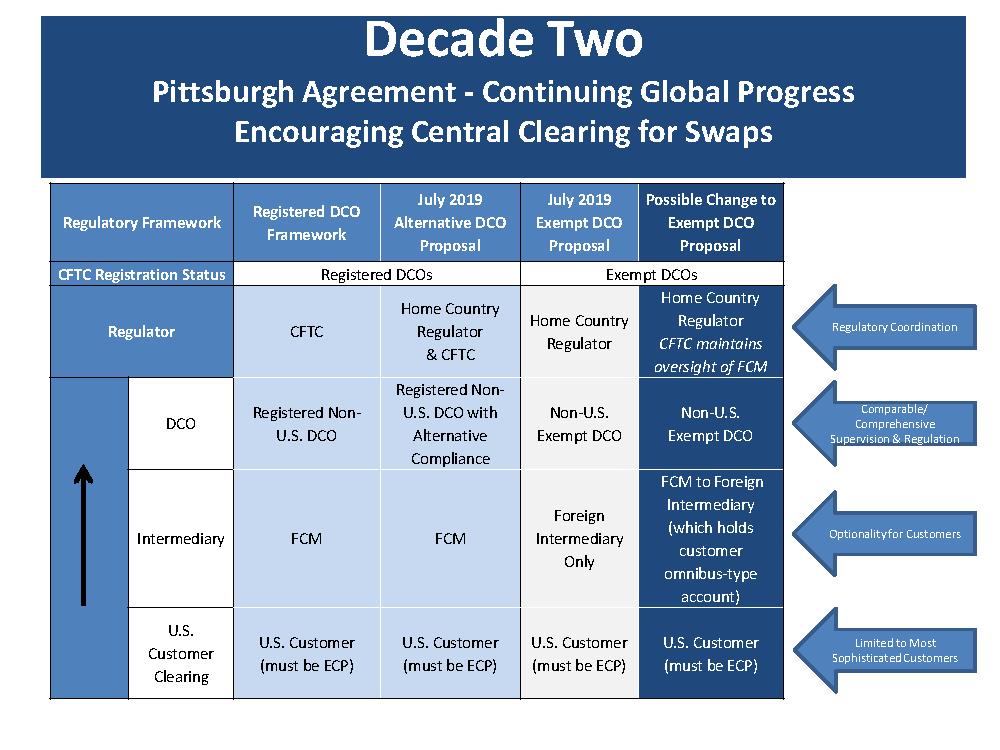
Decade Two

Data Protection

As you may have heard, data protection is a priority for me, and I have initiated what we refer to as the Data Protection Initiative[17].  It is hard to fathom the state of play back in 1975 in terms of data submission, retention, and protection.  In our world of instant access to information from the palm of our hand, it is difficult to imagine regulatory information being physically transmitted via the Postal Service or later the fax machine.  As for data retention, the Commission recently changed its recordkeeping rule to remove antiquated terms, such as microfiche, as allowable formats for data retention.  At the CFTC’s creation, concerns about data protection were different and were limited mostly to physical security.  We can assume that there was considerably less data being delivered to us simply due to the challenges in quickly and easily providing voluminous amounts of physical information.

Today, not only have the original futures markets the Commission was tasked with overseeing grown tremendously, but Dodd-Frank incorporated the massive swaps market, and all of its associated data, within the remit of the agency.  Additionally, the Agency’s data collection efforts have increased commensurate with the growth, speed, and technological advancement of derivatives trading.  The associated risks with ingesting and protecting sensitive data have also expanded.  Like many of you, we are a data rich target, and that requires a top to bottom review of our approach.  The Data Protection Initiative is designed to address these issues, as depicted below.
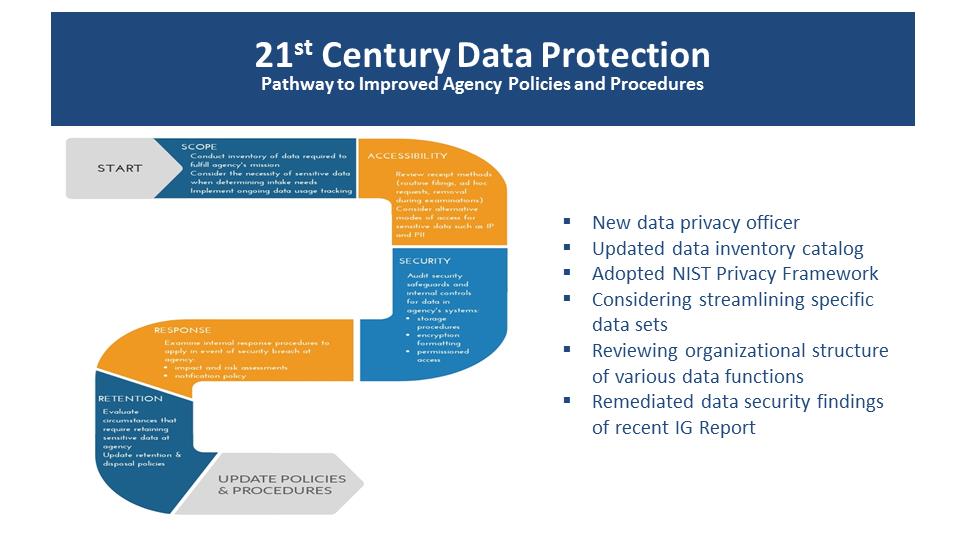
21st Century Data Protection

Regardless of how much data we collect and how it is reported, the CFTC needs to have a holistic data strategy that includes policies and procedures governing data in a uniform manner across all parts of the Agency to ensure that data is protected.  Who knows what the future will hold in terms of the mechanism for the collection and protection of data?  Perhaps blockchain technology could develop in such a way that both regulators and reporting counterparties could benefit from its adoption and facilitate easier, faster, and less costly reporting.  Maybe regulators could eventually receive permissioned access and hypothetically serve as a node on the distributed ledger.

I briefly mentioned our recently expanded data needs per Dodd-Frank and want to elaborate a bit on an upcoming swap data reporting rulemaking that may be of interest to you, and certainly is relevant to the conversations we are having on data protection.  A decade ago, the G-20 leaders in Pittsburgh identified a need for regulators and central banks to be aware of and understand swaps market activity across jurisdictions.  As we prepare to propose rules to improve swap data reporting, I am hopeful that we can recognize that this recent data intake requires particular attention to protection.  Three specifics I would like to see:  (1) refine the number of required data elements to be reported to only those with an identified use-case by the Commission; (2) reasonable streamlining that will effectively decrease the number and type of messages being submitted by reporting counterparties, ingested by swap data repositories, and reviewed by Commission staff; and (3) extend the time delay for Part 45 regulatory reporting to 24 hours to allow for counterparties to exchange confirmations with each other and report the data more completely and correctly.  This would harmonize the CFTC timing requirements with those of both the European Securities and Markets Authority (“ESMA”) and the SEC.

Position Limits

And now for something completely different: A word about position limits.  This is an issue that certainly has spanned decades of derivatives regulations – it even predates the CFTC.

The CFTC and its predecessor agency have had a position limits regime for futures and options on futures since the 1930s.  Although there have been twists and turns over time, the basics of the regime consisting of federal spot and non-spot month limits for contracts in certain agricultural commodities, and exchange-set limits or position accountability rules for others, has generally worked well.

But some have argued that the position limits regime was insufficient to prevent excessive speculation in the derivatives markets for energy during 2007-2008, and that this led to sharp increases in energy prices paid by consumers at that time.  CFTC studies have not borne this out, and other studies have been inconclusive.  Yet, since then, energy prices have dropped due to developments wholly unrelated to the futures markets (such as shale drilling, and further development of liquefied natural gas).

These market dynamics, though, do not change the fact that in Dodd-Frank, Congress amended the CEA’s position limit provisions, and the CFTC has been trying to implement those amendments ever since:  (1) final rules adopted in 2011[18] but vacated by a federal court in 2012[19]; (2) another proposal in 2013[20]; (3) a supplemental proposal in early 2016[21]; (4) a re-proposal in late 2016[22]; and (5) a new proposal that the Commission just issued on January 30, 2020.[23]

As depicted in the diagram below, much of the legal debate over the years has focused on whether a finding that position limits are necessary is a prerequisite to the CFTC’s mandate to establish limits.
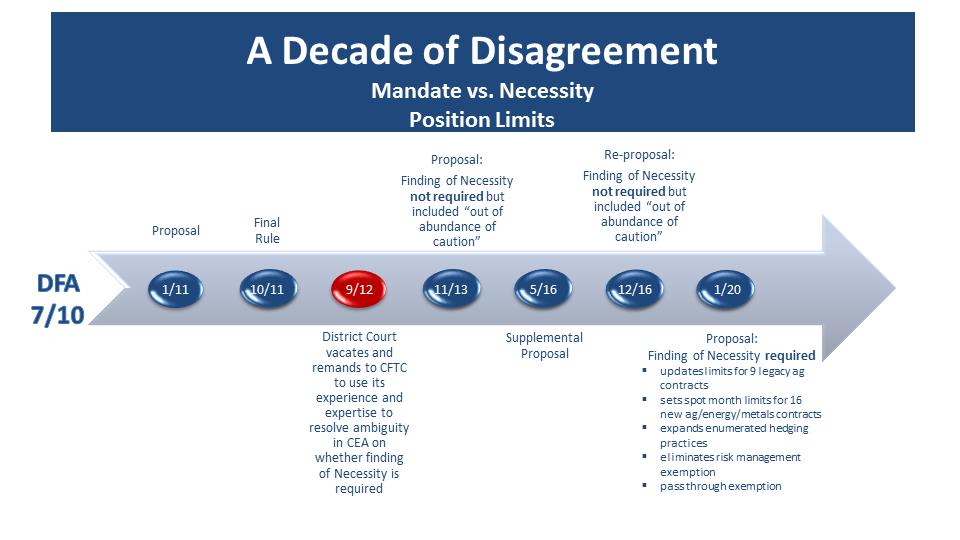
A Decade of Disagreement

For the reasons that I provided in my Statement on the recent proposal, I believe that such a necessity finding is required.[24]  But regardless of one’s views on the necessity of position limits in general, market participants need and deserve certainty.  And the CFTC’s position limits regime is in need of updating in certain areas, such as:  (1) deliverable supply estimates underlying federal spot-month limits; and (2) the list of enumerated bona fide hedging practices.

The key elements of the new position limits proposal are as follows:

New (higher) federal spot and non-spot month limits for the nine legacy agricultural contracts currently subject to such limits;

New spot month limits (but not non-spot month limits) for 16 other physically-settled agricultural, energy, and metals contracts;

An expanded definition of bona fide hedging positions and transactions;

In general, significant reliance on exchanges to administer position limits; and

A new 10/2-day review process for CFTC review of exchange recognitions of non-enumerated bona fide hedges.

I believe that overall, the proposal is reasonable in its design, balanced in its approach, and workable in practice for both market participants and the Commission.  There certainly are areas for improvement, and commenters should focus on those.  It is a good proposal – tell us where and how we can make it better.

Finally, no-action relief from the Division of Market Oversight is currently in place for certain aspects of the position aggregation rules that the Commission finalized in late 2016.  Last July, DMO extended this relief through August 2022.  The no-action relief was issued so that the Commission and its staff could study the operation of the recent position aggregation amendments and determine whether further rule changes are warranted.  I support such an examination.

Closing

When I first moved to Washington, DC, there was an establishment named simply “Decades,” where my friends and I spent many of our weekends.  As the name suggests, patrons could hear music from the 70’s, 80’s, or 90’s depending on the floor you chose.  I preferred the 80’s level, where one could be mindful of the nostalgia generated by the songs and also be grateful that “big hair” was no longer a fashion trend.

As music has changed over the decades, so have our markets, yielding many positive results.  Regulation of evolving markets requires adaptation, but we should not abandon the classics that still serve us well, such as:  (1) global regulatory coordination; (2) a culture of a compliance partnership among regulators and market infrastructure providers, as opposed to reliance on enforcement of subjective rules; and (3) principles rather than prescription, which will help avoid constantly outdated regulatory obligations.

As we enter this new decade and celebrate the CFTC’s 45 years, I would say we have much to be proud of.  We also have much work ahead to ensure that our regulations remain appropriately attuned to preserving the integrity of the markets you have built.


[1] See Dodd-Frank Wall Street Reform and Consumer Protection Act, Public Law 111-203, 124 Stat. 1376 (2010) (“Dodd-Frank”).

[2] See Registration and Compliance Requirements for Commodity Pool Operators and Commodity Trading Advisors: Registered Investment Companies, Business Development Companies, and Definition of Reporting Person, 84 Fed. Reg. 67343 (Dec. 10, 2019); and Registration and Compliance Requirements for Commodity Pool Operators (CPOs) and Commodity Trading Advisors: Family Offices and Exempt CPOs, 84 Fed. Reg. 67355 (Dec. 10, 2019).

[3] Amendments to Certain Swap Execution Facility Requirements and Real-Time Reporting (adopted Jan. 30, 2020) (publication in Federal Register pending), available at https://www.cftc.gov/PressRoom/PressReleases/8112-20.

[4] See 17 C.F.R. Part 30.

[5] See CEA § 5b(h), 7 U.S.C. 7a-1(h) (authorizing the CFTC to exempt DCOs from registration for the clearing of swaps); CEA § 5h(g), 7 U.S.C. 7b-3(g) (authorizing the CFTC to exempt SEFs from registration).

[6] See CEA § 2(i), 7 U.S.C. 2(i) (“The provisions of [the CEA] relating to swaps that were enacted by the Wall Street Transparency and Accountability Act of 2010 (including any rule prescribed or regulation promulgated under that Act), shall not apply to activities outside the United States unless those activities (1) have a direct and significant connection with activities in, or effect on, commerce of the United States; or (2) contravene such rules or regulations as the Commission may prescribe or promulgate as are necessary or appropriate to prevent the evasion of any provision of [the CEA] that was enacted by the Wall Street Transparency and Accountability Act of 2010.”).

[7] See id.

[8] Interpretive Guidance and Policy Statement Regarding Compliance with Certain Swap Regulations, 78 Fed. Reg. 45292 (July 26, 2013).

[9] See Cross-Border Application of Certain Swaps Provisions of the Commodity Exchange Act, 77 Fed. Reg. 41214, 41239 (proposed July 12, 2012) (Statement of Commissioner Sommers, expressing the view that in drafting the CFTC’s proposed cross-border interpretive guidance, “staff had been guided by what could only be called the ‘Intergalactic Commerce Clause’ of the United States Constitution . . .”).

[10] See CFTC Staff Advisory No. 13-69, Applicability of Transaction-Level Requirements to Activity in the United States (Nov. 14, 2013), available at http://www.cftc.gov/idc/groups/public/@lrlettergeneral/documents/letter/13-69.pdf.

[11] See Leaders’ Statement from the 2009 G-20 Summit in Pittsburgh, Pa. (Sept. 24-25, 2009) (“G-20 Pittsburgh Leaders’ Statement”), available at https://www.treasury.gov/resource-center/international/g7-g20/Documents/pittsburgh_summit_leaders_statement_250909.pdf.

[12] See In the Matter of the Exemption of Multilateral Trading Facilities and Organised Trading Facilities Authorized Within the European Union from the Requirement to Register with the Commodity Futures Trading Commission as Swap Execution Facilities, Order of Exemption, available at https://www.cftc.gov/International/ForeignMarketsandProducts/ExemptSEFs#European%20Union (Dec. 8, 2017); In the Matter of the Exemption of Multilateral Trading Facilities and Organised Trading Facilities Authorized Within the European Union from the Requirement to Register with the Commodity Futures Trading Commission as Swap Execution Facilities, Amendment to Appendix A to Order of Exemption, available at https://www.cftc.gov/International/ForeignMarketsandProducts/ExemptSEFs#European%20Union (Dec. 3, 2018).

[13] See In the Matter of the Exemption of Approved Exchanges and Locally-Incorporated Recognised Market Operators Authorized within Singapore from the Requirement to Register with the Commodity Futures Trading Commission as Swap Execution Facilities, Order of Exemption, available at https://www.cftc.gov/International/ForeignMarketsandProducts/ExemptSEFs#Singapore (Mar. 13, 2019).

[14] See In the Matter of the Exemption of Electronic Trading Platforms Registered Within Japan from the Requirement to Register with the Commodity Futures Trading Commission as Swap Execution Facilities, Order of Exemption, available at https://www.cftc.gov/International/ForeignMarketsandProducts/ExemptSEFs#Japan (July 11, 2019).

[15] Cross-Border Application of the Registration Thresholds and Certain Requirements Applicable to Swap Dealers and Major Swap Participants, 85 Fed. Reg. 952 (proposed Jan. 8, 2020).

[16] See Registration with Alternative Compliance for Non-U.S. Derivatives Clearing Organizations, 84 Fed. Reg. 34819 (proposed July 19, 2019) (“Alternative Compliance Proposal”); Exemption from Derivatives Clearing Organization Registration, 84 Fed. Reg. 35456 (proposed July 23, 2019) (“Exempt DCO Proposal”).

[17] See Statement of Commissioner Dawn D. Stump Announcing Further Progress in the CFTC’s Data Protection Initiative (Nov. 21, 2019), available at https://www.cftc.gov/PressRoom/SpeechesTestimony/stumpstatement112119.

[18] Position Limits for Futures and Swaps, 76 Fed. Reg. 71626 (Nov. 18, 2011).

[19] International Swaps and Derivatives Association v. U.S. Commodity Futures Trading Commission, 887 F.Supp. 2d 259 (D.D.C. 2012).

[20] Position Limits for Derivatives, 78 Fed. Reg. 75680 (proposed Dec. 12, 2013).

[21] Position Limits for Derivatives: Certain Exemptions and Guidance, 81 Fed. Reg. 38458 (proposed June 13, 2016).

[22] Position Limits for Derivatives, 81 Fed. Reg. 96704 (proposed Dec. 30, 2016).

[23] Position Limits for Derivatives (adopted Jan. 30, 2020) (publication in Federal Register pending), available at https://www.cftc.gov/PressRoom/PressReleases/8112-20.

[24] Statement of Commissioner Dawn D. Stump Regarding Proposed Rule: Position Limits for Derivatives, Jan. 30, 2020, available at https://www.cftc.gov/PressRoom/SpeechesTestimony/stumpstatement013020.