


Federal Court Orders Defendants to Pay More Than $2.7 Million in a Forex Fraud Scheme
Release Number 7994-19
August 9, 2019
Federal Court Orders Defendants to Pay More Than $2.7 Million in a Forex Fraud Scheme
Washington, DC — The U.S. Commodity Futures Trading Commission today announced that the U.S. District Court for the Northern District of Georgia entered a default judgment against defendants Kevin Andre Perry and Lucrative Pips Corporation of Atlanta, Georgia in an enforcement action in which the Commission alleged the defendants fraudulently solicited and misappropriated nearly $700,000 from more than 50 clients in a forex trading scheme.
The court’s order requires the defendants to pay $694,799 in restitution to defrauded clients and a civil monetary penalty of more than $2 million. Additionally, the defendants are now permanently enjoined from engaging in conduct that violates the Commodity Exchange Act (CEA), and are permanently banned from registering with the CFTC and trading in any CFTC-regulated markets.
The CFTC’s case was filed September 28, 2018. [See Press Release 7812-19] In its motion for default judgment, the CFTC presented evidence that Perry fraudulently and repeatedly told prospective pool participants that the initial funds they gave to the defendants were fully “guaranteed” against trading losses and that their accounts would grow in value approximately 200% to 350% in less than 60 days. When pool participants attempted to withdraw their funds at the end of their trading cycle, the defendants knowingly made false statements to explain why they could not return pool participants’ funds.
A related criminal case was filed against Perry in the U.S. District Court for the Northern District of Georgia on December 12, 2018. See Case No. 1:18-cr-00486-WMR-AJB-1, USA v. Perry. The criminal case, which includes one count of wire fraud, is pending before Judge William M. Ray, II.
The CFTC cautions victims that restitution orders may not result in the recovery of money lost, because wrongdoers may not have sufficient funds or assets. The CFTC will continue to fight vigorously for the protection of customers and to ensure the wrongdoers are held accountable.
The CFTC Division of Enforcement staff members responsible for this case are Jason Gizzarelli, Traci Rodriguez, Patricia Gomersall, and Paul Hayeck.
* * * * * * *
CFTC’s Foreign Currency (Forex) Fraud Advisory
The CFTC has issued several customer protection Fraud Advisories that provide the warning signs of fraud. The Foreign Currency Trading (Forex) Fraud Advisory states that the CFTC has witnessed a sharp rise in Forex trading scams in recent years and helps customers identify this potential fraud.
-CFTC-
Remarks of Commissioner Dan M. Berkovitz before the National Cattlemen’s Beef Association, Denver, Colorado
Remarks of Commissioner Dan M. Berkovitz before the National Cattlemen’s Beef Association, Denver, Colorado
Improving Price Discovery for Commercial Hedging
July 31, 2019
Thank you for that kind introduction. I also want to thank Darryl Blakey and the National Cattlemen’s Beef Association (NCBA) for arranging this opportunity to speak to you and to visit beef production facilities here in Colorado.
Coming from Washington, I have to mention some fine print. My remarks here today are my own views and are not the views of the Commodity Futures Trading Commission (CFTC), its staff, or any other Commissioner.
I would like to explain my interest in being here today and then I’ll talk about some issues that this Committee has been interested in.
Futures and options are important hedging and price discovery tools for cattlemen and others in the beef industry. One of the fundamental purposes of the CFTC is to ensure that trading in futures and options contracts for commodities such as cattle is fair, efficient, and effective for commercial end users. I take this responsibility very seriously. It is the reason that our agency exists. All of us at the CFTC must continuously work to help ensure that the futures and options markets for cattle and other commodities provide an effective means for ranchers, farmers, and other end users to manage risks and discover prices.
I grew up in Indiana and ever since I went away to college I’ve been going back home regularly to visit my family and friends there. If there is one thing I have learned in the time I’ve lived in Washington, it’s that it’s important to get out of Washington to see what’s going on and listen to what people in the rest of the country are saying. That’s why I’m here today. I’m here to talk to you and other people who use our commodity markets and learn about what’s working and what isn’t. Only by talking with you and seeing your operations in person can I better understand how the futures markets can best serve America’s ranchers and farmers.
I am in the middle of several visits to some of America’s agricultural centers. Last week, I was in Arkansas visiting poultry feed mills and farms, rice mills, and soybean growers. I heard about many of the challenges Arkansas farmers are facing this year, from torrential rainfalls and record flooding to trade issues. I saw firsthand the resilience and ingenuity of our farmers facing these challenges.
Next week I travel to Minnesota to visit dairy co-ops, grain elevators, and processors of a range of agricultural commodities. I’ll also sit down with farmers and agriculture businesses at an annual agriculture trade show called Farmfest.
These trips are part of a constant learning process. In April, I participated in our Agricultural Advisory Committee meeting and our second Agricultural Commodity Futures Conference in Kansas City. More recently, I sat down several times with our staff economists to review agricultural market developments in the weeks leading up to my trips.
A common theme that emerges is the importance of futures contract design and trading rules. Price limits, contract size, product specifications, grading, delivery locations, and–most importantly for live cattle–the delivery process, all are critical features of a futures contract that determine whether it works as an efficient and effective tool for hedging.
The live and feeder cattle markets pose unique challenges for standardizing futures contracts and exchange trading. There is a significant diversity in the production practices across the country and cattle need to be shipped live. These features make it more difficult to determine how cattle futures contracts can be standardized in contrast to more homogeneous commodities such as grains and metals. There have been tremendous improvements in genetics and production practices that have led to better and more consistent output, so self-regulation of livestock markets is an on-going process, but a vitally important one for your industry.
For the Live Cattle and Feeder Cattle contracts, it is critical that CME get input from cattlemen on contract terms. Only with your input can the exchange and the CFTC better ensure that the contracts reflect the cash market and encourage fair and liquid trading with convergence.
It is my understanding that CME has been working with NCBA, with assistance from the CFTC, to implement a number of changes to the cattle contracts over the past several years. I was pleased to hear that CFTC staff engaged with you and CME to help facilitate market-based improvements to price limits, delivery times, grading, and other requirements for CME-approved livestock yards. I am told that the Live Cattle Marketing Committee views CME’s expandable daily price limits for cattle contracts as having “a positive effect on the markets’ ability to trade efficiently during times of increased volatility.”[1] I look forward to more positive collaborations between producers, exchanges, and the CFTC to improve trading and resolve legitimate concerns among market participants.
Work to improve the futures contracts continues. I applaud your efforts in ensuring that there is an adequate supply of well-trained USDA graders for deliveries. I understand that dynamic specifications for quality and weight are under consideration and further work to provide efficient delivery points can be explored. To the extent the CFTC can support this effort, I encourage the NCBA to engage with us. The CFTC’s role is not to dictate contract terms but to engage with all parties to understand where the areas of concern are and facilitate contract design that serves the livestock industry consistent with our statutory mandate from Congress.
I’d like to touch on a couple of issues for which the CFTC plays a more direct role. First, clearing services are becoming more concentrated. CFTC data shows that the number of registered FCMs that actively clear futures and options for customers has fallen from 90 in 2007, before the financial crisis, to about 55 firms today. Many of the former FCMs were the smaller firms that tended to service commercial hedgers.
Futures and options customer clearing is also concentrated in FCMs affiliated with the largest banks in the country. The ten largest FCMs—all but one of which are affiliated with large banks—hold about 75 percent of all required customer margin.[2] Concentration of clearing services is even greater in the swaps markets where five large bank FCMs clear 80 percent of the notional amount of swaps.
The changes in the make-up of FCMs mean fewer available FCMs and larger FCMs. The larger FCMs have substantial fixed costs and so prefer large traders who trade in volume and generate more fees. Commercial hedgers generally trade only when hedging or covering and so engage in fewer trades than speculators and high frequency traders. This adds up to fewer clearing services options for commercial hedgers.
A second concern is systemic risk. Due to the current capital requirements, bank FCMs have limited ability to take on additional clearing clients. In this capital-constrained environment, the sudden loss of a single large FCM could be disruptive to markets if its clients’ positions cannot be ported smoothly to other FCMs and the positions are liquidated in bulk.[3]
The on-going availability of clearing services for the agricultural sector and systemic risk go to the heart of your ability to access the markets efficiently and effectively. These are concerns I think we all share.
There are no simple fixes to reverse this trend. A number of factors have contributed, including low interest rates, cross-border competition, capital demands, and the cost of new technology. I have supported revisions to bank capital requirements so that capital does not have to be set aside to cover customer margin funds. This change will increase clearing capacity at bank FCMs. Hopefully, more banks will expand clearing services as this change gets implemented. However, changing capital requirements alone will not solve the clearing capacity problem so I think this is an issue we must continue to address. Many of the factors that have contributed to this problem are outside the control of the CFTC, but we must do what we can to increase the capacity and diversity of clearing services.
Turning to the issue of confidence in the markets, your Committee included a number of resolutions in NCBA’s 2019 Policy Book regarding transparency, monitoring markets for manipulative behavior, preventing spoofing, quote stuffing, and layering, and generally “foster[ing] an environment that builds confidence in the ability of the hedging community to effectively manage forward price risk . . .”[4] I support these goals. While CME is the front line market monitor and data provider, the CFTC plays a significant role in market surveillance and provides a strong deterrent against wrongful conduct through our enforcement actions.
The CFTC’s aggressive enforcement activities against spoofing demonstrate our commitment to policing trading in these markets. The CFTC has litigated or settled 27 spoofing cases since receiving spoofing enforcement authority in 2011 and more spoofing cases are progressing as I speak. In my prior position as General Counsel at the CFTC I was part of the CFTC team that worked with the Congress to develop the prohibition on spoofing. It is particularly gratifying for me to see that this provision has been very useful in prosecuting abusive trading in our markets.
In conclusion, I want to emphasize my commitment to making sure the futures markets serve ranchers, farmers, and other commercial firms that use these markets to manage risk. I support and will encourage engagement by the CFTC with cattlemen, beef processors, CME, and other market participants to help improve hedging and price discovery for commercial operators.
Thank you for taking the time to listen and I look forward to talking with you more in the future.
Thank you.
[1] National Cattlemen’s Beef Association, 2019 Policy Book (Updated: January 2019), at 97.
[2] CFTC data available at https://www.cftc.gov/MarketReports/financialfcmdata/index.htm. The sole non-bank is ADM Investor Services Inc.
[3] The Financial Stability Board has warned that “concentration in clearing service provision could amplify the consequences of the failure or withdrawal of a major provider. In particular, concerns have been expressed about the ability to port client positions and collateral in this situation.” Financial Stability Board, Incentives to centrally clear over-the-counter (OTC) derivatives: A post-implementation evaluation of the effects of the G20 financial regulatory reforms—final report at 3 (Nov. 19, 2018), http://www.fsb.org/wp-content/uploads/R191118-1-1.pdf.
[4] National Cattlemen’s Beef Association, 2019 Policy Book (Updated: January 2019), at 99.
Dissenting Statement of Commissioner Rostin Behnam on the Exemption from Derivatives Clearing Organization Registration; Notice of Supplemental Proposal
Dissenting Statement of Commissioner Rostin Behnam on the Exemption from Derivatives Clearing Organization Registration; Notice of Supplemental Proposal
July 11, 2019
Introduction
I respectfully dissent from the Commodity Futures Trading Commission’s (the “Commission” or “CFTC”) supplemental notice of proposed rulemaking addressing the granting of exemptions from registration as a derivatives clearing organization (“DCO”) to non-U.S. clearing organizations and further permitting such “exempt DCOs” to clear swaps for U.S. customers through intermediaries that would be wholly outside the Commission’s direct regulation and oversight (the “Supplemental Proposal”). While I supported the Commission’s 2018 proposal to codify its current policies and procedures for granting exemptions from DCO registration[1] as a positive step towards increased cross-border cooperation and deference to our foreign regulatory counterparts, I cannot support it in its “supplemental” form. The Supplemental Proposal is not the product of internal consensus and its brief history and questionable timeline signal a lack of appropriate scrutiny and evaluation of the potential consequences of taking these first steps towards diverging from the customer protection model provided by the Commodity Exchange Act (“CEA” or “the Act”) and U.S. Bankruptcy Code.[2]
I support the Commission’s endeavor to explore ways to adapt and—if appropriate—seek to alter the current intermediary structure established under the CEA and Commission regulations to better accommodate both U.S. customer demand for increased access to clearing in foreign jurisdictions and evolving global swaps market structures. However, I cannot support the Commission’s proposed use of its limited public interest exemptive authority to create a regulatory easement as a short cut to legal certainty in furtherance of such efforts and to the detriment of U.S. customers, market participants, and the financial system.
If the Commission believes it is appropriate at this time to provide U.S. customers with greater access to non-U.S. swap markets, then we can and should engage in a more careful analysis of options, assessment of alternatives, and evaluation of consequences. Policy decisions made in haste amid ongoing uncertainty undermine the regulatory process and our accountability. As I have said before, when evaluating our regulatory landscape and making critical determinations as to which parts to revisit, which to complete, and how we can guide legislation and develop regulations to address market evolution and developments—regardless of the underlying impetus, we must hold one another accountable, adhere to appropriate process, be wary of false progress, and engage in genuine dialog.[3] Today’s Supplemental Proposal in its timing, in its limitations, and in its uncertainty, is at best, false progress and, at worst, the false promise of benefits that will never be realized.
The substantial revisions to the Supplemental Proposal throughout these last several weeks with their various additions and carefully crafted excerpts do little to bolster the justifications and rationales put forth in advocacy of the proposed change in policy and attendant exemptive relief that would permit U.S. customer positions to be cleared at an exempt DCO through a foreign intermediary that is not registered as a futures commission merchant (“FCM”). Nowhere is this clearer than in the Request for Comments.[4]
The Supplemental Proposal utilizes its Request for Comments primarily to explore why this proposal represents the regulatory route that will cause the least amount of harm by soliciting the public for their best arguments as to the operation of the U.S. Bankruptcy Code (and relevant laws), and to solicit feedback on eligibility elements and several conditions of the exemption for DCOs. However, it also introduces and requests comment on alternatives to the Commission’s longstanding policy (consistent with longstanding interpretation of the CEA) of allowing U.S. customers’ swap positions to be cleared only through registered FCMs at registered DCOs. While this is an entirely appropriate issue to raise in the context of a proposed rulemaking (or other formal request for public comment such as an advance notice of proposed rulemaking, request for input, or concept release), the effectiveness of any comments received will be largely lost in this “supplement” since the line of questioning fails to accentuate—or itself propose—a rule from which any final Commission action could be taken as a logical outgrowth.[5] A line of questioning that seeks to introduce potentially new policy considerations for future consideration by a Commission in the midst of changing leadership is ill-fated, detracts commenters from the critical issues at hand, and undermines the integrity of the 2018 Proposal and the Supplemental Proposal.[6]
When You are Boxed in by Uncertainty
Though I have many concerns with the Supplemental Proposal, I am most concerned with the Commission’s contorted plan to permit DCOs that it would exempt from registration to clear swaps for U.S. customers through unregistered foreign intermediaries. This juggernaut of a proposal gained momentum from the ongoing uncertainty regarding the extent to which U.S. customers’ funds would be protected under the U.S. Bankruptcy Code when clearing swaps at an unregistered DCO. While the Commission’s decision to put a premium on legal certainty is laudable, it is not clear to me that the Commission ought to do so if it undermines key components of the CEA’s customer protection regime aimed at protecting both U.S. customers and the stability of our markets and misaligns the Commission’s already questionable use of its public interest exemptive authority with the purposes of the Act.[7] It appears that in attempting to deliver on the concept of permitting exempt DCOs to clear swaps for FCM customers—introduced just months ago by the Commission as a single question in the 2018 Proposal[8]—the Commission found itself boxed in by uncertainty. The only way out would be to remove any and all doubt that a U.S. customer who seeks to clear swaps on an exempt DCO will have to do so through a foreign intermediary not subject to CFTC regulation or oversight and outside the protections of the U.S Bankruptcy Code.[9]
Ongoing uncertainty
The Supplemental Proposal would permit U.S. customers to clear at an exempt DCO only through a foreign intermediary and not through an FCM due to uncertainty regarding the protection of U.S. customer funds in the event of an insolvency of the FCM. The Commission is continuing to consider and evaluate this issue, consider alternative approaches, and identify possible risks to customers that may result from that uncertainty. While this approach was selected as a means to provide the greatest clarity with regard to the Commission’s current understanding of the U.S. Bankruptcy Code, given that it necessitates the Commission’s exercise of exemptive authority to permit foreign intermediaries to accept U.S. customer funds to clear swaps without having to register as FCMs (or having to comply with Commission rules and regulations applicable solely to registered FCMs), it would seem, on its face, to be inconsistent with the customer protection regime established under the CEA and Commission regulations.[10] This should give the Commission ample reason to pause its consideration of moving forward on the Supplemental Proposal at this time. Inexplicably, it does not. And instead, the Commission is soliciting comments from the public on a number of issues involving the interpretation and applicability of the U.S. Bankruptcy Code (or other relevant laws) and the clearing of swaps customer funds deposited at an exempt DCO by an FCM directly or through a foreign member of the exempt DCO.[11]
Misuse and Abuse of Authority
In order to permit foreign intermediaries to clear swaps for U.S. persons, and to ensure that only foreign intermediaries that are not FCMs will clear U.S. customer positions on exempt DCOs, the Commission is proposing to exercise its authority under section 4(c) of the CEA to exempt foreign intermediaries from the prohibition in section 4d(f) of the CEA against accepting customer funds to clear swaps at a registered or exempting DCO without registering as FCMs. Even assuming that the Commission’s exemptive authority extends to the non-U.S. clearing organizations and intermediaries that are the subject of the Supplemental Proposal,[12] the Commission’s proposed justifications for the use of such authority do not align with the very purpose of the authority to promote innovation and competition without sacrificing key components of the Commission’s regulatory and oversight structure.
Section 4(c) of the CEA, commonly referred to as the public interest exemption, authorizes the Commission, in order to promote responsible innovation and fair competition, by rule, regulation, or order, to exempt, among other things, any person or class of persons offering, entering into, rendering advice, or rendering other services with respect to transactions from any of the provisions of the CEA other than certain enumerated provisions.[13] When enacting section 4(c), Congress noted that the purpose of the provision is “to give the Commission a means of providing certainty and stability to existing and emerging markets so that financial innovation and market development can proceed in an effective and competitive manner….with due regard for the continued viability of the marketplace and considerations related to systemic risk in financial markets.”[14] Indeed, in exercising its exemptive authority under section 4(c) of the CEA, the Commission has long understood that it was Congress’s intention and expectation that “the Commission will assess the impact of a proposed exemption on the maintenance of the integrity and soundness of markets and market participants.”[15] As well, Congress, in requiring the Commission to consider any material adverse effect on regulatory or self-regulatory responsibilities, indicated that the Commission is to consider such regulatory concerns as “market surveillance, financial integrity of participants, protection of customers, and trade practice enforcement.”[16]
The Commission’s section 4(c) proposal, which would be codified in § 3.10(c)(7) of the Commission regulations, purports to be consistent with the exempt DCO framework being proposed in that it is based on deference to the regulation and supervision of foreign intermediary’s home country regulator. To qualify for the exemption, the foreign intermediary: (1) must accept funds from a U.S. person to margin, guarantee, or secure swap transactions that are cleared by an exempt DCO; (2) may not engage in other activities requiring registration as an FCM or voluntarily register as an FCM; and (3) must be a clearing member of an exempt DCO and must directly clear the swap transactions of the U.S. person at an exempt DCO. A foreign intermediary that is exempt from registering as an FCM pursuant to the foregoing requirements is not required to comply with those provisions of the Act and of the rules, regulations, or orders thereunder applicable solely to any registered FCM and may provide commodity trading advice to U.S. persons without registering as a commodity trading advisor (“CTA”), provided that the advice is provided solely with respect to swaps that are cleared by an exempt DCO.[17]
The Commission believes the proposed exemption for foreign intermediaries promotes responsible financial innovation and fair competition, and is consistent with the public interest and purposes of the CEA. In support of these beliefs, the Commission focuses on: (1) the provision allowing U.S. persons additional options for trading and clearing swap transactions and the concomitant expansion of available intermediaries, which has the potential to reduce the current concentration of U.S. customer funds in a small number of FCMs and (2) increased access for U.S. persons to swaps that are cleared in foreign jurisdictions, which may provide for greater hedging opportunities and increased liquidity in more standardized, cleared contracts.[18] However, these rationales ignore that this approach removes U.S. customers from the protections of the U.S. Bankruptcy Code and puts both FCMs and registered DCOs at a competitive disadvantage and with respect to clearing in non-U.S. swaps markets. While the Commission puts forth mitigating factors in response to the loss of U.S. Bankruptcy Code protections, as discussed below, its solution can only be said to promote “responsible” innovation if we assume that individual U.S. Customers need nothing more than notice of their lack of protections to engage responsibly in foreign financial markets to prevent harm to themselves and to the larger financial system. It is my belief that history has not demonstrated that this is the case. Regarding the competitive disadvantage to FCMs and registered DCOs, the Commission admits that this is a cost of its proposal, [19] but makes no arguments regarding fairness beyond briefly discussing the economics of being regulated as a clearing organization in any jurisdiction.
The Commission also concludes that the proposed exemption will be limited to appropriate persons, “as only U.S. persons that are eligible contract participants (“ECPs”) would be permitted to maintain accounts with a foreign intermediary for swaps cleared at an exempt DCO” and cites CEA section 2(e) which makes it unlawful for any person, other than an ECP, to enter into a swap unless the swap is entered on or subject to the rules of a designated contract market.[20] Of note, the Commission makes no reference to whether or how the foreign intermediary will comply with this limitation and the proposed conditions of exemption for DCOs do not require the DCO to have rules that would limit a foreign intermediary’s ability to solicit and accept U.S. customers that are not ECPs. Similarly, it is unclear as to whether the Exempt DCO or the foreign intermediary’s home regulator will ensure that the foreign intermediary does not solicit or provide trading advice to U.S. customers warranting CTA registration beyond the trading advice permitted by the exemption. It is difficult to even evaluate whether the Commission considered the adverse effect on its regulatory responsibilities, in terms of market surveillance, financial integrity of participants, protection of customers, and trade practice enforcement.
The Commission acknowledges that (1) some foreign regulatory regimes may prove to be less effective than the United States and (2) that foreign intermediaries clearing for customers at an exempt DCO may not be subject to the same level of effective supervision as an FCM. [21] However, it does not elaborate on the obvious concerns that ought to be raised by these assertions. Rather, the Commission maintains that any risks to U.S. customers from clearing swaps traded on exempt DCOs through foreign intermediaries that are not registered as FCMs would be mitigated under the Supplemental Proposal’s requirements for exempt DCOs in two key ways.[22] First, the exempt DCOs must be in good regulatory standing in their home country jurisdictions, and subject to comparable, comprehensive supervision and regulation that includes a regulatory structure consistent with the PFMIs. Second, an exempt DCO must require a foreign intermediary to provide written notice to, and obtain acknowledgement from, a U.S. person in advance of engaging in any clearing on their behalf that: (1) the clearing member is not a registered FCM; (2) that the exempt DCO is not registered with the CFTC; and (3) that the protections of the U.S. Bankruptcy Code do not apply to the U.S. person’s funds. The notice must also explicitly compare the protections available to the U.S. person under U.S. law and the laws of the exempt DCO’s home country regulatory regime.
There is much to be said for the views of the Commission in this regard, but in the interest of brevity, this approach favors what amounts to wholesale deregulation in the interest of deference absent any analysis of the potential individual customer and systemic consequences. Congress did not intend for the Commission to use its section 4(c) exemptive authority to engage in “wide scale deregulation of markets falling within the ambit of the Act,”[23] so it seems even more egregious that it would attempt to reach beyond the Act to empower U.S. customers to act outside of the Commission’s jurisdiction as conduits of risk. Indeed, given the Commission’s own struggles with the application of the U.S. Bankruptcy Code, I am especially curious to hear from U.S customers seeking to hedge risk or access non-U.S. swaps markets as to whether the Commission’s proposed “caveat emptor” notice model would satisfy the rigors of internal risk management.
Conclusion
In issuing this dissent, I have only touched upon the many issues of concern raised by the Supplemental Proposal. With each reading, I find myself questioning how the 2018 Proposal morphed from a “Project Kiss” initiative[24] to codify the policies and procedures currently followed by the Commission with respect to granting exemptions from DCO registration—which we have historically used sparingly—into a quest to capture a concept of how U.S. swaps customers may fare outside the protections offered through operation of the U.S Bankruptcy Code and protections offered by the CEA and Commission regulations. I believe that the Commission has acted in haste, without due consideration of the risks to individuals and the financial system, and outside its authority. I remain hopeful that the public comment period will provide ample time and opportunity for thoughtful consideration and response to the critical questions posed directly and issues raised by the Supplemental Proposal.
Despite today’s dissent, and as I have said many times before,[25] I look forward to working with my colleagues on cross-border policies that will meet our core responsibilities of promoting safe, transparent and fair markets, while supporting global market access through responsible rule-makings that further harmonize our rules with international partners.
[1] Exemption from Derivatives Clearing Organization Registration, 83 FR 39923 (proposed Aug. 13, 2018) (the “2018 Proposal”).
[2] The Supplemental Proposal was drafted ad hoc in a rash attempt to launch a conception of how U.S. swaps customers may fare outside the protections offered through operation of the U.S Bankruptcy Code. The critical financial, market, consumer protection, and systemic risk issues raised by the Supplemental Proposal should be considered in the context of a more fulsome and informed discussion.
[3] See, e.g., Rostin Behnam, Accountability & Moving Forward, Remarks of Commissioner Rostin Behnam at the FIA Boca 2018 International Futures Industry 43rd Annual Conference, Boca Raton, Florida (Mar. 15, 2018), https://www.cftc.gov/PressRoom/SpeechesTestimony/opabehnam4.
[4] Supplemental Proposal at Section V.
[5] See, e.g. CSX Transportation, Inc. v. Surface Transportation Board, 584 F.3d 1076, 1079-81 (D.C. Cir. 2009) (“A final rule qualifies as a logical outgrowth ‘if interested parties ‘should have anticipated’ that the change was possible, and thus reasonably should have filed their comments on the subject during the notice-and-comment period”).
[6] It seems particularly unfortunate in this instance where some extra time and staff attention may have permitted the Commission to deliberate and vote to issue an entirely separate proposal aimed at addressing timely and emerging concerns in the FCM community.
[7] See H.R. Rep. No. 102–978, 102d Cong. 2d Sess. 80 (1992).
[8] 2018 Proposal, 83 FR at 39930.
[9] Indeed, the Commission succinctly dismisses the consideration of proposed alternatives suggested by commenters on the 2018 Proposal “given the uncertainty as to extent to which U.S. customers would be protected under the Bankruptcy Code…” Supplemental Proposal at VI.C.4.
[10] See Supplemental Proposal at III.C.2.
[11] See Supplemental Proposal at V. I appreciate that asking these direct questions encourages interested parties and perhaps even bankruptcy scholars to provide their best interpretations and arguments. However, it is not clear to me that the U.S. Bankruptcy Court would be obliged to defer to such interpretations—even if accepted by the Commission. And that, unless the Commission aims to seek a legislative solution to alleviate the uncertainty presented by U.S. customer clearing on exempt DCOs—which it has not presented as a viable alternative in this Supplemental Proposal, I cannot appreciate the value of this exercise at this time when our immediate goal should be to codify policies and procedures for granting exemptions from DCO registration.
[12] Section 4(c) of the CEA, 7 U.S.C. 6(c), provides the Commission may exempt any agreement, contract, or transaction (including any persons offering, entering into, rendering advice or rendering other services with respect thereto) from the exchange trading requirements of section 4(a), or any other provision of the Act (subject to express limitations identified in section 4(c)(1)(A)) if such transaction—or person—is subject to section 4(a). Section 4(a) includes a parenthetical indicating that it does not apply to contracts “made on or subject to the rules of a board of trade, exchange, or market located outside the United States…” The Supplemental Proposal does address this potential limitation on its exemptive authority in its reading of section 4(c) (see Supplemental Proposal at Section II, n. 14). However, the CFTC’s General Counsel confirmed that the Commission’s use of section 4(c) exemptive authority is within the Commission’s authority in this instance during the open public meeting at which the Supplemental Proposal was deliberated. See Press Release Number 7967-19, CFTC, CFTC Voted on Open Meeting Agenda Items (July 11, 2019), https://www.cftc.gov/PressRoom/PressReleases/7967-19.
[13] 7 U.S.C. 6(c)(1). Section 4(c)(2) of the CEA further provides that the Commission may not grant exemptive relief unless it determines that: (1) The exemption would be consistent with the public interest and the purposes of the
CEA; (2) the transaction will be entered into solely between ‘‘appropriate persons’’ as that term is defined in
section 4(c); and (3) the exemption will not have a material adverse effect on the ability of the Commission or any
contract market to discharge its regulatory or self-regulatory responsibilities under the CEA. 7 U.S.C. 6(c)(2).
[14] H.R. Rep. No. 102–978, 102d Cong. 2d Sess. 80 (1992).
[15] See Exemption for Certain Swap Agreements, 58 FR 5587, 5592 (Jan. 22, 1993), citing H.R. Rep. No. 102–978, 102d Cong. 2d Sess. 80 (1992).
[16] See Exemption for Certain Swap Agreements, 58 FR 5587, 5592 (Jan. 22, 1993), citing H.R. Rep. No. 102–978, 102d Cong. 2d Sess. 79 (1992).
[17] See Supplemental Proposal at Section II.
[18] Id.
[19] Supplemental Proposal at Section VI.C.2.b.
[20] Id.
[21] Supplemental Proposal at Section VI.C.3.a.
[22] Supplemental Proposal at Section II.
[23] H.R. Rep. No. 102–978, 102d Cong. 2d Sess. 80 (1992).
[24] See 2018 Proposal, 83 FR at 39923.
[25] See, e.g., Rostin Behnam, Sowing the Seeds of Success in 2020, Remarks of CFTC Commissioner Rostin Behnam at the ISDA 34th Annual General Meeting, Grand Hyatt Hong Kong, Hong Kong (Apr. 10, 2019), https://www.cftc.gov/PressRoom/SpeechesTestimony/opabehnam13.
Agenda
Statement of CFTC Commissioner Dawn D. Stump Announcing Important Progress in the CFTC’s Data Protection Initiative
Statement of CFTC Commissioner Dawn D. Stump Announcing Important Progress in the CFTC’s Data Protection Initiative
July 12, 2019
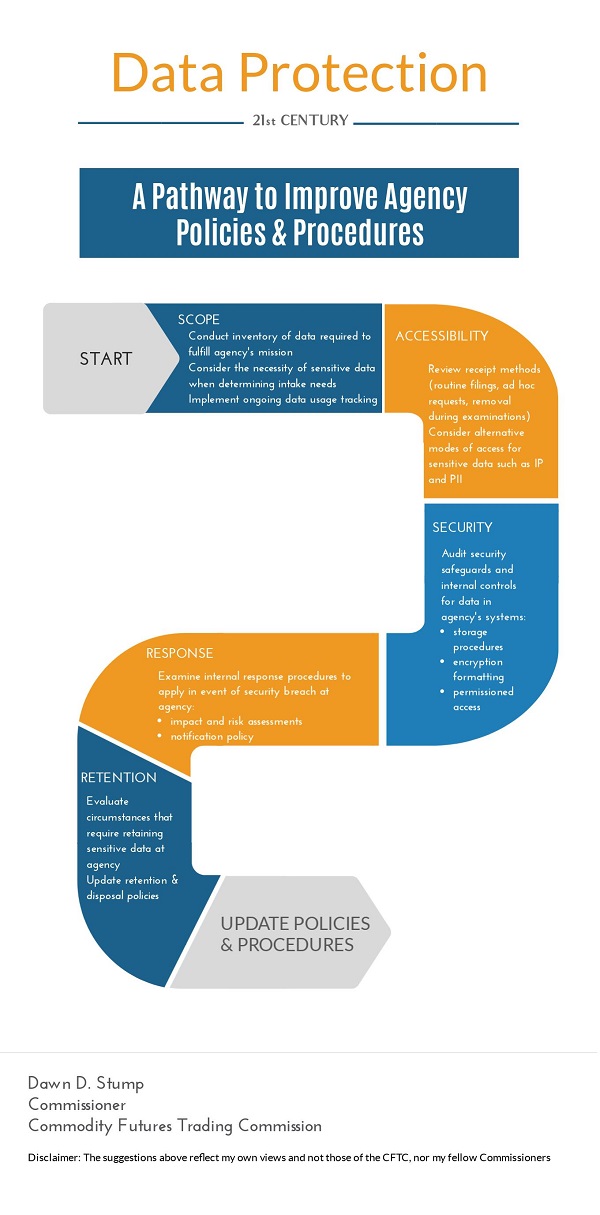
Today, I am pleased to provide an update to the Data Protection Initiative I announced in March[1]. This initiative is meant to serve as a pathway to better ascertain the CFTC’s regulatory data needs and enhance its internal data protection measures. Data is critical to our markets and our regulatory mission, but the specter of data breaches requires our agency to consider the breadth of our data intake needs while weighing the sensitivity of the data with the possibility of unauthorized access. The CFTC collects information via both legacy and recently expanded powers and it must constantly evaluate its approach to data. The effort seeks to appraise our strengths and vulnerabilities through a structured process in an attempt to develop a meaningful policy adapted to ever-evolving threats and advances in data security. At the end of the day, I hope to implement consistent data protection procedures across the many functions required to carry out our mission that will benefit the agency and market participants.
I am happy to announce that the Scope component, the first of five parts of this initiative, has been successfully completed and we now have an updated and detailed Data Catalogue at the CFTC. Substantial time and effort has been invested in the Scope portion of the plan to create this inventory of all the data inflows to the Commission. This is a significant undertaking in and of itself since the agency collects a tremendous amount of sensitive information from a multitude of sources and reporting counterparties. This data is required to be reported under a myriad of regulations promulgated by various Divisions within the CFTC. The Data Catalogue includes information concerning the regulation providing the authority for the collection, type of entity serving as the data submitter, category of data reported, primary CFTC data user, technology or interface by which it is collected, whether the collection is ad-hoc or recurring, and the frequency of submission.
Documenting all the data the CFTC captures is the prerequisite first step in the process and we now have an up to date agency wide view of the data we ingest from the markets we regulate. We must identify the various use-cases of each data stream and consider the sensitivity of the data collection in light of the regulatory value. Then consideration should be given as to whether its collection should continue by comparing the sensitivity of information to its value to the Commission. If a data set has a demonstrable use-case, then the next steps in the Data Initiative process must be applied: (1) Access - review the manner in which we receive all data and consider alternative modes of access for sensitive data, such as not ingesting it into CFTC systems and reviewing the data on-site at market participants; (2) Security – analyze our security safeguards and internal controls, storage procedures, encryption formatting, permission access and usage tracking; (3) Response – examine how the CFTC responds in the event of a security breach through impact and risk assessments as well as notification to parties whose data is impacted; and (4) Retention – evaluate the time and means by which the agency stores types of information based upon sensitivity and update data destruction policies as appropriate.
Undertaking this laborious step has demonstrated the necessity of not only having such a Data Catalogue, but that it must always be refreshed and stay current. I hope this initiative will foster a CFTC-wide commitment and cultural shift to ensure that this process is performed on a recurring frequency.
I want to thank the staff of all the Divisions and Offices across the entire CFTC for their assistance as many parts of the agency are involved in this project and data protection is truly everyone’s responsibility. I look forward to continuing to work with staff and also hope to partner with market participants and cyber security experts, across both the private and public sectors, as appropriate through various mediums, such as potential future roundtables, to highlight best practices and lessons learned from this initiative.
[1] See Statement of CFTC Commissioner Dawn D. Stump on Data Protection Initiative (March 1, 2019), available at https://www.cftc.gov/PressRoom/SpeechesTestimony/stumpstatement030119.