Statement of Concurrence by CFTC Commissioner Rostin Behnam

Statement of Concurrence by CFTC Commissioner Rostin Behnam

Amendments to Registration and Compliance Requirements for Commodity Pool Operators and Commodity Trading Advisors

November 25, 2019

I support the two final rules amending Part 4 of the Commission’s regulations addressing various registration and compliance requirements for commodity pool operators (CPOs) and commodity trading advisors (CTAs).  I support these amendments because they represent the latest step in the Commission’s ever evolving understanding of the needs of this dynamic segment of the derivatives market, along with the needs of consumers and the national public interest we are charged with protecting.  The amendments adopted today reflect many years of staff experience and familiarity with the affected market participants.  They incorporate commonly-relied upon no-action and exemptive relief into the Commission’s regulations, reducing regulatory burdens while promoting legal certainty.  However, these rules are not perfect.  In particular, the Commission’s decision to omit a notice filing requirement for claiming a CPO or CTA exemption for Family Offices gives me pause and raises concerns that we will not have direct visibility into the identity of entities claiming these exemptions.  I am hopeful that the Commission will monitor whether this lack of visibility impacts our oversight and protection of market participants, and take action, if appropriate.

CPOs and CTAs were two of the three classes of commodity professionals recognized and required to register with the newly established Commodity Futures Trading Commission under the Commodity Futures Trading Commission Act of 1974,[1] the third being associated persons of futures commission merchants.[2]  Prior to that time, CPOs were largely unregulated save for being subject to certain exchange rules requiring recordkeeping and higher margin,[3] and, beginning in 1968, to the anti-fraud provisions of the Commodity Exchange Act when amendments made the anti-fraud prescription applicable to “any person.”[4]  Although the first rules governing the operations of CPOs and CTAs were not adopted as Part 4 until 1979, CFTC staff began granting exemptive relief and issuing interpretive letters almost immediately after the statutory registration provisions became effective in 1975.[5]

Over forty years later, the CPO and CTA registration categories are the most mixed in terms of organizational structure, investment focus, participation, and solicitation.  Along the way, Part 4 has at times challenged us in its complexities; but such complexity has always been driven by the deep, multifaceted, and varied entities that fall within the Commission’s statutory authority, and at times, the authority of the Securities and Exchange Commission (SEC) and others.  It has always been our practice to rely on first principles when engaging with market participants in evaluating whether, through granting exemptions, defining exclusions, or permitting compliance via alternative means, we can harmonize the regulatory treatment of dually CFTC-SEC regulated entities and individuals such as in the case of Family Offices, business development companies (BDCs), and under the JOBS Act, without compromising customer protections or undermining anti-fraud authority.

I believe today’s amendments to Part 4 demonstrate the Commission’s commitment toward achieving that balance, utilizing its extensive surveillance and oversight resources, including that of the NFA and through its relationship with the SEC.  The investor protection standards implemented via CFTC and SEC regulations as applied to Family Offices will operate in unison, which in turn will relieve such entities of the burdens of considering multiple standards in determining their registration and compliance obligations with respect to securities and commodity interest transactions.  The Commission is facilitating full implementation of the JOBS Act through finalizing amendments to Commission regulations 4.7 and 4.13 that provide claiming CPOs the option to use general solicitation in their qualifying offerings.  In incorporating by reference corresponding SEC regulations applicable to the same issuers, the Commission is providing the greatest clarity as to scope and legal certainty possible.  The same is true for the revision to the exclusionary language in Commission regulation 4.5 which unequivocally relieves operators of BDCs subject to oversight of the SEC from the CPO definition.

The Commission’s decision to not move forward at this time on proposals to exempt from registration qualifying CPOs operating commodity pools outside of the U.S. consistent with Commission Staff Advisory 18-96[6] and to add a prohibition against statutory disqualifications for certain exempt CPOs reflects a thoughtful consideration of the comments received and the practicalities of both proposals as they relate to ongoing concerns about cross-border issues and the Commission’s regulatory goals.  While a pause in the deliberative process as to these issues is entirely appropriate, I urge the Commission staff to keep up the momentum, continue discussions with industry participants and the National Futures Association (NFA), and proceed with the understanding that good faith efforts and the desire to comply should align interests on all sides.  As the relief provided in Staff Advisory 18-96 remains available, it is especially important that the Commission move forward expeditiously on finalizing rules implementing a suitable and effective prohibition on statutorily disqualified persons claiming CPO exemptions for qualifying pools so as to ensure that all persons claiming a CPO exemption in Commission regulation 4.13 are treated similarly and customer protections are upheld.

The amendments to Part 4 being finalized today, as a whole, exemplify how the rulemaking process ought to work.  The revised rules may add intricacy to the ever evolving ruleset, but simplicity does not always mean brevity.  Today’s rules reflect many years of active engagement and consideration of the evolving regulatory structure, market structure, and investment culture.  Market participants have been heard and Commission interests and those of the NFA and the SEC have been accounted for.  I commend the staff of DSIO for working with me and my staff and demonstrating that we can reduce registration and compliance burdens, obviating the need for hundreds if not thousands of individual requests for and grants of relief, and free up market participants and Commission resources to pursue other critical functions, while preserving the core purposes of CPO and CTA registration.  I will continue to engage with the Chairman and DSIO staff as we monitor the impact of the Part 4 amendments on our regulatory interests and the critical markets and market participants we oversee and protect.


[1] Commodity Futures Trading Commission Act of 1974, Pub. L. No. 93-463, 88 Stat., 1389 (1974).

[2] Jeffrey B. Rosen, Regulation of Commodity Pool Operators under the Commodity Exchange Act, 40 Wash. &. Lee L. Rev. 937, 940 (1983).

[3] Id. at 941.

[4] Id.

[5] Id. at 961.

[6] Advisory No. 18-96, Offshore Commodity Pools Relief for Certain Registered CPOs from rules 4.21, 4.22 and 4.23(a)(10) and (a)(11) and From the Location of Books and Records Requirement of Rule 4.23 (Apr. 11, 1996), https://www.cftc.gov/sites/default/files/tm/advisory18-96.htm.


Statement of Chairman Heath P. Tarbert Before the November 25, 2019 Open Meeting

Statement of Chairman Heath P. Tarbert Before the November 25, 2019 Open Meeting

November 25, 2019

Thank you for attending this public meeting of the U.S. Commodity Futures Trading Commission (CFTC or Commission).  I am pleased to support both sets of final rules on today’s agenda.  Both amend Part 4 of the Commission’s regulations governing commodity pool operators (CPOs) and commodity trading advisors (CTAs), significantly improving the regulatory experience for our market participants.  Each rule is a step toward further harmonizing regulations for entities subject to both CFTC and SEC oversight.

The first set of amendments adopts exemptions from CPO and CTA registration for entities that qualify as “Family Offices” under Securities and Exchange Commission (SEC) rules, consistent with past CFTC staff no-action relief.  This rulemaking also amends certain exemptions in Part 4 to permit general solicitation in these dually regulated offerings, as contemplated by the Jumpstart Our Business Startups (JOBS) Act of 2012[1] and applicable SEC regulations.

The second set of amendments clarifies an existing exclusion from the CPO definition for registered investment companies, and expands it to also exclude registered investment advisers operating or soliciting on behalf of business development companies.  The rulemaking also eliminates certain duplicative and unnecessary regulatory filings by carving out particular classes of CPOs and CTAs from the filing requirements.

Amendments to Part 4 Rules: CPOs and CTAs

I support all of today’s amendments to Part 4 of the Commission’s regulations.  Each amendment is designed to simplify the rules governing CPOs and CTAs, advancing our strategic goal of “encouraging innovation and enhancing the regulatory experience for market participants at home and abroad.”[2]  In particular, today’s amendments to Part 4 will also improve harmonization for market participants subject to concurrent CFTC and SEC jurisdiction.

Family Offices and JOBS Act Entities

The first final rule we are considering adopts CPO and CTA registration exemptions for persons meeting the definition of “Family Office,” a term the SEC adopted in 2012 for the purpose of excluding such entities from investment adviser regulations.  Family Offices are entities established by families to manage their wealth and provide other services to family members, such as tax and estate planning.[3]

In addition to adding exemptions for Family Offices, this final rule amends existing Part 4 exemptions to permit dually regulated firms to use “general solicitation” in certain of their offerings, consistent with the statutory goals of the JOBS Act and SEC regulations.  This is a meaningful step in the process of harmonizing CFTC and SEC regulations in a manner that is sensible and imposes no limitation on our Commission’s ability to regulate CPOs and CTAs effectively in the interest of customer protection.

Today’s final rule also improves the regulatory experience for Family Offices.  By definition, Family Offices do not solicit the public or market themselves as an investment strategy or product available to the public; therefore, they do not raise the same customer protection concerns as do other types of CPOs and commodity pools.  Requiring them to file exemption claims with the Commission creates a paperwork burden that does not provide any meaningful customer protection benefit.  Today’s amendments account for the low risks Family Offices pose to customers.

This final rule also amends two Part 4 exemptions to permit general solicitation in certain dually regulated private offerings and resales under SEC Regulation D and Rule 144A, respectively, consistent with the JOBS Act.  These SEC rules allow issuers and resellers to market their securities more widely and to confirm their existence to the public without fear of violating federal securities laws and regulations, provided that securities sales are limited to sophisticated investors. 

Until today, Part 4 did not account for those SEC regulations.[4]   Today’s final rule will harmonize two Part 4 exemptions with SEC regulations to eliminate this inconsistency with respect to marketing certain investment products.  I stress, however, that customer protection will in no way be constrained by the rule because—while wider marketing will be permitted in some instances—the limited types of participants allowed to invest in these exempt pools are unchanged.

Registered Investment Companies, Business Development Companies, and their Registered Investment Advisers

The amendments to Regulation 4.5 clarify that existing exclusions from the CPO definition[5] for SEC-registered investment companies (RICs) should be claimed by the entity that solicits for and operates the RIC—usually its SEC-registered investment adviser (RIA).[6]  These changes harmonize the Commission’s Part 4 registration requirements with the SEC’s statutory scheme for RICs and RIAs.  As RIAs more closely approximate CPOs and are already registered with the SEC, it makes far more sense for them—rather than the RICs they operate—to claim the exclusion from the CPO definition.  Making this change will eliminate unnecessary burdens and improve the regulatory experience for asset managers. 

I also support amending Regulation 4.5 to exclude RIAs of business development companies from the CPO definition.  This amendment is consistent with existing staff no-action relief that has been in effect since 2012.[7] 

Business development companies are closed-end investment companies[8] established by Congress for the purpose of making capital available to small, developing, and financially troubled entities that may not have ready access to public capital markets.  Given their unique role, business development companies (through their RIAs) tend to use derivatives for hedging and to manage risks related to the companies in which they invest.

Business development companies function similarly to closed-end RICs, and it is therefore appropriate for our Commission to treat them similarly.  Excluding business development company RIAs from the CPO definition promotes regulatory consistency and harmonization, and I am pleased to support it.  This consistency will improve the regulatory experience for entities that perform a unique and valued role in our markets.

Elimination of Regulatory Filings for Certain CPOs and CTAs

Finally, I support today’s amendments to the definition of “Reporting Person” in Regulation 4.27, which determines which CPOs and CTAs must file Forms CPO-PQR (Pool Quarterly Report for Commodity Pool Operators) and  CTA-PR (Annual Program Report for Commodity Trading Advisors) with the Commission. 

The amendments to Regulation 4.27 will provide relief consistent with current exemptions while streamlining reporting obligations for CPOs and CTAs.  In particular, the amendments will remove redundancy from regulatory filing requirements for certain registered CPOs that only operate pools for which they claim a CPO exemption or exclusion. 

Finally, the amendments will remove filing requirements for registered CTAs that do not direct client accounts, or who are already required to report substantially similar information due to being registered in another capacity, e.g., dual CPO-CTA registration.  These amendments will reduce the burdens placed on our market participants by more carefully tailoring our regulations to remove filing requirements that are duplicative of those of the SEC or otherwise of limited utility to the CFTC.


[2] See Remarks of Chairman Tarbert at the 2019 FIA Expo (Nov. 6, 2019), https://www.youtube.com/watch?v=HedqIdrZ2y0.

[3] See SEC Rel. 2011-134, SEC Adopts Rule Under Dodd-Frank Act Defining “Family Offices” (June 22, 2011), https://www.sec.gov/news/press/2011/2011-134.htm.

[4] Commission staff did, however, issue an exemptive letter in 2014 to permit general solicitation in certain Part 4 exempt pools, consistent with the SEC’s amendments.  See CFTC Letter No. 14-116 (Sept. 9, 2014), available on the CFTC’s website.  But the contents of the exemption letter have never been codified in Part 4 of our regulations.

[5] The term “commodity pool operator” is set forth in Section 1a(11) of the Commodity Exchange Act.

[6] The SEC oversees investment advisers pursuant to the Investment Advisers Act of 1940, as amended, and through SEC regulations promulgated thereunder.

[7] See CFTC Letter No. 12-14 (Oct. 11, 2012), available on the CFTC’s website.

[8] Closed-end RICs arise under the Investment Company Act of 1940 and are characterized by several characteristics under the securities laws, including the absence of continuously offered shares and redemption rights.  See SEC, “Closed-End Fund Information,” available at https://www.sec.gov/fast-answers/answersmfclosehtm.html.

Statement of CFTC Commissioner Dawn D. Stump Announcing Further Progress in the CFTC’s Data Protection Initiative

Statement of CFTC Commissioner Dawn D. Stump Announcing Further Progress in the CFTC’s Data Protection Initiative

November 21, 2019

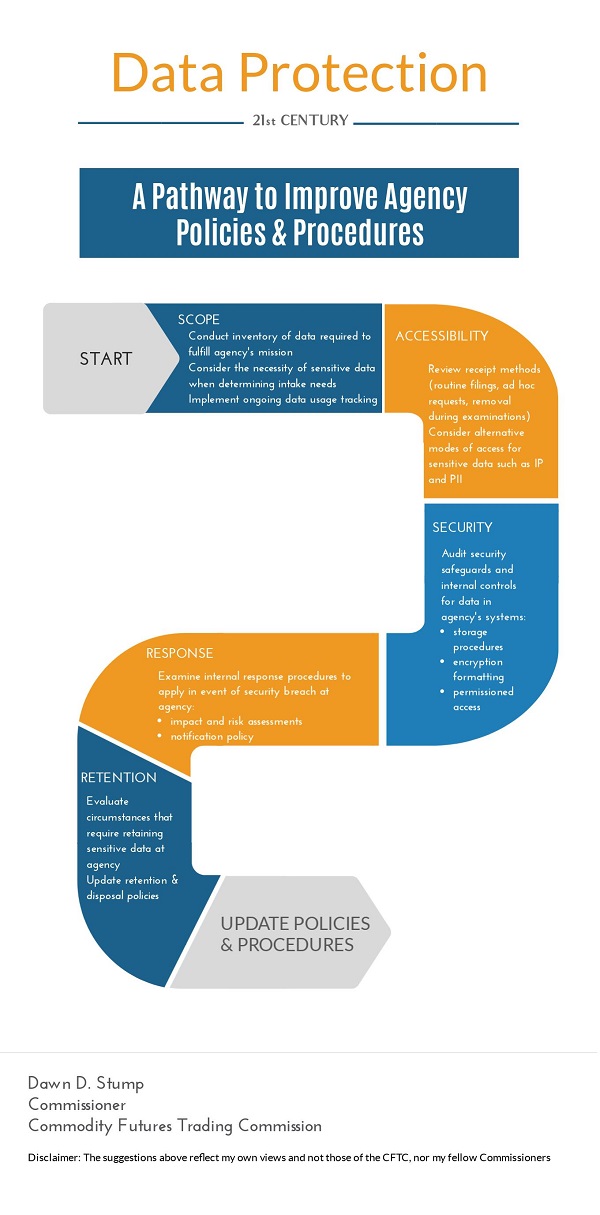
I am pleased to provide another[1] update to the Data Protection Initiative that I announced in March.[2] Data is critical to our markets and our regulatory mission. At the same time, the CFTC must be mindful of cyber threats and its data risk profile. The creation of a Data Catalogue to document all the data the CFTC captures provides the agency with a view into all of the information ingested from the markets we regulate. This exercise afforded me the opportunity to examine each data stream and corresponding use-cases. Based on the current frequency of use and the regulatory value of the data, I have identified data that I feel is ripe for streamlining.

I believe that we should:

  1. Codify the no-action relief applicable to Ownership and Control Reports (OCR) required by Parts 17, 18 and 20 of the Commission’s Regulations and explore whether certain forms and/or questions need further modifications or removal.
  2. Evaluate whether the Commission should continue to require the reporting of physical commodity swaps both to Swap Data Repositories (SDRs) via Part 45 and directly to the agency per Part 20.  If SDR data enables the Commission to effectively oversee commodity swaps markets, then we should explore the sunset of duplicative Part 20 Large Trader Reporting for Physical Commodity Swaps.
  3. Amend Form CPO-PQR to remove certain schedules and questions while focusing only on data points that the CFTC and National Futures Association (NFA) currently use and have been deemed to be valuable over time. This could include reverting to the original Form-PQR version previously collected by the NFA while adding an extremely limited number of questions that have proven utility. Separately, I want to applaud the joint work of Commissioners Peirce and Quintenz in coordinating across our respective agencies in refining Form PF for the purposes of systemic risk review. I thank them both for their work on the CFTC-SEC harmonization efforts.
  4. Examine whether to continue the Cotton-On-Call Report.
  5. Consider the breadth of the CFTC’s upcoming swap data reporting regulations and limit the collection to the Critical Data Elements published by CPMI and IOSCO[3] while only augmenting the collection with additional data elements that are required to accomplish our core mission and have a demonstrable and regularly recurring use-case.
  6. Explore ways in which the CFTC can better leverage cash-market reporting provided to exchanges in order to avoid duplicative filings, such as on Form 204.

These identified data streams are required to be reported under a myriad of regulations relating to various Divisions within the CFTC and represent both legacy and recently expanded authorities of the agency. The CFTC must constantly evaluate its approach to data and develop a meaningful policy adapted to ever-evolving threats and advances in data security. I hope to implement consistent data protection procedures across the many functions required to carry out our mission that will benefit the agency and market participants. I look forward to engaging with market participants to discuss any other applicable data streams in need of review.

As the CFTC continues its commitment to robust data protection measures, I also am able to convey that recent progress has been achieved concerning the security of the agency’s data. An audit from the Office of the Inspector General[4] regarding information technology management and security issued multiple recommendations. The CFTC addressed all of these recommendation and they were recently closed.

In addition to specific data refinements, the CFTC should review the structure of the agency’s data organization, create a data business plan, and develop a long-term strategy to generate internal operational efficiencies and become a 21st century, data-driven regulator.

I want to thank the staff of all the Divisions and Offices across the entire CFTC for their assistance, as many parts of the agency are involved in this project and data protection is truly everyone’s responsibility. The specter of data breaches requires the CFTC to remain vigilant and ensure that we have both a culture, and policies and procedures, that are conducive to data protection. I look forward to continuing to work with staff and market participants, as appropriate, to implement the remaining steps of the Data Protection Initiative.  

Data Protection Chart


[1] See Statement of CFTC Commissioner Dawn D. Stump Announcing Important Progress in the CFTC’s Data Protection Initiative (July 12, 2019), available at https://www.cftc.gov/PressRoom/SpeechesTestimony/stumpstatement071219.

[2] See Statement of CFTC Commissioner Dawn D. Stump on Data Protection Initiative (March 1, 2019), available at https://www.cftc.gov/PressRoom/SpeechesTestimony/stumpstatement030119.

[3] See Committee on Payments and Market Infrastructures and Board of the International Organization of Securities Commissions, Technical Guidance, Harmonisation of Critical OTC Derivatives Data Elements (Other than UTI and UPI) (April 9, 2018), available at https://www.bis.org/cpmi/publ/d175.htm.  

[4] See Review of CFTC’s Data Governance Program:  Integrated Surveillance System, Report Number 18-AU-07 (OIG May 7, 2019), available in “Other Audits” at https://www.cftc.gov/About/OfficeoftheInspectorGeneral/index.htm.

Remarks of DSIO Director Joshua B. Sterling Before the K&L Gates Chicago Investment Management Conference

Remarks of DSIO Director Joshua B. Sterling Before the K&L Gates Chicago Investment Management Conference

November 14, 2019

Trillions.

Introduction.

Good morning.  I wish to begin by thanking K&L Gates for hosting this important conversation, and for the hospitality that they have extended to all gathered here today.

It is impossible to overstate the value of the bar in an open society that is sustained by a common respect for natural rights, fealty to the law, and the coruscating power of free markets.  Those markets afford a broad and grand wealth unparalleled in human history, and they operate under laws enacted with the consent of the governed.  General prosperity is only possible in such a system.  The alternative prescription of resource distribution by fiat would visit upon everyone a moribund and general destitution, delivered by a government of thuggery, cloaked in the color of law and malevolent towards the very idea that individual freedom is the birthright of all.

In our system, the bar is a protector of freedom and a guarantor against the creep of soft despotism.  So I have always been, and will remain, proud to be a member of the bar.  It has given me the great privilege of serving clients in the exercise of their rights under the law in our free society.

Today, of course, my one and only client is the greatest of all — the United States of America.  I bear in mind the lessons of my years in the private bar as I seek to walk circumspectly in overseeing registered firms that play such a vital role in our great markets.

Let us then talk about a group of registered firms that exercise tremendous power in the derivatives markets.  Given this audience, I refer to asset management firms that are commodity pool operators (CPOs) and commodity trading advisors (CTAs).  We will explore the CFTC’s role in overseeing CPOs and CTAs as we further our mission of promoting the integrity, resilience, and vibrancy of the U.S. derivatives markets through sound regulation.  That oversight must consider the evolution of the asset management industry and the likelihood that the vital role your firms play in our markets will continue to grow.

Before going any further, and in case my “free markets forever” riff hasn’t made it clear enough, the views I express are my own and not necessarily those of the Commission or its staff.

Bigger, Faster, Stronger.

Years ago, my old football coach convinced the team that an offseason of following the Bigger, Faster, Stronger training program would help us improve on the field.[1]  By using weightlifting to shape specific muscle groups, our combined physical prowess would make for a better team that got better results.  I quit the team after my first year because I was athletically hopeless, but the idea of combining strengths across all positions on the squad made a lot of sense.

As I look at the asset management industry, I recognize a similar trend towards getting bigger, faster, and stronger.  The financial press abounds with news of the industry being shaped by competitive pressures and broader economic trends.

To wit:

  • Bigger.  Over the past several years, investors have generally pushed their assets into a smaller set of very large funds.  The funds that are winning these investor flows can deliver greater economies of scale and more attractive pricing, putting those funds that are experiencing significant outflows at a real competitive disadvantage.  Some funds have achieved such great scale that they can even offer “no fee” share classes, presumably because revenues from securities lending and other portfolio-related activities make that choice commercially viable.
  • Faster.  Technology is increasing the velocity and volume of everything, including investment decisions.  Some asset managers rely exclusively on algorithms and other quantitative tools to pursue high- and mid-frequency trading strategies, pushing the speed curve to impressive lows.  Other, more traditional managers increasingly incorporate quantitative tools into their portfolio management activities as a complement to fundamental research, factor analysis, and other longstanding investment techniques.  Even more advanced tools, like quantum computing, are on the industry’s event horizon.[2]  There are indeed many more ways that managers will seek to capture returns, ever more quickly, while asset prices take their proverbial “random walk” down Wall Street.[3]
  • Stronger.  Large managers are becoming larger still through strategic transactions and business flows driven by investor preferences.  The leadership of one global asset manager has even suggested that a third of his peer firms could cease to exist over the coming years, due to consolidation driven by competitive pressures.[4]  Firms have grown to running several hundred billion or even trillions in client assets by offering compelling products, cutting-edge technology, and excellent investor services.  Amid these large-scale transactions and the undeniable comparative advantage of scale, I am reminded of the time, not long ago, when a general counsel quipped that a trillion in assets under management would be table stakes for the next decade.

It is not the CFTC’s place to dictate the direction or pace of product development.  Nor does it get involved in strategic transactions.  Yet the evolution toward bigger, faster, and stronger in the asset management industry will undeniably affect the derivatives markets.  This ongoing change will implicate my Division’s strong interest in ensuring effective oversight of CPOs and CTAs, given the CFTC’s market oversight and investor protection mandates.

Your Market Impact and Our Market Resiliency.

Let me lay out some more plain facts:

  • As a class, asset managers have long been among the largest participants in the futures markets, measured both by transaction volume and open interest.
  • The data say much the same for our swaps markets.
  • Asset managers are also the largest providers of market liquidity that we regulate.
  • To provide liquidity is also to transmit risk.

If we take as true the proposition that asset managers will continue to get bigger, faster, and stronger, then these facts suggest a strong likelihood that asset managers will only grow to have a larger impact on our markets.  If scale in asset management leads to greater concentration in portfolio decision making and risk management, then there’s a real potential for very large managers to move markets in ever greater proportions of size and speed.  It’s reasonable to anticipate that the various dependencies in our markets will experience outsize effects from this increasing scale.  In this regard, I refer to the connections with and among FCMs, swap dealers, contract markets, swap execution facilities, and clearinghouses.

In relation to our markets, scale has to be considered in relative terms at the level of an asset management organization, less so in the absolute terms of separate client and proprietary accounts.  Putting this notion into more specific relief, if a large firm has a centralized investment function (e.g., a global CIO), we can reasonably expect coordinated decision making among several accounts when the firm seeks to express a particular view, whether in taking or offloading risk.

Even if there is no single “large” position relative to the market in question, the accumulation of several individual positions across the same organization can be quite “large” in the aggregate.  So, several investment decisions that express the same view can have a market impact that could, in certain circumstances, affect market resiliency.  And this is to say nothing of larger firms that trade “large” positions, or even the high- and mid-frequency firms that use their speed and agility to trade in and out of positions quicker than a heartbeat.

We also have to consider the impact of bigger, faster, and stronger given where asset managers lie on the continuum of liquidity and risk transmission, and the interconnectedness of our registrants that transact in client, customer, and counterparty assets:

  • Liquidity and Risk Continuum.  CPOs and CTAs lie at the outside of our markets, typically as initiators of derivatives trades.  By placing trades and maintaining positions, they push liquidity and risk along strings that are tied either to the middle of the market through FCMs, in the cleared context, or to swap dealers, in the bilateral context.  Those FCMs and swap dealers are often part of larger financial holding companies that have significant connections to the financial system.  So, as a bigger, faster, and stronger asset manager pushes or pulls on any of those strings, it can greatly affect the liquidity and risk attributes along the continuum for cleared and uncleared trades in our markets.  And our markets are tied to the broader financial system in many ways, most immediately through participation in clearinghouse guarantees and by the connections that bank-affiliated firms have to deposit taking, lending, and other banking activities.  This proposition will hold even more when multiple large asset managers push or pull these strings at the same time and in the same direction.
  • Interconnectedness.  Liquidity and risk are transmitted from the many CPOs and CTAs into the many fewer FCMs and swap dealers that take their trades.  The number of FCMs has shrunk dramatically over the past 15 years.[5]  Among the remaining 55 registered FCMs with customer business, our data indicate that just 10 firms hold about 75 percent and 93 percent of customer funds for futures and foreign futures, respectively, 17 FCMs alone are responsible for all customer cleared swaps activity.[6]  As for swap dealers, while there are 107 registered firms, our data show that, as of the end of the second quarter of 2019, just 10 swap dealers accounted for well over 50 percent of total dealer swap positions.

To sum up, I do not consider bigger, faster, and stronger asset managers as inherently good or bad.  And I recognize the potential advantages of size, speed, and scale for investors and clients.  We must also give due consideration to the existing rule framework for other registrant categories that both seek to mitigate risks — such as margin, capital, and risk management requirements — and to provide transparency through mandatory reporting.

We do, however, have to accept these facts and the propositions that flow from them as true.  When we do so, it’s undeniable that we have to evolve in how we oversee CPOs and CTAs.  But we must do so carefully.  Our role is not to call shots in the evolution of the asset management industry, but to promote the strength, resiliency, and vibrancy of the markets in which asset managers operate.

Respecting the Critical Role of Asset Managers in Society.

The CFTC’s uptake in responsibility for asset management was sudden and significant, starting in earnest earlier this decade.  Despite some hue and cry about this development at the outset, I’ve seen little in the years since that would dissuade me from carrying our oversight forward.  Your firms are getting bigger, faster, and stronger all the time, and our oversight needs our rules to keep up with how your size, speed, and agility affect our markets.  It’s as simple as that.

While that idea is simple, my own respect and admiration for asset management is profound.  The impact that your firms have on the lives of all Americans is singular.  I think of my own family, and how the transformation of income to investment, and investment to wealth, has made all the difference.

As a kid, I remember the day my father came home with a new and rather basic Ford Ranger pickup; the only extra was the red paint.  Times were tight.  But my parents always invested, and they had the opportunity to make prudent choices based on the myriad of sound investment products available to retail investors.  My parents are now enjoying their golden years with a solid nest egg built over decades of hard work and savings.

I will never forget this life lesson as I think about how we should balance our need to oversee registrants, as they put client and investor money to work, and the imperative for asset managers to deliver on the promise that our free markets offer to all.

*****

Thank you for your time.  In the end, we want our regulation of CPOs and CTAs to be smart, effective, and practical.  To do that, we have to keep up with the significant changes underway in the asset management industry.

My world-class staff and I look forward to working with you.

Thank you all again.


[2] Risk.net, “Barclays, IBM test quantum computing for settlement” (Oct. 17, 2019), available at https://www.risk.net/risk-management/7087566/barclays-ibm-test-quantum-computing-for-settlement.

[3] Malkiel, Burton Gordon, A Random Walk down Wall Street : the Time-Tested Strategy for Successful Investing, (New York, W.W. Norton, 1973).

[4] Financial Times, “One in three asset management firms could disappear, says Invesco Chief” (Mar. 13, 2019), available at https://www.ft.com/content/c4ff2a92-4508-11e9-a965-23d669740bfb.

[5] At the end of 2004, a total of 190 FCMs were registered with the Commission, compared to 64 registered FCMs as of the end of September 2019.

[6] See Selected Financial Data as of September 30, 2019, from reports filed by October 24, 2019, available at https://www.cftc.gov/sites/default/files/2019-11/09%20-%20FCM%20Webpage%20Update%20-%20September%202019.pdf.

Opening Statement of Chairman Heath P. Tarbert Before the Energy and Environmental Markets Advisory Committee

Opening Statement of Chairman Heath P. Tarbert Before the Energy and Environmental Markets Advisory Committee

November 7, 2019


Good morning.  I am very pleased to be attending my first EEMAC meeting as CFTC Chairman.


America’s energy markets are part of the bedrock of our economy.  The United States is the world’s largest producer of both natural gas and oil.[1]  It’s the second-largest generator of electricity overall.[2]


One of my strategic goals as Chairman is to regulate our derivatives markets to promote the interests of all Americans.  This is critical for energy in particular.  

Energy derivatives markets affect the pocketbook of every American, from the price of gasoline at the pump to the cost of heating our homes.


To achieve this goal, the Commission needs insight from all of you.  That makes today’s EEMAC meeting especially important.  I want to thank Commissioner Berkovitz and his staff for sponsoring this meeting.  Thanks also to Abigail Knauff, the EEMAC Designated Federal Officer, for organizing it.  


Of course, I am also grateful to the Chair, Dena Wiggins, and to all members and associate members of the EEMAC.  Thank you for taking the time to share your valuable experience and perspectives.


Many of the CFTC’s core agenda items directly touch the energy markets.  The Commission’s forthcoming position limits rule proposal is one example.  The proposal is intended to provide an appropriately flexible bona fide hedging exemption.  This will allow energy producers, merchandisers, and distributors to better manage the many risks of their businesses.  


Another example is the Commission’s swap data reporting rules.  The changes we propose will be designed to streamline reporting.  This should reduce regulatory burdens and also make it easier to use swaps data, increasing transparency in energy swaps markets.


These and other efforts will help promote America’s energy derivatives markets through sound regulation.  I look forward to working with you all to ensure that our energy derivatives markets continue to serve participants and their customers. 


[1] U.S. Energy Information Administration, The U.S. Leads Global Petroleum and Natural Gas Production with Record Growth in 2018, Today in Energy (August 20, 2019), https://www.eia.gov/todayinenergy/detail.php?id=40973; U.S. Energy Information Administration, The United States is Now the Largest Global Crude Oil Producer, Today in Energy (Sept. 12, 2018), https://www.eia.gov/todayinenergy/detail.php?id=37053.

Opening Statement of Commissioner Brian D. Quintenz before the CFTC Energy and Environmental Markets Advisory Committee

Opening Statement of Commissioner Brian D. Quintenz before the CFTC Energy and Environmental Markets Advisory Committee

November 7, 2019

Thank you Commissioner Berkovitz for convening today’s meeting of the Energy and Environmental Markets Advisory Committee (EEMAC).  Sadly, I am not able to participate in person due to a prior commitment, but I am looking forward to watching all the panels later via webcast.

The Committee has a packed agenda before it today, exploring issues that are timely and pertinent to the intersection of the derivatives markets with environmental and energy developments.  Historically, exchange-traded and over-the-counter derivatives products have enabled producers, merchants, and users of energy and environmental products to manage and hedge their commercial risks.  Today, the derivatives markets continue to be on the cutting edge of risk management by offering an ever-expanding suite of products designed to assist firms hedge risks related to climate, government-mandated emissions reduction targets, or fuel prices, including renewable fuels.

As I have noted previously, I believe the robust energy derivatives markets in the United States have played a pivotal role in supporting our nation’s energy independence as well as our country’s unheralded reduction in carbon emissions.  This fall, the U.S. Environmental Protection Agency (EPA) released its latest Greenhouse Gas Reporting Program data which found that reported U.S. greenhouse gas emissions have declined roughly 10 percent since 2011.[1]  In 2018, greenhouse gas emissions were 13 percent below 2005 levels – the biggest reduction compared to 2005 among all the G-20 countries.[2]  A significant part of this decline in emissions has come from an unlikely source: the shale oil boom.  Let me explain.

The energy revolution in the United States over the last 10 years provided by shale oil extraction has not only resulted in an 80% increase in oil production, but also a 50% increase in natural gas production. That huge new supply of natural gas has led to a 50% increase in the amount of electricity produced from natural gas which, in turn, has led to a 2.3 billion metric ton reduction in carbon emissions.[3]

None of that progress – the benefits to national security secured from energy independence or the climate benefit from carbon emissions reductions – would have been possible without the explorers, innovators, and entrepreneurs behind the shale oil revolution, which, in my opinion, would not have been possible without having the world’s deepest and most liquid energy derivatives and hedging markets to offset the risk of those exploratory efforts.

In 2010, when the shale boom was just beginning, commodity price risk management in the futures markets enabled entrepreneurs to secure financing from banks, deploy capital effectively, and minimize cash flow fluctuations attributable to commodity price swings.  The ability to largely insulate their firms from volatile price movements in the oil and natural gas markets enabled these entrepreneurs to access credit and continue to innovate and expand, resulting in the shale oil revolution. 

There is an important lesson to be gleaned here:  the vibrancy and liquidity of the American futures and swaps markets have already played an important part in the reduction of carbon emissions related to electricity generation by serving as effective hedging venues that supported private sector ingenuity, discovery, and production of cleaner energy resources.

Unfortunately, the status of those markets, particularly related to energy derivatives, is under significant threat. 

I have noted repeatedly my concerns that the Prudential Regulators’ proposal to implement the standardized approach for counterparty credit risk (SA-CCR) methodology for purposes of calculating risk-weighted assets under the agencies’ capital rule could have a profoundly negative impact on the derivatives markets and energy end-users specifically.[4]

In 2014, the Basel Committee published a formula for SA-CCR calculations - without any supporting data or analysis - that penalized derivatives contracts through exaggerated risk weightings, particularly with respect to cleared futures and swaps.  The Prudential Regulators’ Proposal goes even further by cherry-picking the Basel Committee’s highest “supervisory factor” from the various commodity asset classes and applying it to every energy-related derivative –including exchange-traded, margined, and cleared WTI and natural gas futures, as well as energy swaps.  The result is enormously punitive treatment of oil and gas derivatives transactions on bank balance sheets that, according to some commenters, would increase a bank’s exposure calculations under SA-CCR with an end-user counterparty by up to 460%.[5]

Increased exposure calculations will result in higher capital charges to the bank, which, in turn, will either be passed on to the end-user in the form of higher transaction pricing or will simply cause the bank to withdraw from the market.  As I have stated previously, I believe the Proposal should revisit the supervisory factors for all types of commodities to ensure they are appropriately calibrated to the actual risks of the underlying commodity and the maturity of the derivatives contract.  Failure to do so may do irreparable damage to the energy markets, inhibiting or preventing altogether the next revolution in energy production.

Similarly, I remain concerned that the proposal does not recognize non-cash collateral arrangements.  Alternative collateral arrangements are frequently used by banks in commodity derivatives transactions with end-users to create “right way” risk and can be effective means of managing the credit risk of certain derivatives transactions.  Allowing for the appropriate degree of recognition of these risk-reducing arrangements would increase the risk-sensitivity of SA-CCR and mitigate any increased transaction costs passed on to commercial end-users.

In closing, I would like to reiterate my thanks to all of today’s panelists and the EEMAC membership for their participation, as well as Commissioner Berkovitz for organizing this meeting.


[1] Greenhouse Gas (GHG) Reporting Program, EPA, https://www.epa.gov/ghgreporting/ghgrp-reported-data#emissions-trends.  This estimate is based on direct emissions reported to the EPA; statistics relating to total U.S. GHG Inventory are not yet available.

[2] Inventory of U.S. Greenhouse Gas Emissions and Sinks, EPA, https://www.epa.gov/ghgemissions/inventory-us-greenhouse-gas-emissions-and-sinks.

[3] August 2018 Monthly Energy Review, U.S. Energy Information Administration, https://www.eia.gov/environment/emissions/carbon/?src=email.

[4] Standardized Approach for Calculating the Exposure Amount of Derivative Contracts, 83 Fed. Reg. 64,660 (proposed Dec. 17, 2018) (hereinafter, the “Proposal”), available at https://www.federalregister.gov/documents /2018/12/17/2018-24924/ standardized-approach-for-calculating-the-exposure-amount-of-derivative-contracts.

[5] Comment Letter from Coalition for Derivatives End-Users at 5 (March 18, 2019).

Opening Statement of Commissioner Dan M. Berkovitz before the Energy and Environmental Markets Advisory Committee

Opening Statement of Commissioner Dan M. Berkovitz before the Energy and Environmental Markets Advisory Committee

November 7, 2019

Good morning, and welcome to the Energy and Environmental Markets Advisory Committee (EEMAC or Committee).

I would like to begin by welcoming our six new associate members.  Dr. John Parsons from MIT will serve the Committee as a Special Government Employee.  Dr. Parsons is a financial economist specializing in, among other things, risk management in energy and environmental markets and the process of decarbonization.  Sean Cota is the President and CEO of NEFI, a national association of retail heating fuel companies, and third-generation owner of a New England fuel marketing business.  Noha Sidhom is the CEO of TPC Energy, LLC, which trades power products in the organized markets and on CFTC regulated exchanges, and the co-founder and Executive Director of the Energy Trading Institute representing commercial energy market participants.  Kaiser Malik is Vice President and Assistant General Counsel for Calpine’s wholesale power, natural gas, and environmental trading and marketing operations, and leads the legal division for Calpine’s retail energy businesses.  Erik Heinle is an Assistant People’s Counsel with the Office of the People’s Counsel for the District of Columbia, representing District ratepayers before PJM and various federal regulators, and served as Co-Chair of the Energy Bar Association’s Renewable Energy Subcommittee.  And Dan Dunleavy is a former energy trader and the Manager of Energy Strategy for Ingevity Corporation, a specialty chemical company based in Charleston, S.C.  We are pleased welcome each of you and look forward to hearing your diverse perspectives.

I would also like to thank all of our returning Members and Associate Members for joining us today.  The insights you share with the Commission through your participation in the EEMAC are very valuable and much appreciated.

I would like to thank Dena Wiggins for her continued service to the Committee as our EEMAC Chair.  Ms. Wiggins is the President and CEO of the Natural Gas Supply Association, and has over 25 years of experience representing energy clients in federal regulatory matters.  This is her third meeting as EEMAC Chair and we are grateful for her leadership.

I am pleased to recognize Chairman Tarbert, and Commissioners Behnam and Stump, and appreciate their participation today.

I would like to thank the Commission staff that made today’s meeting possible, including Abigail Knauff, the EEMAC secretary; Margie Yates and Altonio Downing; Lucy Hynes and Erica Quinlan on my staff; Michelle Ghim in the Office of General Counsel, and everyone else that worked so hard behind the scenes to prepare for this meeting.

I now would like to recognize Sue Kelly, President of the American Public Power Association.  Sue has announced that she will be retiring at the end of this year.  This will be her last meeting on this advisory committee.  My relationship with Sue goes back many years, form our time working on the Dodd-Frank legislation and its implementing regulations.  I recall attending an APPA meeting in Seattle in 2013, at Sue’s invitation, to provide a tutorial on the CFTC’s new Dodd-Frank requirements.  Both then and now Sue has been a tireless—perhaps relentless is better word to describe Sue’s activity at the CFTC—and effective advocate for the interests of the public power utilities.  Sue is a true leader in the energy industry, and her strong voice will be missed at the CFTC.

The CFTC established this Committee in 2008 as the Energy Markets Advisory Committee, to advise the Commission on developments in energy markets that raise new issues for the CFTC, and to recommend appropriate regulatory responses to ensure market integrity and protect consumers.[1]  In 2009, under former Commissioner Bart Chilton’s leadership, the Commission expanded the scope of the Committee to include environmental markets.

Like the Committee’s inaugural meeting in 2009, we will focus today’s presentations on the environmental markets.  But in the intervening ten years, the landscape of energy generation has changed dramatically.  New technologies have enabled the U.S. to be the world’s largest producer of natural gas and crude oil, and energy generation from renewable sources such as solar and wind has doubled.[2]  As the mix of energy sources continues to diversify and firms continue to innovate, we can expect further changes in the physical markets, which may lead to corresponding changes in how market participants use derivatives to hedge their risks.

Today’s meeting will focus on how the evolving mix of energy generation resources—which includes coal, natural gas, nuclear, oil, and various renewable energy sources—is impacting the physical markets and may subsequently impact the energy and environmental derivatives markets regulated by the CFTC.

Panel I: The Global Energy Transition: Evolving Standards Impacting Physical Markets

Our first panel will explore the evolving state, federal, and global regulations that impose various renewable energy mandates and goals for energy production and procurement.  Tyson Slocum from Public Citizen will begin by discussing how regulation and market forces are affecting the deployment of renewable energy, and suggest ways in which the federal government can assist in the growth of renewable energy.  Jenny Fordham from the Natural Gas Supply Association, Sue Kelly from APPA, and Vincent Johnson from BP Energy Company will discuss some of the challenges of, and opportunities for, incorporating renewables into the power supply, including the shifts in capital investment, maintaining affordable prices, and managing risk.

Panel II: Exchange-Traded Environmental Derivatives Contracts

On the second panel, we will hear from Daniel Scarbrough of IncubEx, a partner of Nodal Exchange and EEX Group, and Michael Kierstead of ICE.  Dan and Mike will give us an overview of the current state of CFTC-regulated environmental futures markets, including emissions trading and Renewable Energy Certificate futures.  Dr. Richard Sandor, who is a global leader in successfully creating new financial products and markets, will explain how new products and markets are created.

Panel III: The Impact of the Global Energy Transition on Market Participants’ Use of the Energy and Environmental Derivatives Markets

Our third and final panel will discuss the effect of the energy transition on how market participants hedge risk using exchange-traded and OTC derivatives.  Our panelists include Matthew Picardi of the Commercial Energy Working Group, Lopa Parikh of Edison Electric Institute, Paul Hughes of Southern Company, Bill McCoy of Morgan Stanley, and Jackie Roberts of the Consumer Advocate Division of West Virginia.  The panelists will describe how they use CFTC-regulated exchanges and OTC markets to manage risks for renewable energy commodities and project financing, as well as limitations presented by those markets.

We look forward to hearing from our Members and Associate Members on these issues.


[1] EEMAC Agenda, Executive Summary (May 13, 2009), available at https://www.cftc.gov/idc/groups/public/@aboutcftc/documents/generic/eemac051309_agenda.pdf.

[2] EIA, U.S. renewable electricity generation has doubled since 2008 (Mar. 19, 2019), available at https://www.eia.gov/todayinenergy/detail.php?id=38752.

Dissenting Statement of Commissioner Dan M. Berkovitz

Dissenting Statement of Commissioner Dan M. Berkovitz

In re Tower Research Capital LLC: Waiver of SEC “Bad Actor” Disqualifications

November 7, 2019

I dissent from the Commission’s approval of the administrative settlement with Tower Research Capital LLC (“Tower”).  While I agree with the substantial remedial sanctions the CFTC is imposing on Tower, I do not support the Commission’s decision to grant Tower a waiver from the “bad actor” disqualification in Securities and Exchange Commission (“SEC”) Rule 506.[1]  The CFTC has neither the legal authority nor the expertise to determine the appropriate procedures and qualifications for public and private securities offerings and how best to protect investors from fraud in the securities markets.  These matters are the core responsibility of the SEC, not the CFTC.

As a legal matter, the CFTC does not have the authority to make determinations—such as by providing binding “advice” under SEC Rule 506—as to the appropriate procedures or qualifications for the offering of securities under the Securities Act of 1933 (“Securities Act”).  There is nothing in the Commodity Exchange Act (“CEA”), the securities laws, or any other law that authorizes the CFTC to make these securities law determinations.   “[A]n agency literally has no power to act . . . unless and until Congress confers power upon it.”[2]   Because there has been no delegation by Congress to the CFTC to administer the registration of securities, including determining which firms should be exempt from registration requirements, the CFTC’s determination that Tower should not be disqualified from certain registration requirements under the Securities Act is ultra vires—it has no legal effect.

As a matter of policy, it is inappropriate for the CFTC—the federal derivatives regulator—to opine on, or determine, whether securities offerings should be exempt from registration under the securities laws.  The CFTC does not possess the expertise to determine the appropriate procedures for securities offerings, or how to best protect investors from fraud in securities offerings.  Administering the securities laws is the responsibility of the SEC.

The SEC’s process for waiving automatic disqualifications does not serve the interests of the CFTC, the SEC, or the public.  The rule complicates the CFTC’s ability to prosecute violations of the CEA because firms that are subject to disqualification will not resolve their actions unless the CFTC agrees to waive the disqualification.  And the rule does not advance the SEC’s interests in protecting investors because decisions regarding waivers are being made by a derivatives regulator for a hodgepodge of reasons, not by the securities regulator according to the criteria it has established for those decisions.

I look forward to working with my colleagues, and our counterparts at the SEC, to find a solution that extracts the CFTC from the SEC’s waiver process and allows the CFTC to resolve its enforcement actions without delay.

Background on “Bad Actor” Disqualifications

SEC Rule 506 is one of three rules under the SEC’s Regulation D that exempts certain securities offerings, particularly to accredited investors, from the registration requirements of the Securities Act.[3]  Because registered public offerings entail significant SEC disclosure requirements, an exempt private offering under Rule 506 enables companies to obtain funding faster, at less cost, and with much less disclosure than with a public offering.[4]  In addition, securities offered in compliance with Rule 506 are considered “covered securities” and are largely exempt from state regulation.[5]  Rule 506 is by far the most widely used Regulation D exemption, accounting for 95% of all Regulation D offerings and trillions of dollars in capital raised.[6]  Regulation A is an analogous exemption from SEC registration requirements for certain public offerings.[7]

Just as these registration exemptions have been around for decades, so have disqualification provisions than automatically ban corporations from using them when they run afoul of the securities laws.  “‘Bad actor’ disqualification requirements . . . disqualify securities offerings from reliance on exemptions if the issuer or other relevant persons . . . have been convicted of, or are subject to court or administrative sanctions for, securities fraud or other violations of specified laws.”[8]  In the absence of a waiver, a company subject to one of these automatic disqualification provisions is not prohibited from participating in the capital markets, but it may not rely on the safe harbor exemptions, which substantially reduce their disclosure obligations and the cost and time of registration.  Companies may also face reputational harm as a result of the ban.

Disqualifications and Waivers Under Section 926 of the Dodd-Frank Act

In July 2010, Congress enacted Section 926 of the Dodd-Frank Wall Street Reform and Consumer Protection Act[9] with the goal of enhancing oversight of the capital markets and reducing fraud in private offerings.[10]  This provision required the SEC to adopt rules that disqualify certain securities offerings involving “bad actors” from relying on the safe harbor protections of Rule 506, which did not previously contain a disqualification provision.

Section 926 directed that the SEC adopt by rule bad actor disqualification provisions with respect to offerings of securities under Rule 506 that: (1) were “substantially similar” to SEC Rule 262, the disqualification provision then in existence under Regulation A; and (2) “disqualify any offering or sale of securities by a person that—(A) is subject to a final order of a State securities commission . . . , a State authority that supervises or examines banks, savings associations, or credit unions, a State insurance commission . . . , an appropriate Federal banking agency, or the National Credit Union Administration . . . .”[11]  Congress did not identify the CFTC as an agency whose orders would give rise to automatic disqualification under SEC Rule 506, nor was the CFTC identified in Rule 262 at the time the Dodd-Frank Act was adopted.[12]

In response to this mandate, in 2011, the SEC proposed amendments to Rule 506.  Although the CFTC was not identified in the statute, the SEC solicited public comment on whether CFTC orders should also trigger disqualification from the Rule 506 safe harbor from registration.[13]  Two years later, the SEC adopted the new rule, adding the CFTC as an agency whose orders would automatically give rise to disqualification.[14]  The SEC reasoned that “the conduct that would typically give rise to CFTC sanctions is similar to the type of conduct that would result in disqualification if it were the subject of sanctions by another financial services industry regulator,” and that CFTC actions trigger consequences under other SEC rules.[15]

The new Rule 506 also provided that automatic disqualification “shall not apply . . . [i]f, before the relevant sale, the court or regulatory authority that entered the relevant order, judgment or decree advises in writing . . . that disqualification . . . should not arise as a consequence of such order, judgment or decree . . . .”[16]  In 2015, the SEC conformed the bad actor provisions in Rule 262 to be substantially similar to those in Rule 506.[17]

SEC Rule 506 provides that the SEC may waive the disqualification “[u]pon a showing of good cause” and “if the Commission determines that it is not necessary under the circumstances that an exemption be denied.”[18]  The Commission (SEC) has delegated authority to grant waivers to the Director of its Division of Corporation Finance, but has retained authority to make any particular determination, “including granting [waivers] in connection with settling [an SEC] enforcement action.”[19]  The SEC’s Division of Corporation Finance has issued guidance regarding the facts and circumstances it will consider when determining whether to issue a waiver from disqualification, including who was responsible for the misconduct; the duration of the misconduct; the remedial steps that have been taken to address the misconduct; and the impact if the waiver is denied.[20]  Former SEC Chair Mary Jo White described the SEC’s waiver determinations as “a thorough, rigorous, and principled application of the law to the particular facts of each case and a process that we continue to scrutinize and enhance.  It is not at all a routine or kneejerk exercise.”[21]

CFTC’s Involvement in the Waiver Process

Given the consequence of Regulation D offerings to market participants, CFTC staff is regularly faced during settlement negotiations with requests to waive the SEC “bad actor” disqualification that would otherwise result from a CFTC enforcement action.  In fact, firms inform the CFTC that they will not resolve its enforcement actions absent a waiver.  This puts our agency in the untenable position of either issuing a waiver it is both unauthorized and unqualified to provide, or indefinitely delaying our enforcement actions until the SEC can render an opinion, which hinders the CFTC from performing one of its core missions—enforcing the CEA and Commission regulations.  Facing this dilemma, the CFTC has grappled with how to respond to these waiver requests.[22]  The result has been an incoherent foray beyond our jurisdictional boundaries and expertise, driven by the desire to avoid delays in concluding enforcement cases that can result from involving another federal agency in the settlement process.

Initially, following the adoption of the SEC Rule 506 disqualification provision in 2013, the CFTC included language in settlement agreements providing the requested waivers.[23]  However, in mid-2015, following SEC Commissioner Stein’s criticism of the CFTC’s for its decision to grant a waiver to Deutsche Bank AG in a case involving manipulation and false reporting of LIBOR,[24] the CFTC suspended the granting of such requests and instead began referring those requests to the SEC.[25]  In 2018, the CFTC resumed granting waivers of disqualification under SEC Regulations A and D.[26]  It appears that this reversal was due to considerations of expediency—to avoid the potential delay and complication that could result from involving another federal agency in the CFTC’s settlement negotiations.

CFTC Cannot and Should Not Issue Waivers of Disqualification under the Securities Laws

Considerations of expediency, however, do not expand the CFTC’s legal authority beyond its statutory limits.  “Regardless of how serious the problem an administrative agency seeks to address, however, it may not exercise its authority ‘in a manner that is inconsistent with the administrative structure that Congress enacted into law.’”[27]  Neither the CEA, the Securities Act, the Securities and Exchange Act of 1934, the Dodd-Frank Act, nor any other federal statute provides the CFTC with authority to determine the procedures a firm must follow for the public or private offering of securities.

Similarly, there is no statutory authority for the SEC to issue a rule that provides the CFTC with the authority to opine on public offerings of securities.  The SEC cannot confer upon the CFTC powers that Congress has not delegated.  “[A]n agency’s power is no greater than that delegated to it by Congress.”[28]  Section 926 of the Dodd-Frank Act did not provide for the SEC to delegate to the CFTC authority to determine whether firms that violate fraud or manipulation provisions of the CEA should be disqualified from certain securities offerings.  As the U.S. Court of Appeals for the Seventh Circuit has stated, “the CFTC and SEC [cannot] reapportion their jurisdictions in the face of a clear, contrary statutory mandate.”[29]


Rule 506 provides that the automatic disqualification triggered by a CFTC order “shall not apply” if the CFTC “advises” the SEC in writing that such disqualification should not arise as a consequence of its order.  But when the CFTC makes such a finding in one of its orders, it does not operate as discretionary “advice”; it is a legally binding waiver of the SEC’s disqualification provisions.[30]  Our involvement eliminates the need for the company to seek a waiver from the SEC, taking the ultimate decision out of the hands of our sister agency.  This transfer of responsibilities was not contemplated by Congress in the Dodd-Frank Act and is inconsistent with the statutory division of responsibilities between these two agencies.

It is also inappropriate, as a matter of policy, for the CFTC to issue these waivers.  The CFTC does not regulate the securities markets, nor do its Commissioners and staff have the relevant experience or information needed to analyze whether a market participant should be disqualified from certain securities offerings, and how to best protect securities investors from fraud.  CFTC waivers have the additional consequence of preempting state authorities from regulating certain conduct the firms may undertake in their states.  The determination of whether to issue a waiver “can be complex,” and “the robust analysis performed by the Divisions of Corporation Finance and Investment Management has proven critical to the [SEC’s] consideration of these issues.”[31]  When the CFTC makes determinations regarding waivers to firms that are the subject of its enforcement actions, the CFTC does not have the benefit of any such “robust analysis” of the SEC’s Divisions of Corporation Finance and Investment Management.  We should leave this determination to the agencies tasked with regulating securities trading.

Former SEC Chair Mary Jo White has emphatically described the SEC’s core responsibility for implementing the securities laws and its process for waiving automatic disqualifications:


We are responsible for administering the federal securities laws with each part of our mission as our guide—investors and market participants rightfully demand that we do so.  The laws that provide for disqualification, but also provide an accompanying authority for exemptions or waivers, reflect the balance that is at the core of our multi-faceted mission to protect investors, maintain fair, orderly, and efficient markets, and facilitate capital formation.  That must always be our overarching guide in everything we do.[32]


I encourage my colleagues to work with the SEC to properly allocate responsibilities across our respective agencies without delaying the resolution of CFTC enforcement actions.


I thank the CFTC’s Division of Enforcement for their diligent and successful prosecution of the underlying violations of the CEA.


[1] See In re Tower Research Capital LLC, CFTC No. 20-06, at 11 (Nov. 6, 2019) (“Based on the nature of the violations; the findings made, and the sanctions, conditions, and undertakings imposed in this Order; and the facts and representations in the Request Letter, the Commission advises that, under the circumstances, disqualification under [Rule 506] should not arise as a consequence of this Order.”).

[2] Louisiana Pub. Serv. Comm'n v. FCC, 476 U.S. 355, 374 (1986).

[3] See Final Rule, Disqualification of Felons and Other “Bad Actors” From Rule 506 Offerings, 78 FR 44730, 44731 (July 24, 2013) (“Reg. D Final Rule”); SEC, Fast Answers, Rule 506 of Regulation D, available at https://www.sec.gov/fast-answers/answers-rule506htm.html.

[4] Urska Velikonja, Waiving Disqualification: When Do Securities Violators Receive a Reprieve?, 103 Cal. L. R. 1081, 1096-97 (Oct. 2015); see also Investopedia.com, Regulation D, available at https://www.investopedia.com/terms/r/regulationd.asp; cf. Amendments for Small and Additional Issues Exemptions Under the Securities Act (Regulation A), 80 FR. 21806, 21885 (Apr. 20, 2015) (“Reg. A Final Rule”) (“The disqualification provisions also impose costs on issuers and covered persons.  Issuers that are disqualified from using amended Regulation A may experience an increased cost of capital or a reduced availability of capital . . . .”).

[5] See Reg. D Final Rule, at 44731 n.22 (explaining that the National Securities Market Improvement Act of 1996 preempts state registration and review requirements for transactions involving “covered securities.”).

[6] Id. at 44731 n.15; Velikonja, supra note 4, at 1084 n.11 (noting that the amount of capital raised under Rule 506 exceeds “by an order of magnitude” capital raised in all other private offerings).

[7] See generally SEC, Regulation A, available at https://www.sec.gov/smallbusiness/exemptofferings/rega; Reg. A Final Rule.

[8] Reg. D Final Rule, at 44731. 

[9] See Dodd-Frank Wall Street Reform and Consumer Protection Act, section 926, Pub. L. 111-203, 124 Stat. 1376 (2010) (“Dodd-Frank Act”)

[10] See  Statement of Senator Dodd, 156 Cong. Rec. S3813 (May 17, 2010) (“New Section 926 would disqualify felons and other ‘bad actors’ who have violated Federal and State securities laws from continuing to take advantage of the rule 506 private placement process.  This will reduce the danger of fraud in private placements.”); see also Rep. on the Activity of the Comm. on Fin. Serv. for the 111th Congress, H.R. Rep. No. 111-702, 2011 WL 13942, at 204-05 (Jan. 3, 2011) (“To police this segment of our capital markets more effectively, Section 926 of the Dodd-Frank Act makes the registration exemption under Rule 506 unavailable if the issuer or its principals have been the subject of civil, criminal or administrative disciplinary proceedings, including actions brought by State securities, banking, or insurance regulators. This provision enhances the oversight of Rule 506 offerings under both State and Federal law.”). 

[11] Dodd-Frank Act, section 926(1), (2).

[12] See 17 CFR 230.262 (Apr. 2010).

[13] See Proposed Rule, Disqualification of Felons and Other “Bad Actors” From Rule 506 Offerings, 76 FR 31518, 31526 (June 1, 2011). 

[14] 17 C.F.R. 230.506(d)(1)(iii); see also Reg. D Final Rule, at 44740.

[15] Reg. D Final Rule, at 44740.

[16] 17 C.F.R. 230.506(d)(2)(iii) (emphasis added).  At the time Section 926 of the Dodd-Frank Act was adopted, SEC Rule 262 did not contain any provisions triggering automatic disqualification on the basis of other state or federal regulatory authorities’ orders, with the exception of the U.S. Postal Service.  See 17 CFR 230.262 (Apr. 2010).  At the time the SEC adopted the Rule 506 “bad actor” disqualification provisions in 2013, no SEC regulations contemplated that the CFTC, or other authorities, would “advise” on whether disqualification should apply as a consequence of their orders. 

[17] See 17 CFR 230.262 (2016); see generally Reg. A Final Rule.

[18] 17 CFR 230.506(d)(2)(i) (2019).

[19] SEC, Process for Requesting Waivers of “Bad Actor” Disqualification Under Rule 262 of Regulation A and Rules 505 and 506 of Regulation D, available at https://www.sec.gov/divisions/corpfin/guidance/262-505-waiver.htm

[20] SEC, Division of Corporation Finance: Waivers of Disqualification under Regulation A and Rules 505 and 506 of Regulation D, available at https://www.sec.gov/divisions/corpfin/guidance/disqualification-waivers.shtml

[21] SEC Chair Mary Jo White, Understanding Disqualifications, Exemptions and Waivers Under the Federal Securities Laws, Remarks at the Corporate Counsel Institute, Georgetown University, Washington D.C. (Mar. 12, 2015) (“Understanding Disqualifications”), available at https://www.sec.gov/news/speech/031215-spch-cmjw.html

[22] Initially, CFTC orders providing the requested waiver did not undertake any analysis of whether disqualification should arise, stating only that “[u]nder the specific facts and circumstances presented here, . . . disqualification under [Rule 506] should not arise as a consequence of this Order.” See, e.g., In re JPMorgan Chase Bank, N.A., CFTC No. 14-01, 2013 WL 6057042, at *14 (Oct. 16, 2013).  In 2018, the CFTC began to frame its waivers as “advice,” mirroring the language of SEC Rules 262 and 506, and explained that it was considering factors “similar to those considered by the SEC when it issues waivers of disqualification under Regulation A and Regulation D.”  See, e.g., In re Deutsche Bank AG, CFTC No. 18-06, 2018 WL 684634, at *12 n.5 (Jan. 29, 2018).  Today, in the Tower Order, the CFTC introduces new factors—“the nature of the violations; the findings made, and the sanctions, conditions, and undertakings imposed in this Order; and the facts and representations in the Request”—that it considered in determining that disqualification should not arise as a consequence of its order.  See In re Tower, CFTC No. 20-06, at 11.

[23] See In re JPMorgan, CFTC 14-01, 2013 WL 6057042, at *14; In re Citibank, N.A., CFTC No. 15-03, 2014 WL 6068386, at *13 (Nov. 11, 2014); In re JPMorgan Chase Bank, N.A., CFTC No. 15-04, 2014 WL 6068387, at *13 (Nov. 11, 2014); In re Royal Bank of Scotland plc, CFTC No. 15-05, 2014 WL 6068388, at *12 (Nov. 11, 2014); In re UBS AG, CFTC No. 15-06, 2014 WL 6068389, at *13 (Nov. 11, 2014); In re HSBC Bank plc, CFTC No. 15-07, 2014 WL 6068390, at *15 (Nov. 11, 2014); In re Deutsche Bank AG, CFTC No. 15-20, 2015 WL 1874880, at *27 (Apr. 23, 2015).

[24] Commissioner Stein stated: 

[B]based on a loophole contained in Rule 506(d)(2)(iii), the CFTC has intervened and prevented the bad actor disqualification question from even coming before the [SEC].  The CFTC saw fit to opine on the SEC’s Rule 506 jurisprudence about whether Deutsche Bank AG should receive a waiver from automatic disqualification under SEC rules.  It is unclear to me what, if any, analysis went into this decision and what prompted the CFTC to insert language into its final order stating that a bad actor disqualification “should not arise as a consequence of this Order.”  The implications of the CFTC’s actions here—and in other actions—are deeply troubling.  The [SEC] should closely review this provision and how it is being used.

SEC Commissioner Kara M. Stein, Dissenting Statement in the Matter of Deutsche Bank AG, Regarding WKSI (May 4, 2015), available at https://www.sec.gov/news/statement/dissenting-statement-deutsche-bank-ag-wksi.html.

[25] See In re JPMorgan Chase Bank, N.A., CFTC No. 16-05, 2015 WL 9268695 (Dec. 18, 2015); Division of Corporation Finance No-Action, Interpretive and Exemptive Letters, Securities Act of 1933, Regulation D – Rule 506(d) Waivers of Disqualification, The Goldman Sachs Group Inc., et al., available at https://www.sec.gov/corpfin/corpfin-no-action-letters#regd506d (providing link to SEC Order).   

[26] See, e.g., In re Deutsche Bank AG, CFTC No. 18-06, 2018 WL 684634, at *12 (Jan. 29, 2018); In re UBS AG, CFTC No. 18-07, 2018 WL 684636, at *12; In re HSBC Secs. (USA) Inc., CFTC No. 18-08, 2018 WL 684635, at *6 (Jan. 29, 2018).

[27] FDA v. Brown & Williamson Tobacco Corp., 529 U.S. 120, 125 (2000) (quoting ETSI Pipeline Project v. Missouri, 484 U.S. 495, 517 (1988)).

[28] Lyng v. Payne, 476 U.S. 926, 937 (1986).

[29] Bd. of Trade of the City of Chicago v. SEC, 677 F.2d 1137, 1142 n.8 (1982), vacated as moot, 459 U.S. 1026 (1982) (“The role of the agencies remains basically to execute legislative policy; they are no more authorized than are the courts to rewrite acts of Congress.”) (citing Talley v. Matthews, 550 F.2d 911, 919 (4th Cir. 1977)) (alterations omitted). 

[30] The Merriam-Webster dictionary defines “advise” as:  “1a—to give (someone) a recommendation about what should be done . . . ; 1b—caution, warn . . . ; 1c—recommend . . . ; 2—to give information or notice to: inform.”  See https://www.merriam-webster.com/dictionary/advise.  Because the CFTC’s action of advising that the waiver should not apply legally operates to waive the disqualification without any opportunity for the SEC to determine otherwise, the word “advise” in this context has the meaning of “to give information or notice to:  inform.”  It is not a mere recommendation; it informs the SEC of a legal, binding determination that the otherwise applicable disqualification shall not apply.  

[31] SEC Chair Jay Clayton, Statement Regarding Offers of Settlement (July 3, 2019), available at https://www.sec.gov/news/public-statement/clayton-statement-regarding-offers-settlement

[32] White, Understanding Disqualifications, supra note 21.