


Statement of CFTC Chairman Heath P. Tarbert on the FSOC Annual Report
Statement of CFTC Chairman Heath P. Tarbert on the FSOC Annual Report
Chairman Heath P. TarbertDecember 03, 2020
Washington, D.C. — I am pleased to vote in favor of this year’s annual report. As the report notes, the COVID-19 outbreak was an extraordinary shock to the global financial system and led to substantial financial stress. But—importantly—it did not lead to a financial crisis. During this real-world, real-time test of the resilience of our markets, of our market participants, and of our agencies, all three have performed exceptionally well.
Of course, we cannot take a victory lap. Risks to U.S. financial stability remain, and the magnitude of those risks is tied at least in part to the severity and duration of the ongoing pandemic. The annual report describes and assesses those risks individually and in the aggregate. I congratulate the FSOC team for an excellent work product.
I would also like to recognize the outstanding leadership Secretary Mnuchin has provided as our Chair and thank my other FSOC colleagues for their partnership, especially as we have developed a comprehensive response to the pandemic. When things got most challenging, we pulled together, worked together, and made sure the system held together. The American people deserve nothing less from us.
-CFTC-
Cillian Holdings LLC and Jeremy R. O'Friel v. National Futures Association, CFTC Docket No. CRAA 20-03
Cillian Holdings LLC and Jeremy R. O'Friel v. National Futures Association, CFTC Docket No. CRAA 20-03
Statement of Chairman Heath P. Tarbert Regarding the Transition Away from IBORs
Statement of Chairman Heath P. Tarbert Regarding the Transition Away from IBORs
Chairman Heath P. TarbertNovember 24, 2020
On October 23, 2020, ISDA launched its protocol to introduce robust fallback language for interest rate swaps. This is a key step in the broader effort to transition financial markets away from interbank offered rates (IBORs)—and in particular the London Interbank Offered Rate (LIBOR)—to relevant alternative reference rates. There is broad recognition that adherence to the protocol by all market participants with open positions in interest rate swaps referencing various IBORs is critical to strengthening the integrity of the derivatives markets and the stability of the global financial system.
There is no guarantee that LIBOR or any other IBOR will be available after 2021. Therefore, market participants with exposures to interest rate swaps referencing LIBOR do not have an option about whether to adhere to the protocol or otherwise amend their swaps. Yet many of those market participants have not acted.
As of November 17, 2020, ISDA reported that 800 legal entities globally had adopted the protocol, falling under approximately 400 corporate groups.[1] This includes most of the largest banks and swap dealers. But “it takes two to tango,” as they say, and that is most certainly the case with each and every swap. Unless both counterparties to a swap have adopted the protocol, that swap cannot fallback to a non-LIBOR rate when LIBOR ceases. Based on our analysis, there are approximately 2,400 corporate groups with open interest rate swap exposures referencing LIBOR that have not yet adopted the protocol or otherwise made amendments to the relevant contracts. These include large numbers of asset managers and non-financial corporate entities.
If a swap counterparty fails to adopt the ISDA protocol by January 25, 2021, it risks being locked out of the interest rate swap markets. Banks and dealers will be reluctant to enter into swaps with those counterparties because they would not be able to hedge the LIBOR exposure. Regulated entities worldwide will face pressure from their relevant authorities if they continue to have exposures with counterparties who have not yet adhered to the protocol or amended their contracts through an alternate bilateral process.
The CFTC has worked closely with the Alternative Reference Rates Committee and other market participants to remove any potential regulatory hurdles to adoption of the new ISDA fallback language. The CFTC has cleared the path; now it is time for market participants to act.
-CFTC-
Statement of Commissioner Dan M. Berkovitz Regarding the CFTC Staff Report on the Trading of Nymex WTI Crude Oil Futures Contracts On and Around April 20, 2020
Statement of Commissioner Dan M. Berkovitz Regarding the CFTC Staff Report on the Trading of Nymex WTI Crude Oil Futures Contracts On and Around April 20, 2020
Commissioner Dan M. BerkovitzNovember 23, 2020
The Report issued today (November 23, 2020) by the CFTC Staff, “Interim Staff Report: Trading in NYMEX WTI Crude Oil Futures Contract Leading up to, on, and around April 20, 2020” (Report) is incomplete and inadequate. The Report fails to determine the cause of the unprecedented plunge in the price of the WTI futures contract and divergence from physical markets on April 20, the penultimate day of trading in the May contract. Rather, it provides a general recitation of economic conditions in the weeks and days leading up to April 20, and offers only aggregated statistics regarding trading on that day. Unfortunately, this Report does not provide the public with an adequate explanation for the extraordinary price collapse on April 20.
As the regulatory body responsible for ensuring the integrity and fairness of derivatives markets, the CFTC should provide an accurate analysis of the events that caused the sudden and extreme price movement on that one trading day, in a manner consistent with the requirements of the Commodity Exchange Act. By leaving out important facts and analysis, the “interim, preliminary observations” in the Report do not provide the public with a meaningful understanding of the events of that day and their implications for our markets.
The inadequacy and incompleteness of the Report stems from the limited scope of factors identified in the Report and the absence of any analysis of the effect of those and other factors on the April 20 WTI price. The Report identifies certain “fundamental factors that impacted supply and demand for domestic crude oil,” and certain “technical factors,” such as overall levels of open interest, high-level measures of liquidity and trading, and the operation of circuit breakers.[1] The Report states that these fundamental and technical factors “coincided with” the extreme price movements of April 20, and “may have influenced” those prices.[2] But correlation—and even more so, coincidence—does not mean causation.[3] The Report acknowledges as much: “this Interim Report [does not] identify the root cause(s) of any price movement of the WTI Contract leading up to, on, or around April 20, 2020.”[4] In the absence of a root cause analysis, it is not possible to draw any conclusions from the presence of a few coincident facts identified in the Report.
The Report also suffers from these specific omissions and deficiencies:[5]
Failure to analyze the lack of convergence. On April 20, the price of the WTI futures contract disconnected from the price of crude oil in the physical market and the price of other derivative contracts.[6] Convergence with the physical market was re-established on April 21, the day of the final settlement of the contract. The extreme divergence on the penultimate day of settlement represents a disconnect on that day from the forces of supply and demand operating in the physical crude oil market. A significant number of commercial market participants have contracts that are priced in whole or in part in reference to the final settlement price on the penultimate day of settlement, and any divergence of that final settlement price from the fundamentals of supply and demand in the physical market can be harmful to those market participants. The Report does not even mention, much less analyze, the causes of the significant disconnect of the WTI contract from the physical market or other derivative instruments.
Insufficient analysis of availability of storage at Cushing, Oklahoma. The Report references “anecdotal reports” “suggesting” that crude oil storage capacity was in short supply at Cushing, Oklahoma—the delivery point of the WTI contract—prior to the April 20 expiration. The Report also cites data from the U.S. Department of Energy’s Energy Information Administration (EIA) regarding the levels of storage at Cushing. However, the Report does not undertake any analysis of the actual storage situation at Cushing, or the ability of market participants to make or take delivery under the contract, leading up to and during April 20. Such an analysis is necessary to determine whether storage scarcity or any type of squeeze—intentional or natural—resulting from the levels of storage at Cushing contributed to the price collapse. Significantly, delivery issues did not disrupt or cause unusual trading activity on the final settlement day, which indicates that tank capacity or other delivery issues may not have been a driving factor of the price activity the day before either. The anecdotes cited in the Report and the EIA data about the levels of storage at Cushing are therefore insufficient to draw any conclusions as to the degree to which storage concerns contributed to the price collapse on April 20.[7]
Failure to analyze role of Trade at Settlement (TAS) contracts. [8] The report identifies the very large number of TAS contracts traded on April 20 and the “well above average” number of TAS contracts traded at the maximum price differential. But the Report provides no analysis of the price effect of this trading. The potential for TAS trading to artificially affect the settlement price of a contract is well known; the CFTC has brought two enforcement cases based on the use of TAS to manipulate the prices of futures contracts.[9] The failure to analyze the price effect of the extraordinary levels of TAS trading on April 20 is a material omission.
Failure to analyze “flash crash” in last 20 minutes of trading. The Report accurately notes that most of the price collapse of the WTI contract occurred in “a 20-minute period between 2:08 p.m. and 2:28 p.m. ET, when the May contract prices moved from $0 to -$39.55 per barrel, before reaching the all-time low of -$40.32 at 2:29 p.m.”[10] The Report, however, provides only general market and aggregated order book data and no detailed analysis or insight into why prices fell so far, so fast during this period. Moreover, the price of the WTI contract the next day rebounded and the final settlement price of the May contract on April 21 was $10.01. The general supply and demand factors identified in the Report that were present on April 20 were similarly present on April 21. The Report provides no explanation of how these same “fundamental” factors could contribute to both a settlement price of -$37.63 on April 20 and a settlement price of $10.01 on April 21. Accordingly, it is necessary to examine whether some other factor or factors not identified in the Report are responsible for the sharp drop in price in the last 20 minutes of trading on April 20, and the extreme difference in settlement prices between April 20 and 21.
It is crucial for the Commission to fully understand the collapse in WTI crude oil futures on April 20, 2020, and to share that understanding with the public as soon as possible. However, the issuance of an incomplete preliminary Report is a disservice to the public, market participants, and small and large businesses that depend on a reliable crude oil futures benchmark for contract pricing, risk mitigation, and price discovery. The Commission should continue to analyze the events of April 20 and provide a complete and accurate report to the public as soon as possible.
[1] Report at 5-6.
[2] Report at 6; see also Report at 5-6 (“In summary, a variety of factors coincided leading up to, on, and around April 20, when WTI Contract prices fell from $17.73 per barrel at the beginning of the trading session to settle at -$37.63 per barrel that day. An oversupplied global oil market faced an unprecedented reduction in demand due to COVID-19 slowdowns and shutdowns, and the uncertainty over supply, demand, and storage capacity coincided with price volatility in the WTI Contract observed at historic levels that day.”) (emphasis added); Report at 42 (“These fundamental factors coincided with a number of technical factors related to trading and liquidity which saw the May contract trade and settle at negative prices on April 20.”) (emphasis added).
[3] The Merriam-Webster Dictionary defines “coincidence” as “the occurrence of events that happen at the same time by accident but seem to have some connection.” See https://www.merriam-webster.com/dictionary/coincidence.
[4] Report at 4-5, n.4.
[5] This list is not exhaustive, but highlights a number of significant deficiencies.
[6] EIA reports that the negative pricing was “mainly confined to the [WTI futures] market.” EIA, Low liquidity and limited available storage pushed WTI crude oil futures below zero (Apr. 27, 2020), available at https://www.eia.gov/todayinenergy/detail.php?id=43495.
[7] The Report also fails to put the EIA data in full perspective. The level of crude oil in the tanks at Cushing in mid-April 2020 was approximately 60 million barrels, which is 16 million barrels less than the working storage capacity at Cushing of approximately 76 million barrels. Tank levels at Cushing had previously exceeded 60 million barrels for extended periods. In particular, from December 2015 through June 2017 the crude oil in storage at Cushing generally exceeded 60 million barrels, without any detrimental consequences for the WTI contract settlement process. See EIA Weekly Petroleum Status Report, Table 4 ( Nov. 18, 2020), available at https://www.eia.gov/petroleum/supply/weekly/.
[8] A TAS order allows a trader to execute, at any time during the trading session, a transaction at a spread to the settlement price. See CME Group, Trading at Settlement (TAS), available at https://www.cmegroup.com/trading/trading-at-settlement.html.
[9]See In re Optiver US LLC, No. 08-Civ-6560, 2012 WL 1632613 (Apr. 19, 2012); In re Shak, CFTC No. 14-03, 2013 WL 11069360 (Nov. 25, 2013) (consent order); see also Craig Pirrong, Derived Pricing: Fragmentation, Efficiency, and Manipulation, Bauer College of Business, University of Houston, at 10 (Jan. 14, 2019), available at https://streetwiseprofessor.com/2020/04/ (“The analysis . . . demonstrates that TAS contracts create trading opportunities with asymmetric price impacts. This suggests that TAS may therefore also create opportunities for profitable trade-based manipulation, and this is indeed the case.”); Paul Peterson, Trading at Settlement for Agricultural Futures: Results from the First Month, farmdoc daily (July 29, 2015), available at https://farmdocdaily.illinois.edu/2015/07/trading-at-settlement-for-agricultural-futures.html (“Over the years TAS has been associated with several efforts to artificially influence the daily settlement price through ‘banging the close’ and other forms of manipulation [citations omitted].”).
[10] Report at 12.
-CFTC-
Statement of Commissioner Rostin Behnam Regarding Staff Report on April 20, 2020 Trading in NYMEX WTI Crude Oil Futures Contract
Statement of Commissioner Rostin Behnam Regarding Staff Report on April 20, 2020 Trading in NYMEX WTI Crude Oil Futures Contract
Commissioner Rostin BehnamNovember 23, 2020
I commend the Division of Market Oversight and the Office of the Chief Economist for issuing today’s Staff Report on the April 20, 2020 trading in the West Texas Intermediate Light Sweet Crude Oil Futures contract (WTI Contract) on the New York Mercantile Exchange (Staff Report).
The events of April 20 and the Staff Report discussion raise some serious questions regarding the Commission’s existing policy and recent rulemaking efforts. Just last month, the Commission issued a final rule regarding position limits (the Position Limits Rule).[1] During the public comment period for the Position Limits Rule proposal, which remained open until May 15, the Commission received at least eight comments that addressed the events of April 20. Rather than appropriately address these comments and the intrinsic issues raised in the Position Limits Rule, the Commission instead compartmentalized the significance of the underlying factors at issue with regard to the findings and directives relevant to the establishment of position limits in section 4a(a) of the Commodity Exchange Act. Seemingly without hesitation, it stated that it would “continue to analyze the events of April 20 to evaluate whether any changes to the position limits regulations may be warranted in light of the circumstances surrounding the volatility in the WTI contract.”[2]
Beyond position limits, the Staff Report also may have implications for the Commission’s proposal regarding Electronic Trading Risk Principles, which the Chairman has indicated will be considered by the Commission in December.[3] In my dissent to the Electronic Trading Risk Principles proposal, I expressed concern that the proposed three principles would not require designated contract markets (DCMs) to do anything new – that the preamble essentially would function as a blessing of the status quo.[4] The events of April 20 triggered both dynamic circuit breakers and velocity logic – exactly the type of risk controls discussed in the proposal that preceded the Electronic Trading Risk Principles proposal, commonly referred to as “Regulation AT,” which was formally withdrawn at the Chairman’s direction and without my support. In considering Electronic Trading Risk Principles, the Commission must consider the effectiveness of these risk controls during trading around April 20—there is arguably no better test case. If the risk controls were effective, we should consider whether more specific risk controls along these lines should be part of the Electronic Trading Risk Principles, in order to be certain that all DCMs are prepared to maintain orderly trading during such a confluence of events. If they were not, we should consider whether stronger risk controls are necessary.
[1] Position Limits for Derivatives (Oct. 15, 2020). https://www.cftc.gov/PressRoom/PressReleases/8287-20.
[2] Position Limits Rule at I.G.
[3] Electronic Trading Risk Principles, 85 FR 42761 (Jun. 25, 2020). https://www.cftc.gov/LawRegulation/FederalRegister/proposedrules/2020-14381.html.
[4] Dissenting Statement of Commissioner Rostin Behnam Regarding Electronic Trading Risk Principles (June 25, 2020). https://www.cftc.gov/PressRoom/SpeechesTestimony/behnamstatement062520b.
-CFTC-
Statement of Commissioner Dan M. Berkovitz Regarding the CFTC Staff Report on the Trading of Nymex WTI Crude Oil Futures Contracts On and Around April 20, 2020
Statement of Commissioner Dan M. Berkovitz Regarding the CFTC Staff Report on the Trading of Nymex WTI Crude Oil Futures Contracts On and Around April 20, 2020
Commissioner Dan M. BerkovitzNovember 23, 2020
The Report issued today (November 23, 2020) by the CFTC Staff, “Interim Staff Report: Trading in NYMEX WTI Crude Oil Futures Contract Leading up to, on, and around April 20, 2020” (Report) is incomplete and inadequate. The Report fails to determine the cause of the unprecedented plunge in the price of the WTI futures contract and divergence from physical markets on April 20, the penultimate day of trading in the May contract. Rather, it provides a general recitation of economic conditions in the weeks and days leading up to April 20, and offers only aggregated statistics regarding trading on that day. Unfortunately, this Report does not provide the public with an adequate explanation for the extraordinary price collapse on April 20.
As the regulatory body responsible for ensuring the integrity and fairness of derivatives markets, the CFTC should provide an accurate analysis of the events that caused the sudden and extreme price movement on that one trading day, in a manner consistent with the requirements of the Commodity Exchange Act. By leaving out important facts and analysis, the “interim, preliminary observations” in the Report do not provide the public with a meaningful understanding of the events of that day and their implications for our markets.
The inadequacy and incompleteness of the Report stems from the limited scope of factors identified in the Report and the absence of any analysis of the effect of those and other factors on the April 20 WTI price. The Report identifies certain “fundamental factors that impacted supply and demand for domestic crude oil,” and certain “technical factors,” such as overall levels of open interest, high-level measures of liquidity and trading, and the operation of circuit breakers.[1] The Report states that these fundamental and technical factors “coincided with” the extreme price movements of April 20, and “may have influenced” those prices.[2] But correlation—and even more so, coincidence—does not mean causation.[3] The Report acknowledges as much: “this Interim Report [does not] identify the root cause(s) of any price movement of the WTI Contract leading up to, on, or around April 20, 2020.”[4] In the absence of a root cause analysis, it is not possible to draw any conclusions from the presence of a few coincident facts identified in the Report.
The Report also suffers from these specific omissions and deficiencies:[5]
Failure to analyze the lack of convergence. On April 20, the price of the WTI futures contract disconnected from the price of crude oil in the physical market and the price of other derivative contracts.[6] Convergence with the physical market was re-established on April 21, the day of the final settlement of the contract. The extreme divergence on the penultimate day of settlement represents a disconnect on that day from the forces of supply and demand operating in the physical crude oil market. A significant number of commercial market participants have contracts that are priced in whole or in part in reference to the final settlement price on the penultimate day of settlement, and any divergence of that final settlement price from the fundamentals of supply and demand in the physical market can be harmful to those market participants. The Report does not even mention, much less analyze, the causes of the significant disconnect of the WTI contract from the physical market or other derivative instruments.
Insufficient analysis of availability of storage at Cushing, Oklahoma. The Report references “anecdotal reports” “suggesting” that crude oil storage capacity was in short supply at Cushing, Oklahoma—the delivery point of the WTI contract—prior to the April 20 expiration. The Report also cites data from the U.S. Department of Energy’s Energy Information Administration (EIA) regarding the levels of storage at Cushing. However, the Report does not undertake any analysis of the actual storage situation at Cushing, or the ability of market participants to make or take delivery under the contract, leading up to and during April 20. Such an analysis is necessary to determine whether storage scarcity or any type of squeeze—intentional or natural—resulting from the levels of storage at Cushing contributed to the price collapse. Significantly, delivery issues did not disrupt or cause unusual trading activity on the final settlement day, which indicates that tank capacity or other delivery issues may not have been a driving factor of the price activity the day before either. The anecdotes cited in the Report and the EIA data about the levels of storage at Cushing are therefore insufficient to draw any conclusions as to the degree to which storage concerns contributed to the price collapse on April 20.[7]
Failure to analyze role of Trade at Settlement (TAS) contracts. [8] The report identifies the very large number of TAS contracts traded on April 20 and the “well above average” number of TAS contracts traded at the maximum price differential. But the Report provides no analysis of the price effect of this trading. The potential for TAS trading to artificially affect the settlement price of a contract is well known; the CFTC has brought two enforcement cases based on the use of TAS to manipulate the prices of futures contracts.[9] The failure to analyze the price effect of the extraordinary levels of TAS trading on April 20 is a material omission.
Failure to analyze “flash crash” in last 20 minutes of trading. The Report accurately notes that most of the price collapse of the WTI contract occurred in “a 20-minute period between 2:08 p.m. and 2:28 p.m. ET, when the May contract prices moved from $0 to -$39.55 per barrel, before reaching the all-time low of -$40.32 at 2:29 p.m.”[10] The Report, however, provides only general market and aggregated order book data and no detailed analysis or insight into why prices fell so far, so fast during this period. Moreover, the price of the WTI contract the next day rebounded and the final settlement price of the May contract on April 21 was $10.01. The general supply and demand factors identified in the Report that were present on April 20 were similarly present on April 21. The Report provides no explanation of how these same “fundamental” factors could contribute to both a settlement price of -$37.63 on April 20 and a settlement price of $10.01 on April 21. Accordingly, it is necessary to examine whether some other factor or factors not identified in the Report are responsible for the sharp drop in price in the last 20 minutes of trading on April 20, and the extreme difference in settlement prices between April 20 and 21.
It is crucial for the Commission to fully understand the collapse in WTI crude oil futures on April 20, 2020, and to share that understanding with the public as soon as possible. However, the issuance of an incomplete preliminary Report is a disservice to the public, market participants, and small and large businesses that depend on a reliable crude oil futures benchmark for contract pricing, risk mitigation, and price discovery. The Commission should continue to analyze the events of April 20 and provide a complete and accurate report to the public as soon as possible.
[1] Report at 5-6.
[2] Report at 6; see also Report at 5-6 (“In summary, a variety of factors coincided leading up to, on, and around April 20, when WTI Contract prices fell from $17.73 per barrel at the beginning of the trading session to settle at -$37.63 per barrel that day. An oversupplied global oil market faced an unprecedented reduction in demand due to COVID-19 slowdowns and shutdowns, and the uncertainty over supply, demand, and storage capacity coincided with price volatility in the WTI Contract observed at historic levels that day.”) (emphasis added); Report at 42 (“These fundamental factors coincided with a number of technical factors related to trading and liquidity which saw the May contract trade and settle at negative prices on April 20.”) (emphasis added).
[3] The Merriam-Webster Dictionary defines “coincidence” as “the occurrence of events that happen at the same time by accident but seem to have some connection.” See https://www.merriam-webster.com/dictionary/coincidence.
[4] Report at 4-5, n.4.
[5] This list is not exhaustive, but highlights a number of significant deficiencies.
[6] EIA reports that the negative pricing was “mainly confined to the [WTI futures] market.” EIA, Low liquidity and limited available storage pushed WTI crude oil futures below zero (Apr. 27, 2020), available at https://www.eia.gov/todayinenergy/detail.php?id=43495.
[7] The Report also fails to put the EIA data in full perspective. The level of crude oil in the tanks at Cushing in mid-April 2020 was approximately 60 million barrels, which is 16 million barrels less than the working storage capacity at Cushing of approximately 76 million barrels. Tank levels at Cushing had previously exceeded 60 million barrels for extended periods. In particular, from December 2015 through June 2017 the crude oil in storage at Cushing generally exceeded 60 million barrels, without any detrimental consequences for the WTI contract settlement process. See EIA Weekly Petroleum Status Report, Table 4 ( Nov. 18, 2020), available at https://www.eia.gov/petroleum/supply/weekly/.
[8] A TAS order allows a trader to execute, at any time during the trading session, a transaction at a spread to the settlement price. See CME Group, Trading at Settlement (TAS), available at https://www.cmegroup.com/trading/trading-at-settlement.html.
[9]See In re Optiver US LLC, No. 08-Civ-6560, 2012 WL 1632613 (Apr. 19, 2012); In re Shak, CFTC No. 14-03, 2013 WL 11069360 (Nov. 25, 2013) (consent order); see also Craig Pirrong, Derived Pricing: Fragmentation, Efficiency, and Manipulation, Bauer College of Business, University of Houston, at 10 (Jan. 14, 2019), available at https://streetwiseprofessor.com/2020/04/ (“The analysis . . . demonstrates that TAS contracts create trading opportunities with asymmetric price impacts. This suggests that TAS may therefore also create opportunities for profitable trade-based manipulation, and this is indeed the case.”); Paul Peterson, Trading at Settlement for Agricultural Futures: Results from the First Month, farmdoc daily (July 29, 2015), available at https://farmdocdaily.illinois.edu/2015/07/trading-at-settlement-for-agricultural-futures.html (“Over the years TAS has been associated with several efforts to artificially influence the daily settlement price through ‘banging the close’ and other forms of manipulation [citations omitted].”).
[10] Report at 12.
-CFTC-
Remarks of Chairman Heath P. Tarbert on Self-Regulation at Northwestern University’s Brodsky Family JD-MBA Lecture
Remarks of Chairman Heath P. Tarbert on Self-Regulation at Northwestern University’s Brodsky Family JD-MBA Lecture
Chairman Heath P. TarbertNovember 09, 2020
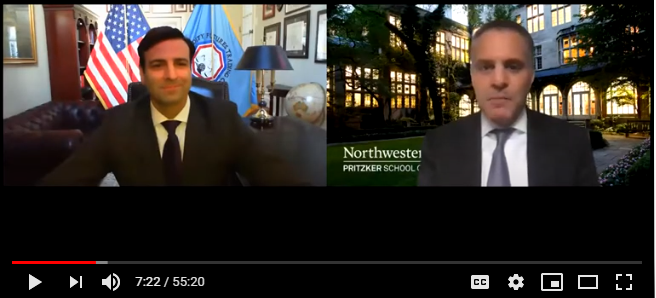
(Chairman Tarbert’s remarks begin at 9:02)
Well thank you so much Steve, and I also want to thank Dean Speta, Dean Cornelli, the Brodsky family, faculty, students, staff, distinguished guests, and visitors. It is a true honor for me to be here today.
Northwestern University is obviously one of the country’s—if not the world's—top schools. In particular the Pritzker School of Law and the Kellogg School of Business are really outstanding. That's an understatement to say, and I can say personally throughout my career I have encountered Northwestern grads, and particularly a law school and business school grads from Northwestern in my private law practice, as a clerk on the U.S. Supreme Court, in the halls of the Treasury, elsewhere in government as well as the private sector, but Northwestern, and again in particular Pritzker and Kellogg, have also played a really important role in the CFTC.
There are a number of graduates that serve not only as staff at the CFTC, but as leaders at the CFTC, so I've included a couple of the different titles that Northwestern grads have at the CFTC: Chief Trial Attorney, a Division Director, Senior Trial Attorney, and there are a number of others as well, and we have we have law school and Kellogg school graduates in most of our offices in Chicago, in New York, and in Washington, so it is particularly wonderful to be here at Northwestern given not only the national and international stellar reputation of both of these schools, but also the close and important connection with my agency.
There's also a close and important connection with, of course, Bill Brodsky and the Brodsky family, so Bill, of course, it's hard to say that this man is not one of the most famous people in the derivatives industry in the United States and throughout the world. He is literally a member of the futures hall of fame. He's not only served as Chief Executive of one of the world's largest exchanges, he served as Chief Executive of two of them—spending 15 years at the Chicago Mercantile Exchange and then another 16 years at the Chicago Board of Options Exchange. He also was the spokesperson for the industry having been Chairman of the World Federation of Exchanges.
I was privileged earlier in my career, 11 years ago, to meet and work with Mr. Brodsky at the Committee on Capital Markets Regulation, and I will tell you that Bill has been one of the greatest advocates for transparency and our derivatives and financial markets, and he left an impression on me so much so that I went on to serve on the Senate Banking Committee staff during the Dodd-Frank Act and focus on greater transparency and then later on, of course now in my current position, I continue to hold those principles and think about Bill's example, so it is a tremendous honor for me to be here, and then of course Bill is not alone.
If we go to the Brodsky family as a whole, and I would say if you're impressed by Bill then you should meet Joan. Joan knows many things, among them is Latin. She taught Latin, she's an expert in library science, and she serves on the boards of a number of national important libraries and conservation facilities, and of course their three sons Michael, Stephen, and Jonathan, who are all with us today, are all Northwestern JD MBA grads, and they have played an important role in the derivatives industry alongside their father. They're shown here in this picture with their lovely spouses. What I'm talking about today is really important because the self-regulation regime that exists in the United States depends on people like the Brodsky’s and thousands of others, and so it is really important that that we honor them and that we honor a number of Northwestern graduates, not only those at the CFTC, but also those that are playing an important role in our system of self-regulation
Since this is an academic lecture, I will ask the question, “What are derivatives?” But the good news is because we're on zoom, I'm not going to use the Socratic method. Well, derivatives are financial products that are valued based on the price movements of an underlying asset, and so derivatives are very unique because the underlying asset can be virtually anything, any commodity, so I like to say that the derivatives markets cover everything from corn to crypto. We literally have derivatives on bushels of corn, we have derivatives on Bitcoin and Ether, and 21st century commodities, and all sorts of stuff in between.
What are the types of derivatives? Just as a refresher, we have futures, which are an agreement to buy or sell something at a future date. We have options, which is not an obligation, but rather a right to buy or sell something at a later date, and we have swaps, which is essentially an exchange of value at various intervals throughout the duration.
But what role do derivatives actually play in our financial system and our economy more generally? Well, they really have two big purposes. The first purpose is a tool for hedging risk. They started a long time ago right there in Chicago where farmers and other people in the agriculture industry wanted to be able to lock in prices at some point in the future when they were to sell their grain, when they were to buy things like milk and things for baking, and all sorts of things having to do with our real economy. Derivatives, just as they did back in the day and just as they do at this very moment, allow people in our real economy to hedge risk. It's a way of transferring and mitigating risk, but the derivatives market also plays another critical role, and that's that by virtue of them existing alongside the underlying markets, which we call the cash markets, derivatives play a price formation role in the real economy. The price that you pay for groceries in the grocery store, the amount that you pay on your home mortgage, for example, and the price that you pay for gas at the gas station—all of those are affected by the trading in the derivatives markets, and in some cases, they're determined by those markets.
So, there's a really critical role that the derivatives markets play with respect to the underlying economy, and that role is also evidenced by the magnitude of derivatives. When you look at the notional amount of the U.S. derivatives markets, it amounts to 300 trillion dollars, keeping in mind that U.S. GDP is somewhere between 20 and 21 trillion dollars, so they literally are the largest financial markets in the world.
So what about me talking about the CFTC? What is the CFTC? Well I like to say, given the fact that we just mentioned the magnitude of the derivative markets, we are the regulator of the derivatives markets, and as a result we may very well be the most important financial regulator you've never heard of. We have more than 700 employees across four offices, but we also have 300 contractors, so we have about a thousand people strong and our mission is to promote the integrity, resilience, and vibrancy of U.S. derivatives markets through sound regulation. But, of course, a thousand people in four offices can do a lot, but we can't do everything, and that's one of the key takeaways of this lecture. Our system of regulation works and works well because we don't act alone. Self-regulation helps us regulate these markets.
So what is self-regulation? Well, it's industry-based regulation operating under government oversight and there are a series of self-regulatory organizations in the derivative space. First of all, there's something called the National Futures Association. The National Futures Association, or NFA, many of whom are watching this and our Northwestern graduates, basically is an organization where all the market participants sign up to participate and they're regulated and examined accordingly, but it's more than just the NFA. Every single exchange is itself a self-regulatory organization because there's members of the exchange, and that's where the trading takes place, and the clearing houses where basically the financial risk is mitigated of those trades, they are also self-regulatory organizations as well, and there are a series of clearing members that are members of that. So again, talking about the magnitude, NFA reports over 3,000 member firms and over 46,000 individual associate members and one of the ways to think about this one analogy, if you will, it's not perfect but I think it does shed some light on it, is to think about it in this way: you've got the federal government, which is like the CFTC, and then you've got a self-regulatory regime of the NFA of exchanges and clearinghouses that are sort of like the states, and so we have this dual system where we have regulation at each level.
One of the things I want to hopefully demonstrate today, and I do so in the longer article that Steve mentioned, is that this is really a way to get to sound regulation, that the two of these systems work together, traditional government regulation alongside self-regulation. To give you a glimpse of that article today, I want to briefly talk about the advantages of self-regulation, the role of government in buttressing that regime, and then I'm going to end with a real-life example of how it all works.
First of all, the advantages of self-regulation. Well, first and foremost are cost and financing. Self-regulatory organizations are member-funded, which means all of us who are on here, most of us at least, are U.S. taxpayers, so we actually don't pay a dime for self-regulation. The market participants themselves do. Secondly, SROs avoid the appropriations process, and that's really important because when your appropriations for a regulator are subject to budgets, to larger political questions, to members of Congress having to vote for it, oftentimes you end up with uneven funding and uncertainty. The fact that the SROs are able to have budgets that are apart from the political climate is really important and offers sound regulation.
Secondly, expertise. Well, these individuals that are in the SROs are much closer to the pulse of the market than the government regulators are, and if you think about it, the exchange in fact is the market. So the exchange is right there, it's seeing everything in real time, it's incredibly important. The other thing is that we rely on self-regulators because they're close to the market to propose to us regulations, so there's an ongoing dialogue between the CFTC and NFA and the various exchanges as to what they're seeing in the markets and whether there needs to be government regulations.
The third major advantage is trust. If you think about it, if you're members of the self-regulatory organization, you have sort of an automatic degree of buy-in that let's say you don't have if you're a government agency headquartered in Washington, and there's a suspicion that some of the decisions you make may be subject to political and other considerations, and I would say that there's a trust factor there with the SRO, and that trust factor also directly relates to incentives for compliance. If you're a member of an SRO, you want the other members to play by the rules, and there's an incentive to comply there that arguably is additional from traditional government regulation.
Fourth, speed and flexibility. This is really important. Many of you, particularly those of you in the Pritzker school of Law, have studied the Administrative Procedure Act and government rulemaking. Well, it takes a long time in part because there are public comments that need to be considered, there are a number of procedural protections that make sure the government does its job and does it thoroughly, but of course the disadvantage of that is it takes an immense amount of time. I've been able to move a number of rules through the CFTC during my tenure, but even for things that are relatively simple, it'll often take when you start initially putting pen to paper about a year to get something from an initial draft into a final regulation. Self-regulatory organizations can move far quicker than that.
They also have expertise in dealing with enforcement. That’s really important there, and if you think about it, SROs have the ultimate sanction, which is you get thrown out of the SRO. If you are a member firm of an exchange and you have been for 30 years, the last thing you want is to be ejected from the exchange, so there's a really important enforcement tool there that self-regulatory bodies have. It also reduces the cost for the CFTC. We can go out and we can pursue maybe some tougher cases with the FBI, with others outside the United States if we know that a number of the infractions are being dealt with directly by the SROs. Then, finally, the SROs allow the CFTC to collaborate. We have an outstanding investigatory team at the CFTC, but we don't spot everything, and more often than not many things are spotted by the exchanges. They're spotted by the NFA or they're spotted by clearinghouses and referred to the CFTC.
What I’ll ask is, with all of these advantages, why on earth would we have the government involved with regulating our derivatives markets? Well, they say that a picture is worth a thousand words and the simple answer is that we need to ensure that responsible self-regulation doesn't turn into the proverbial situation of the fox guarding the hen house. In other words, we want to make sure that the SROs continue to work on behalf of the American people and the American public, and not just industry interests, and this in my view is where government can play a constructive role.
So how do we do that? Well, the role of the CFTC is essentially, as the SROs regulate and supervise their members, the CFTC regulates and supervises the SROs themselves. This provides accountability, it preserves trust in the SRO system, and it avoids conflicts of interest where there is an inherent conflict: that's when the CFTC can step in and sort it out. Here are a couple of examples of that. For SROs registration rules and, in particular for example, the National Futures Association, the rule is that they need to have rules and regulations that are at least as stringent as those of the CFTC, so anytime they propose a new rule or regulation, the CFTC effectively reviews and approves those regulations.
The CFTC also has a series of core principles that both emanate from our statute, the Commodity Exchange Act, but also from our regulations that lay out and say “these are the core principles that every exchange, for example or every clearinghouse, must comply with” and then we review on an annual basis, if not more frequently, compliance with those core principles, and that ensures the accountability that I mentioned.
The biggest role that the CFTC plays in the self-regulatory system is essentially the supervisor and regulation of the SROs, but we also play a number of additional roles as well, roles that the SROs themselves can't play. So, for example, administrative law functions. Only the CFTC can authoritatively interpret statutes written by congress. Only the CFTC can also issue relief from rules and regulations, as well as laws by congress. We have no action authority that non-governmental SROs simply don't have. Another— hearkening back to that analogy I mentioned before between the federal government and the states—if you think about the U.S. Constitution of course, states are prohibited from entering into foreign treaties. Only the national government can do that. Well, when you think about international harmonization, our derivatives markets are by their very nature global, and so we're constantly dealing with other countries, with other regulators, whether they be market regulators or central banks. Only the CFTC can essentially sign into legally binding obligations and agreements. Only the CFTC can make determinations that, for example, another country's regime is the equivalent of our regime, and so the CFTC essentially steps in at the international realm working with both the exchanges as well as NFA and other self-regulatory bodies to make that happen.
The other unique feature about the CFTC is that, is that unlike an exchange or a specific clearinghouse, we are looking at the entire market and we are looking at systemic risk, for example. One of the things we do is we actually examine the clearinghouses, and two of our clearinghouses in the United States have been declared by the United States government to be systemically important. So, in particular, the government regulates and supervises the clearinghouses themselves consistent with what I said [earlier].
Finally, there are a number of individuals that are in our markets, thousands of them in fact that are not actually members of SROs, so someone has to think about how to handle those and to the extent they perpetrate fraud and manipulation. Again, if they're not a member of the SRO, the SRO has a little recourse. That's where the CFTC steps in.
At the end of the day, it's about finding the right balance. I would say if I leave you to today with one thing, it's the important point that there’s not a false dichotomy. It's not as if we can just have self-regulation on the one hand or we can just have government regulation on the other hand. The real key is finding a way to blend the two in an optimal way looking at those advantages that I outlined in the previous slides about what makes self-regulation so dynamic and so important and so effective, but also understanding their limitations.
This isn't just simply a theory, but this is actually evidenced by decades of success, and so let me finally end my comments with an example with the COVID-19 response. Many of you may not know this, but the volatility that we saw in our derivatives markets in March in relation to COVID-19, its spread, and essentially the shutdown or pause of the global economy, that volatility went far beyond the volatility that we even saw during the 2008 financial crisis, so this was really critical that we work together both the financial regulators in the United States as well as those around the world, but also the CFTC with the derivatives markets self-regulatory organizations to essentially make sure that the biggest economic and health crisis of the last century did not turn into the biggest financial crisis, and we did that by using a number of different aspects.
First of all, formal coordination and data sharing. We saw different things. The SROs were clearly closest to the market participants so they could tell us what was going on, they could tell us whether clearing members weren't meeting margin calls, whether there were problems with customers, whether market makers had the requisite liquidity to stay in the markets, for example. The CFTC on the other hand, we were talking to the Federal Reserve, we were talking to the U.S. Treasury, we were understanding what was going on more broadly, and we were talking to our foreign counterparts to understand what markets were doing in other countries that could affect our own markets, and we were able to share all that information to come up with a coordinated response. Volatility in systemic risk management was absolutely critical.
Margin and clearinghouses stand at the very center of our system and literally every day, several times a day, we would be calling the clearinghouses asking whether people made their margin calls. If you think about it, during this crisis, the derivatives markets played a critical role in not being amplifiers of systemic risk, which some could argue they did-at least the uncleared, non-regulated markets back before 2008-but in this crisis the derivatives markets were actually shock absorbers for systemic risk. At a time when the U.S. economy, as well as millions of people around the world needed to lay off risk, they went to the derivatives markets and we kept our markets orderly and liquid.
We did all of this while people were engaged in the new reality, in what we're doing right now—social distancing. We had never thought about how do people trade from home. It wasn't something that we had really thought about, but by working with NFA, by working with the exchanges and the clearinghouses, we were able to make social distancing work in a way that didn't shut down the markets. Business continuity plans by market participants were absolutely critical and they indicated to us, the CFTC, as I mentioned before, we're the only ones that can issue letters saying, “Yes that's technically what the law says or what the regulation says, but given the circumstances we're going to relieve you of that.”
So, for example, voice recordings are something that are critical in regular times to be able to understand when the trade has been made—who made the trade, etc.—but the systems weren't set up for people trading from home. We didn't want trading to stop when we needed it the most, so we were able to do temporary targeted relief from some of the regular rules and regulations so the markets could become orderly and liquid, and ultimately, market resilience. We knew that was what Congress wanted to focus on at that time as opposed to all the little nitty rules and regulations, so we were able to give that targeted relief. But in order to figure out what should we be doing, we relied heavily on the SROs and their members for recommendations.
I will leave you today with what I think is a bottom line and that's that the U.S. system of derivatives and our derivatives markets are really the world's global standard. I would argue there are many reasons for that. The fact that we have the United States, the system of laws, all the things that you learn in law school, and all the things that you learn in business school but I would also add that our unique system of self-regulation alongside of government regulation really is a powerful way to ensure that our markets remain resilient, that they have integrity but at the same time they're vibrant, and so people can rely on our markets and say they're soundly regulated because we have this very unique blend of self-regulation and government regulation. With that, I will conclude my remarks. Thank you.
-CFTC-
External Meetings: Meeting2017-0517-1144a
External Meetings: Meeting2017-0517-1144a
Concurring Statement of Commissioner Rostin Behnam Regarding Exemption from Derivatives Clearing Organization Registration; Final Rule
Concurring Statement of Commissioner Rostin Behnam Regarding Exemption from Derivatives Clearing Organization Registration; Final Rule
Commissioner Rostin BehnamNovember 18, 2020
I respectfully concur with the Commodity Futures Trading Commission’s final rule regarding policies and procedures that it will follow with respect to granting exemptions from derivatives clearing organization (DCO) registration pursuant to authority under section 5b(h) of the Commodity Exchange Act (CEA)[1] (the Final Rule). The Final Rule, with limited exceptions, codifies the policies and procedures followed by the Commission in issuing the four exempt DCO orders which currently limit clearing organizations organized outside of the United States to clearing only proprietary swap positions of U.S. persons and futures commission merchants, and not customer positions (exempt DCOs). Critical to my vote today, the Final Rule prohibits the clearing of U.S. customer positions at an exempt DCO.[2]
I supported the Commission’s 2018 notice of proposed rulemaking[3] as a means to promote transparency and accountability as well as a positive step towards increased cross-border cooperation and deference to our foreign regulatory counterparts. However, I was unable to support the Commission’s 2019 supplement to the 2018 Proposal,[4] which proposed permitting exempt DCOs to clear swaps for U.S. customers through foreign intermediaries that would be wholly outside the Commission’s direct regulation and oversight. As articulated more fully in my dissent,[5] the 2019 Supplemental Proposal was not the product of internal consensus and its brief history and questionable timeline signaled a lack of appropriate scrutiny and evaluation of the critical financial, market, consumer protection, and systemic risk issues raised by diverging from the customer protection model provided by the CEA and U.S. Bankruptcy Code. It was and remains my view that if the Commission believes it is appropriate to provide U.S. customers with greater access to non-U.S. swap markets, then we can and should engage in a more careful analysis of options, assessment of alternatives, and evaluation of consequences consistent with the Administrative Procedure Act.[6] As the Commission is declining to adopt the 2019 Supplemental Proposal at this time, I am comfortable with supporting the Final Rule.
One area in which I will remain vigilant is with regard to the Commission’s reliance on the Principles for Financial Market Infrastructures (PFMI) framework as the benchmark for making the comparability determination with respect to a foreign jurisdiction’s supervisory and regulatory scheme required by CEA section 5b(h). I believe that the Commission’s reliance on the PFMIs as providing a comprehensive framework for DCO supervision that is comparable to the statutory and regulatory requirements applicable to registered DCOs, with a particular focus on the DCO Core Principles,[7] is within its discretion under CEA section 5b(h). However, I am concerned that the Commission’s decision to limit its reference to the PFMIs as they existed in 2012 may lead to untenable divergence in the future should the Commission determine to incorporate subsequent amendments or revisions to the PFMIs or related interpretations and guidance into its own regulatory and supervisory DCO oversight. Alternatively, I am concerned that maintaining a static definition of the PFMIs to provide exempt DCOs with greater regulatory certainty with regard to their ongoing eligibility for the exemption could negatively impact the Commission’s consideration regarding whether to adopt or incorporate future changes to the PFMIs or related interpretations and guidance into its regulatory regime. However, I am reassured that the Commission explicitly reserves the ability to incorporate future amendments to the PFMIs into the Final Rule’s PFMI definition in § 39.2. As well, because the Commission also maintains broad discretion to condition an exemption on any facts and circumstances it deems relevant under new § 39.6(b)(8), I believe the Commission has clear discretion and authority to make appropriate changes with regard to its consideration of exempt DCO eligibility criteria and ongoing compliance to maintain comprehensive application of and adherence to comparable regulatory and supervisory standards.
My decision to support the Final Rule is largely based on the Commission’s determination to move forward with the 2018 Proposal without adopting the 2019 Supplemental Proposal. However, I remain supportive of the Commission’s endeavor to explore ways to adapt and—if appropriate—seek to adjust the current intermediary structure established under the CEA and Commission regulations to better accommodate both U.S. customer demand for increased access to clearing in foreign jurisdictions and evolving global swaps market structures. I remain open and look forward to the possibility of further discussing the regulatory and policy issues raised during this rulemaking.
[1] 7 U.S.C. 7a-1(a).
[2] See Final Rule at II.B.2.a. and §39.6(b)(1).
[3] Exemption from Derivatives Clearing Organization Registration, 83 FR 39923 (proposed Aug. 13, 2018) (the 2018 Proposal).
[4] Exemption from Derivatives Clearing Organization Registration, 84 FR 35456 (proposed July 23, 2019) (the 2019 Supplemental Proposal).
[5] See Appendix 4—Dissenting Statement of Commissioner Rostin Behnam, Supplemental Proposal, 84 FR at 35476-35478.
[6] Id. at 35476.
[7] See CEA section 5b(c)(2), 7 U.S.C. 7a-1(c)(2).
-CFTC-